
 8分
 朗読 J. M. Smallheer
 原文そのまま

 PDFで印刷(A4 9まい)
In our last lecture we saw that water can exist in three forms:— 1st, as an invisible vapour; 2nd, as liquid water; 3rd, as solid snow and ice.前回のお話で、水には三つの形があることを学びました。一つ目は目に見えない水じょう気、二つ目は液体の水、三つ目はかたい雪や氷です。
To-day we are going to take the two last of these forms, water and ice, and speak of them as sculptors.今日は、この三つのうちあとの二つ、水と氷をとり上げ、ちょうこく家として考えてみましょう。
To understand why they deserve this name we must first consider what the work of a sculptor is.水と氷がなぜこうよばれるのにふさわしいのかを知るには、まず、ちょうこく家の仕事とはどんなものかを考えなければなりません。 If you go into a statuary yard you will find there large blocks of granite, marble, and other kinds of stone, hewn roughly into different shapes; but if you pass into the studio, where the sculptor himself is at work you will find beautiful statues, more or less finished; and you will see that out of rough blocks of stone he has been able to cut images which look like living forms.石像をつくる作業場に入ると、花こう岩や大理石、そのほかの石の大きなかたまりが、いろいろな形にあらくけずられて置いてあります。でも、ちょうこく家が自分で仕事をしているアトリエに入ると、多かれ少なかれできあがった美しい像があって、ちょうこく家があらい石のかたまりから、生きているように見える像をほり出したことがわかるでしょう。 You can even see by their faces whether they are intended to be sad, or thoughtful, or gay, and by their attitude whether they are writhing in pain, or dancing with joy, or resting peacefully.顔を見れば、悲しんでいるのか、考えこんでいるのか、楽しんでいるのかさえわかりますし、ポーズを見れば、いたみにもだえているのか、喜んでおどっているのか、静かに休んでいるのかがわかります。 How has all this history been worked out from the shapeless stone?形のない石から、どうやってこんな物語がすっかりほり出されたのでしょう。 It has been done by the sculptor's chisel.ちょうこく家ののみによってです。 A piece chipped off here, a wrinkle cut there, a smooth surface rounded off in another place, so as to give a gentle curve; all these touches gradually shape the figure and mould it out of the rough stone, first into a rude shape and afterwards, by delicate strokes, into the form of a living being.ここで一かけらけずり取り、あそこでしわをきざみ、また別の所ではなめらかな面を丸くけずって、ゆるやかな曲線をつける。こうしたひと手間ひと手間が少しずつ像の形をつくり、あらい石からまずおおまかな形に、そのあと細かなのみさばきで、生き物のすがたにしていくのです。
Now, just in the same way as the wrinkles and curves of a statue are cut by the sculptor's chisel, so the hills and valleys, the steep slopes and gentle curves on the face of our earth, giving it all its beauty, and the varied landscapes we love so well, have been cut out by water and ice passing over them.さて、像のしわや曲線がちょうこく家ののみできざまれるのとちょうど同じように、地球の表面のおかや谷、急な坂やゆるやかな曲線――地球にあらゆる美しさをあたえ、わたしたちが大好きなさまざまな景色をつくっているもの――は、水と氷がその上を通りすぎることでけずり出されてきたのです。 It is true that some of the greater wrinkles of the earth, the lofty mountains, and the high masses of land which rise above the sea , have been caused by earthquakes and shrinking of the earth.たしかに、地球の大きなしわのいくつか、つまりそびえ立つ山々や、海の上に高くもり上がる大きな陸のかたまりは、地しんや地球がちぢむことによってできました。 We shall not speak of these to-day, but put them aside as belonging to the rough work of the statuary yard.今日はそれについては話さず、石像の作業場のあらけずりの仕事だとして、わきにおいておきましょう。 But when once these large masses are put ready for water to work upon, then all the rest of the rugged wrinkles and gentle slopes which make the country so beautiful are due to water and ice, and for this reason I have called them "sculptors."でも、いったんこうした大きなかたまりが水がはたらけるように用意されると、そのほかの、国土を美しくしているでこぼこのしわやゆるやかな坂は、すべて水と氷のおかげなのです。だから、わたしは水と氷を「ちょうこく家」とよんだのです。
Go for a walk in the country, or notice the landscape as you travel on a railway journey.いなかへ散歩に行くか、汽車の旅で景色に注意してみてください。 You pass by hills and through valleys, through narrow steep gorges cut in hard rock, or through wild ravines up the sides of which you can hardly scramble.おかのそばを通り、谷を通りぬけ、かたい岩をけずったせまくて急なきょう谷を通ったり、両側をよじ登るのもむずかしいような、あれた谷を通ったりします。 Then you come to grassy slopes and to smooth plains across which you can look for miles without seeing a hill; or, when you arrive at the seashore, you clamber into caves and grottos, and along dark narrow passages leading from one bay to another.それから、草におおわれた坂や、何マイル見わたしてもおか一つ見えない平らな平野にやってきます。また、海辺に着けば、どうくつやほら穴にもぐりこみ、一つの入りえから別の入りえへと続く、暗くせまい通り道を進むこともあるでしょう。 All these - hills, valleys, gorges, ravines, slopes, plains, caves, grottos, and rocky shores - have been cut out by the water.こうしたもの――おか、谷、きょう谷、あれた谷、坂、平野、どうくつ、ほら穴、岩だらけの海岸――はみな、水によってけずり出されたのです。 Day by day and year by year, while everything seems to us to remain the same, this industrious sculptor is chipping away, a few grains here, a corner there, a large mass in another place, till he gives to the country its own peculiar scenery, just as the human sculptor gives expression to his statue.来る日も来る日も、来る年も来る年も、わたしたちにはすべてが同じままに見えるあいだにも、このはたらき者のちょうこく家は、こちらで数つぶ、あちらで角を一つ、また別の所では大きなかたまりをけずり取りつづけ、ついにはその土地ならではの景色をつくり上げるのです。人間のちょうこく家が像に表情をあたえるのと同じように。
Our work to-day will consist in trying to form some idea of the way in which water thus carves out the surface of the earth, and we will begin by seeing how much can be done by our old friends the rain-drops before they become running streams.今日の仕事は、水がこうして地球の表面をきざんでいくやり方について、何かイメージをつかむことです。まずは、流れる小川になる前に、おなじみの雨つぶがどれほどのことをするかを見てみましょう。
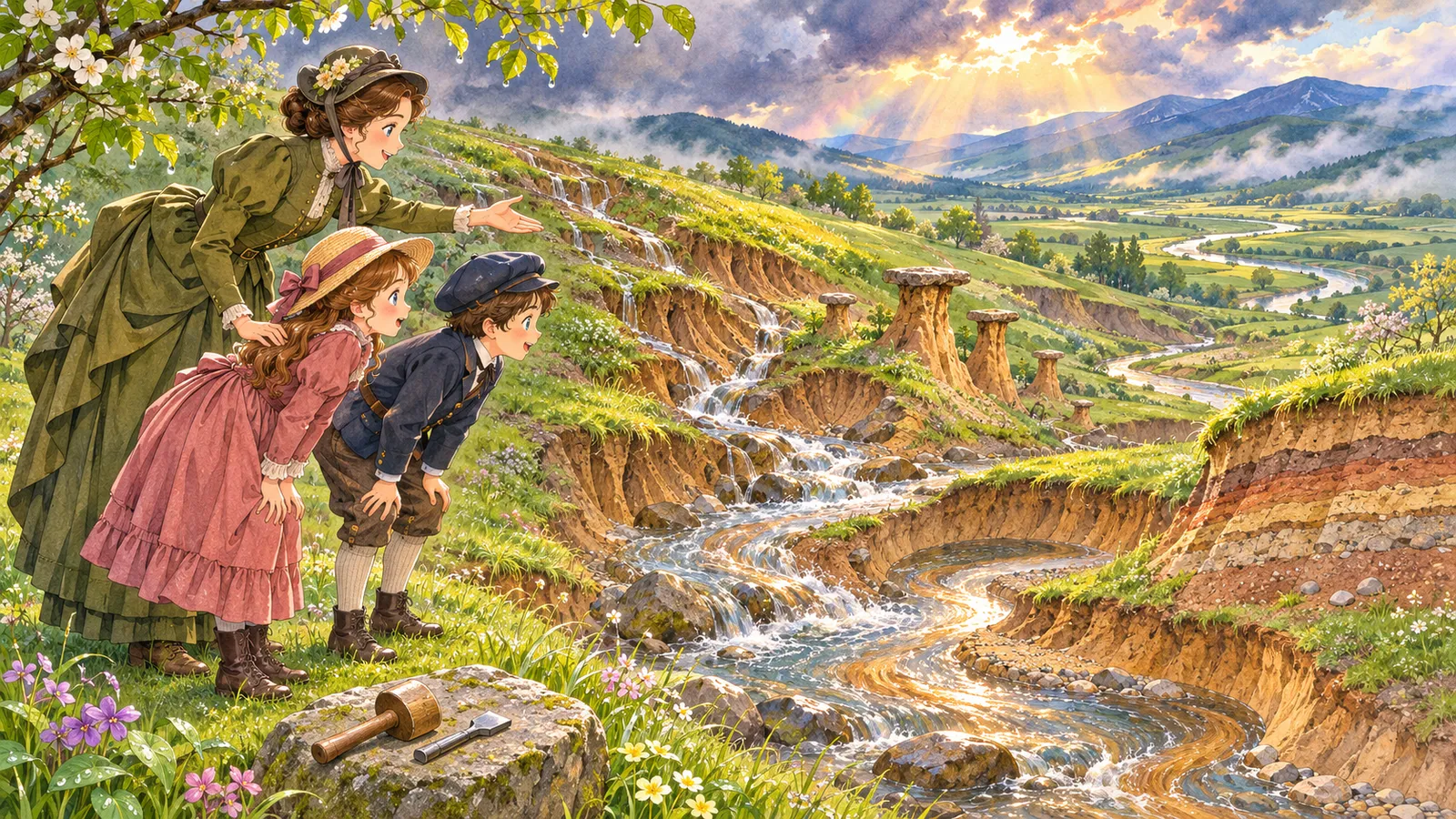
Everyone must have noticed that whenever rain falls on soft ground it makes small round holes in which it collects, and then sinks into the ground, forcing its way between the grains of earth.やわらかい地面に雨がふると、小さな丸いくぼみができて、そこに雨がたまり、それから土のつぶのあいだにおし入るようにして地面にしみこんでいくことには、だれでも気づいたことがあるでしょう。 But you would hardly think that the beautiful pillars in Fig.でも、図 24 have been made entirely in this way by rain beating upon and soaking into the ground.24の美しい柱が、すべてこのように、雨が地面を打ってしみこむことだけでできたとは、なかなか思えないでしょう。
Where these pillars stand there was once a solid mass of clay and stones, into which the rain-drops crept, loosening the earthly particles; and then when the sun dried the earth again cracks were formed, so that the next shower loosened it still more, and carried some of the mud down into the valley below.この柱が立っている所には、昔、ねん土と石のかたいかたまりがありました。そこに雨つぶがしみこんで土のつぶをゆるめ、それから太陽が土をまたかわかすとひびができたので、次の雨はさらに土をゆるめ、どろの一部を下の谷へと運んでいきました。 But here and there large stones were buried in the clay, and where this happened the rain could not penetrate, and the stones became the tops of tall pillars of clay, washed into shape by the rain beating on its sides, but escaping the general destruction of the rest of the mud.でも、ねん土の中のあちこちには大きな石がうまっていて、そういう所には雨がしみこめませんでした。そこで、石は高いねん土の柱の頭になりました。柱は横から打ちつける雨で形をととのえられましたが、まわりのどろがすっかりこわされていくのはまぬがれたのです。 In this way the whole valley has been carved out into fine pillars, some still having capping-stones, while others have lost them, and these last will soon be washed away.こうして谷全体が、りっぱな柱の形にきざまれました。まだ頭の石をのせている柱もあれば、なくしてしまったものもあり、頭をなくした柱は、まもなく洗い流されてしまうでしょう。 We have no such valleys of earth-pillars here in England, but you may sometimes see tiny pillars under bridges where the drippings have washed away the earth between the pebbles, and such small examples which you can observe for yourselves are quite as instructive as more important ones.ここイギリスには、このような土の柱の谷はありません。でも、橋の下などで、しずくが小石のあいだの土を洗い流してできた小さな柱を見かけることがあるかもしれません。自分で観察できるこうした小さな例は、もっと大きな例と同じくらい、多くのことを教えてくれます。
Another way in which rain changes the surface of the earth is by sinking down through loose soil from the top of a cliff to a depth of many feet till it comes to solid rock, and then lying spread over a wide apace.雨が地表を変えるもう一つのやり方は、がけの上のやわらかい土を通って何フィートもの深さまでしみこみ、かたい岩につき当たって、そこで広く広がることです。 Here it makes a kind of watery mud, which is a very unsafe foundation for the hill of earth above it, and so after a time the whole mass slips down and makes a fresh piece of land at the foot of the cliff.そこで雨水は水っぽいどろのようなものをつくります。これは上にある土の山にとってとてもあぶない土台なので、しばらくするとかたまり全体がずり落ちて、がけの下に新しい土地をつくるのです。 If you have ever been at the Isle of Wight you will have seen an undulating strip of ground, called the Undercliff, at Ventnor and other places, stretching all along the sea below the high cliffs.ワイト島に行ったことがあれば、ベントナーなどで、高いがけの下の海ぞいにずっと続く、波打つような細長い土地を見たことがあるでしょう。それは「アンダークリフ(がけ下)」とよばれています。 This land was once at the top of the cliff, and came down by succession of landslips such as we have been describing.この土地は昔はがけの上にあって、今お話ししたような地すべりが次々に起こって、下りてきたのです。 A very great landslip of this kind happened in the memory of living people, at Lyme Regis, in Dorsetshire, in the year 1839.このような大きな地すべりが、当時生きていた人々もおぼえている1839年に、ドーセット州のライム・リージスで起こりました。
You will easily see how in forming earth-pillars and causing landslips rain changes the face of the country, but these are only rare effects of water.土の柱をつくったり、地すべりを起こしたりして、雨が土地のすがたを変えることはよくわかるでしょう。でも、これらは水のはたらきの中ではめずらしいものにすぎません。 It is when the rain collects in brooks and forms rivers that it is most busy in sculpturing the land.雨が小川に集まり、川をつくるときこそ、雨は土地をきざむのにいちばんいそがしくはたらくのです。 Look out some day into the road or the garden where the ground slopes a little, and watch what happens during a shower of rain.いつか、地面が少しかたむいている道や庭を見て、にわか雨のあいだにどんなことが起こるか観察してみてください。 First the rain-drops run together in every little hollow of the ground, then the water begins to flow along any ruts or channels it can find, lying here and there in pools, but always making its way gradually down the slope.まず、雨つぶは地面の小さなくぼみごとに集まり、それから水は見つけたわだちやみぞにそって流れはじめ、あちこちで水たまりになりながらも、いつも少しずつ坂を下っていきます。 Meanwhile from other parts of the ground little rills are coming, and these all meet in some larger ruts where the ground is lowest, making one great stream, which at last empties itself into the gutter or an area, or finds its way down some grating.そのあいだにも、地面のほかの所から小さな流れがやってきて、地面がいちばん低い所の大きなわだちで合わさり、一つの大きな流れになって、最後には道ばたのみぞや地下室の前のくぼみに流れこんだり、どこかの格子のふたから下へ流れていったりします。
Now just this, which we can watch whenever a heavy shower of rain comes down on the road, happens also all over the world.さて、道に強いにわか雨がふるたびに見られるこのことが、世界じゅうでも起こっているのです。 Up in the mountains, where there is always a great deal of rain, little rills gather and fall over the mountain sides, meeting in some stream below.山の上では、いつも雨がたくさんふるので、小さな流れが集まって山のしゃ面を流れ落ち、下の流れで出会います。 Then, as this stream flows on, it is fed by many runnels of water, which come from all parts of the country, trickling along ruts, and flowing in small brooks and rivulets down the gentle slope of the land till they reach the big stream, which at last is important enough to be called a river.それからこの流れが進んでいくと、国じゅうのあちこちからやってくる、たくさんの小さな水の流れが加わります。水はわだちにそってちょろちょろ流れ、小川やせせらぎとなって土地のゆるやかな坂を下り、大きな流れにたどり着きます。こうして流れはついに、川とよばれるほど大きくなるのです。 Sometimes this river comes to a large hollow in the land and there the water gathers and forms a lake; but still at the lower end of this lake out it comes again, forming a new river, and growing and growing by receiving fresh streams until at last it reaches the sea.ときには、この川が土地の大きなくぼみにやってきて、そこに水が集まって湖になります。でも、その湖の下のはしからはまた水が出ていって新しい川になり、新しい流れを受け入れてどんどん大きくなりながら、ついに海にたどり着くのです。
The River Thames, which you all know, and whose course you will find clearly described in Mr. Huxley's 'Physiography,' drains in this way no less than one-seventh of the whole of England.みなさんがよく知っているテムズ川は――その流れ方はハクスリーさんの『自然地理学』にくわしく書かれています――このようにして、イングランド全体のなんと7分の1もの土地の水を集めています。 All the rain which falls in Berkshire, Oxfordshire, Middlesex, Hertfordshire, Surrey, the north of Wiltshire and north-west of Kent, the south of Buckinghamshire and of Gloucestershire, finds its way into the Thames; making an area of 6160 square miles over which every rivulet and brook trickle down to the one great river, which bears them to the ocean.バークシャー、オックスフォードシャー、ミドルセックス、ハートフォードシャー、サリー、ウィルトシャーの北部、ケントの北西部、バッキンガムシャーとグロスターシャーの南部にふった雨は、すべてテムズ川へ流れこみます。その広さは6160平方マイルにもなり、そこを流れるすべての小川やせせらぎが一つの大きな川へと流れ下り、川はそれを大海へと運んでいくのです。 And so with every other area of land in the world there is some one channel towards which the ground on all sides slopes gently down, and into this channel all the water will run, on its way to the sea.世界のほかのどの土地でも同じように、まわりの地面がみなゆるやかにかたむいて下っていく、ある一つの水の通り道があり、すべての水はそこへ流れこんで、海へむかっていくのです。
But what has this to do with sculpture or cutting out of valleys?でも、このことが、ちょうこくや谷をけずり出すことと何の関係があるのでしょう。 If you will only take a glass of water out of any river, and let it stand for some hours, you will soon answer this question for yourself.どこかの川からコップに1ぱい水をくんで、何時間か置いておけば、この問いには自分ですぐに答えられるでしょう。 For you will find that even from river water which looks quite clear, a thin layer of mud will fall to the bottom of the glass, and if you take the water when the river is swollen and muddy you will get quite a thick deposit.とてもすんで見える川の水からでさえ、うすいどろの層がコップの底にしずむことがわかるでしょう。川が増水してにごっているときの水をくめば、かなり厚くつもります。 This shows that the brooks, the streams, and the rivers wash away the land as they flow over it and carry it from the mountains down to the valleys, and from the valleys away out into the sea.このことから、小川や流れや川は、上を流れながら土地を洗い流し、それを山から谷へ、そして谷から海へと運んでいることがわかるのです。