
 20分
 朗読 Paul Mazumdar
 原文そのまま

 PDFで印刷(A4 16まい)
In the street, up there, was an old, a very old house—it was almost three hundred years old, for that might be known by reading the great beam on which the date of the year was carved: together with tulips and hop-binds there were whole verses spelled as in former times, and over every window was a distorted face cut out in the beam.通りのむこうの上のほうに、古い、とても古い家がありました。建ってからもう三百年近くになります。それは、年号がほられた大きなはりを読めばわかりました。そこにはチューリップやホップのつるといっしょに、昔のつづりで書かれた詩がまるごとほられていて、窓という窓の上には、はりにほりこまれたゆがんだ顔がついていました。 The one story stood forward a great way over the other; and directly under the eaves was a leaden spout with a dragon's head; the rain-water should have run out of the mouth, but it ran out of the belly, for there was a hole in the spout.上の階は下の階よりずっと前につき出ていました。のきのすぐ下には、竜の頭のついたなまりの雨どいがありました。雨水は竜の口から出るはずでしたが、おなかから出てきました。雨どいに穴があいていたからです。
All the other houses in the street were so new and so neat, with large window panes and smooth walls, one could easily see that they would have nothing to do with the old house: they certainly thought, “How long is that old decayed thing to stand here as a spectacle in the street?通りのほかの家はどれもとても新しくてこぎれいで、大きな窓ガラスとすべすべのかべをしていました。古い家とはつきあいたくないと思っているのが、すぐにわかりました。きっと、こう思っていたのです。「あのくちかけた古いものは、いつまで通りの見せものとして立っているつもりだろう? And then the projecting windows stand so far out, that no one can see from our windows what happens in that direction!それに、あのつき出た窓がずいぶん前に出ているので、わたしたちの窓からは、あちらのほうで何が起きているのか、だれにも見えやしない! The steps are as broad as those of a palace, and as high as to a church tower.階段は宮殿の階段みたいに広くて、教会の塔までのぼるくらい高いし。 The iron railings look just like the door to an old family vault, and then they have brass tops—that's so stupid!”鉄の手すりときたら、古い一族のお墓の戸にそっくりで、おまけにてっぺんには真ちゅうの玉がついている。なんてばかげているんでしょう!」
On the other side of the street were also new and neat houses, and they thought just as the others did; but at the window opposite the old house there sat a little boy with fresh rosy cheeks and bright beaming eyes: he certainly liked the old house best, and that both in sunshine and moonshine.通りの反対側にも新しくてこぎれいな家がならんでいて、やっぱり同じように思っていました。けれども、古い家の真向かいの窓に、ばら色のほっぺたと、きらきらかがやく目をした小さな男の子がすわっていました。その子は古い家がいちばん好きでした。お日さまの光の中でも、月の光の中でも。 And when he looked across at the wall where the mortar had fallen out, he could sit and find out there the strangest figures imaginable; exactly as the street had appeared before, with steps, projecting windows, and pointed gables; he could see soldiers with halberds, and spouts where the water ran, like dragons and serpents.しっくいがはがれ落ちたかべをながめていると、男の子は、それはそれはふしぎな形を見つけることができました。階段やつき出た窓やとがった屋根のある、昔の通りのようすがそっくり見えるのです。ほこを持った兵隊や、竜やヘビのように水が流れ出る雨どいも見えました。 That was a house to look at; and there lived an old man, who wore plush breeches; and he had a coat with large brass buttons, and a wig that one could see was a real wig.それはながめがいのある家でした。そこには、ビロードのズボンをはいたおじいさんが住んでいました。大きな真ちゅうのボタンのついた上着を着て、ひと目で本物とわかるかつらをかぶっていました。 Every morning there came an old fellow to him who put his rooms in order, and went on errands; otherwise, the old man in the plush breeches was quite alone in the old house.毎朝、年とった男の人がやってきて、部屋をかたづけたり、お使いに行ったりしました。それ以外は、ビロードのズボンのおじいさんは、古い家にまったくのひとりぼっちでした。 Now and then he came to the window and looked out, and the little boy nodded to him, and the old man nodded again, and so they became acquaintances, and then they were friends, although they had never spoken to each other—but that made no difference.ときどき、おじいさんは窓のところへ来て外をながめました。男の子がうなずいてみせると、おじいさんもうなずき返しました。こうして二人は顔見知りになり、やがて友だちになりました。一度も話したことはありませんでしたが、そんなことはどうでもよかったのです。 The little boy heard his parents say, “The old man opposite is very well off, but he is so very, very lonely!”男の子は、両親がこう話すのを聞きました。「向かいのおじいさんはとてもお金持ちだけれど、とても、とてもさびしいんだよ!」
The Sunday following, the little boy took something, and wrapped it up in a piece of paper, went downstairs, and stood in the doorway; and when the man who went on errands came past, he said to him—次の日曜日、男の子は何かを紙に包んで、階段をおり、戸口に立ちました。そして、お使いをするあの男の人が通りかかると、こう言いました。
“I say, master! will you give this to the old man over the way from me?「ねえ、おじさん!これを、ぼくからだって、向かいのおじいさんにわたしてくれない? I have two pewter soldiers—this is one of them, and he shall have it, for I know he is so very, very lonely.”ぼく、すずの兵隊を二つ持っているんだ。これはそのひとつで、おじいさんにあげるの。だって、おじいさんはとても、とてもさびしいって知ってるから。」
And the old errand man looked quite pleased, nodded, and took the pewter soldier over to the old house.お使いのおじいさんはとてもうれしそうな顔をしてうなずき、すずの兵隊を古い家へ持っていきました。 Afterwards there came a message; it was to ask if the little boy himself had not a wish to come over and pay a visit; and so he got permission of his parents, and then went over to the old house.しばらくすると、使いが来ました。男の子自身が遊びに来たくはないか、というのです。そこで男の子は両親のゆるしをもらって、古い家へ出かけていきました。
And the brass balls on the iron railings shone much brighter than ever; one would have thought they were polished on account of the visit; and it was as if the carved-out trumpeters—for there were trumpeters, who stood in tulips, carved out on the door—blew with all their might, their cheeks appeared so much rounder than before.鉄の手すりの真ちゅうの玉は、いつもよりずっとぴかぴか光っていました。お客さまが来るのでみがいたのだと思えるほどでした。それに、戸にほられたラッパふきたち――チューリップの中に立つラッパふきがほってあったのです――も力いっぱいふいているようで、ほっぺたが前よりずっとまるくふくらんで見えました。 Yes, they blew—“Trateratra!そうです、ラッパふきたちはふいたのです。「トラテラトラー! The little boy comes!男の子が来たぞ! Trateratra!”—and then the door opened.トラテラトラー!」――そして、戸が開きました。
The whole passage was hung with portraits of knights in armor, and ladies in silken gowns; and the armor rattled, and the silken gowns rustled!ろうかには、よろいを着た騎士たちや、絹のドレスの貴婦人たちの肖像画が一面にかかっていました。よろいはガチャガチャ鳴り、絹のドレスはサラサラと音をたてました! And then there was a flight of stairs which went a good way upwards, and a little way downwards, and then one came on a balcony which was in a very dilapidated state, sure enough, with large holes and long crevices, but grass grew there and leaves out of them altogether, for the whole balcony outside, the yard, and the walls, were overgrown with so much green stuff, that it looked like a garden; only a balcony.それから階段があって、上へはずいぶんのぼり、下へは少しおりると、バルコニーに出ました。たしかにとてもいたんでいて、大きな穴や長いさけ目がありましたが、そこからは草や葉っぱがいっぱい生えていました。外のバルコニーも中庭もかべも、すっかり緑におおわれていたので、まるで庭のように見えました。ただのバルコニーなのに。 Here stood old flower-pots with faces and asses' ears, and the flowers grew just as they liked.そこには、顔とロバの耳がついた古い植木ばちが置いてあって、花たちは好きなようにのびていました。 One of the pots was quite overrun on all sides with pinks, that is to say, with the green part; shoot stood by shoot, and it said quite distinctly, “The air has cherished me, the sun has kissed me, and promised me a little flower on Sunday! a little flower on Sunday!”植木ばちのひとつは、ナデシコでまわりじゅうがおおわれていました。といっても、緑の葉やくきのことです。芽がぎっしりならんで、はっきりとこう言っていました。「空気がわたしをかわいがってくれた、お日さまがキスしてくれた、そして日曜日に小さな花をひとつくれると約束してくれた!日曜日に小さな花をひとつ!」
And then they entered a chamber where the walls were covered with hog's leather, and printed with gold flowers.それから二人は、かべがぶたの革でおおわれ、金色の花がおしてある部屋に入りました。
said the walls.と、かべが言いました。
And there stood easy-chairs, with such high backs, and so carved out, and with arms on both sides.そこには、とても背の高い、みごとなほりもののある、両側にひじかけのついた安楽いすがありました。 “Sit down! sit down!” said they.「おすわり!おすわり!」といすたちは言いました。 “Ugh! how I creak; now I shall certainly get the gout, like the old clothespress, ugh!”「うう!なんてギシギシいうんだろう。これじゃきっと、古い洋服だんすみたいに痛風になっちまう、うう!」
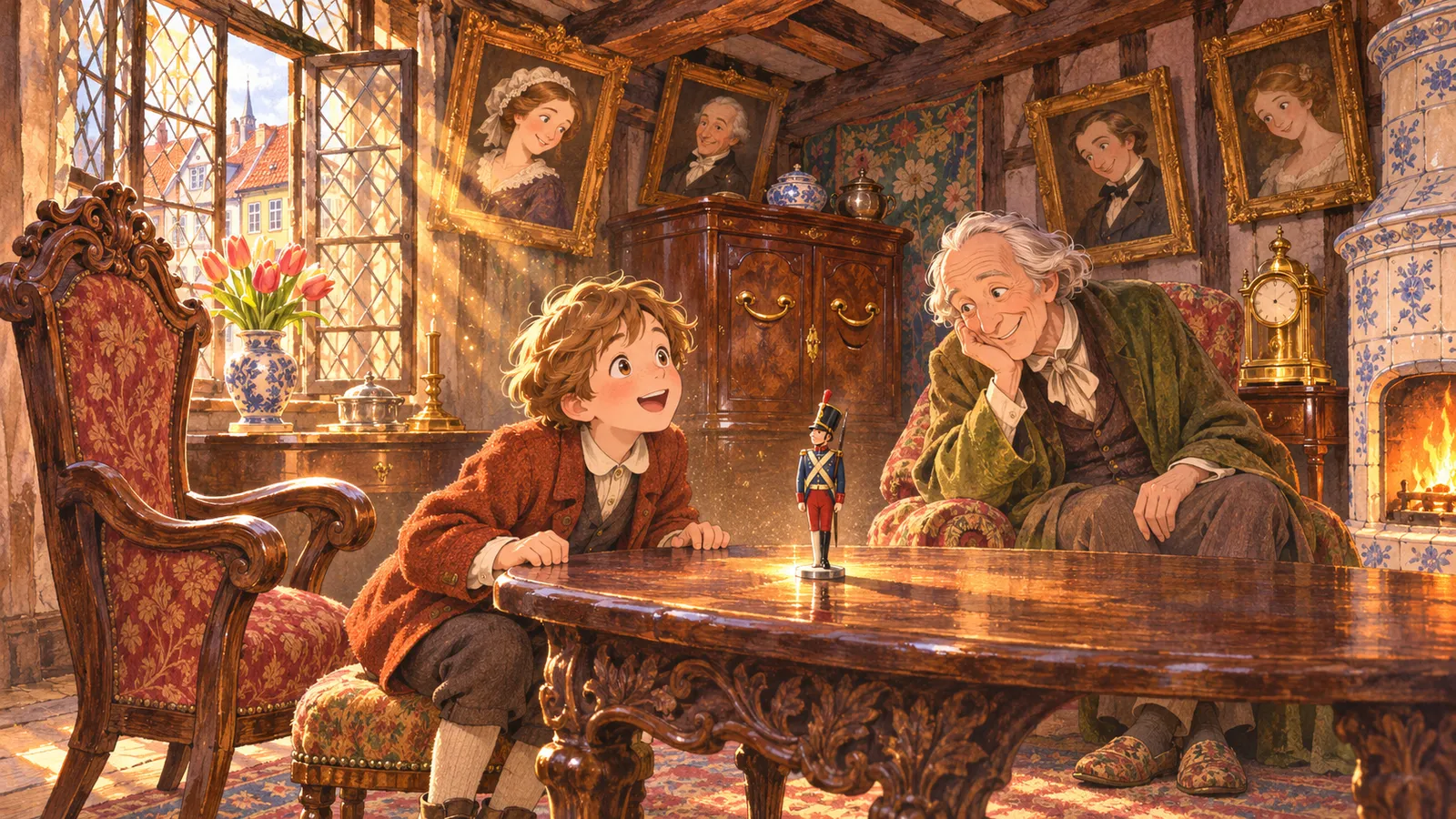
And then the little boy came into the room where the projecting windows were, and where the old man sat.それから男の子は、つき出た窓のある部屋に入りました。そこにおじいさんがすわっていました。
“I thank you for the pewter soldier, my little friend!” said the old man.「すずの兵隊をありがとう、小さなお友だち!」とおじいさんは言いました。 “And I thank you because you come over to me.”「それから、わたしのところへ来てくれて、ありがとう。」
“Thankee! thankee!” or “cranky! cranky!” sounded from all the furniture; there was so much of it, that each article stood in the other's way, to get a look at the little boy.「ありがと!ありがと!」とか「ギシギシ!ギシギシ!」という声が、家具じゅうからひびきました。家具があまりにたくさんあるので、男の子をひと目見ようとして、おたがいにじゃまし合っていました。
In the middle of the wall hung a picture representing a beautiful lady, so young, so glad, but dressed quite as in former times, with clothes that stood quite stiff, and with powder in her hair; she neither said “thankee, thankee!” nor “cranky, cranky!” but looked with her mild eyes at the little boy, who directly asked the old man, “Where did you get her?”かべのまん中には、美しい女の人の絵がかかっていました。とても若く、とても楽しそうでしたが、服はすっかり昔ふうで、ぴんとかたい服を着て、かみには白い粉をふっていました。その人は「ありがと、ありがと!」とも「ギシギシ、ギシギシ!」とも言わず、やさしい目で男の子を見つめていました。男の子はすぐにおじいさんにたずねました。「この人、どこで手に入れたの?」
“Yonder, at the broker's,” said the old man, “where there are so many pictures hanging.「あそこの古道具屋さんだよ」とおじいさんは言いました。「絵がたくさんかかっているところさ。 No one knows or cares about them, for they are all of them buried; but I knew her in by-gone days, and now she has been dead and gone these fifty years!”だれもその絵のことなんか知らないし、気にもかけない。描かれた人たちはみんなもうお墓の中だからね。でも、わたしは昔、この人を知っていたんだよ。もう亡くなってから五十年になる!」
Under the picture, in a glazed frame, there hung a bouquet of withered flowers; they were almost fifty years old; they looked so very old!絵の下には、ガラスのはまった額の中に、しおれた花たばがかかっていました。五十年近くも前の花で、とても古く見えました!
The pendulum of the great clock went to and fro, and the hands turned, and everything in the room became still older; but they did not observe it.大きな時計のふりこは行ったり来たりし、針はまわり、部屋の中のものは何もかもますます古くなっていきました。でも、みんなはそれに気がつきませんでした。
“They say at home,” said the little boy, “that you are so very, very lonely!”「うちではね」と男の子は言いました。「おじいさんはとても、とてもさびしいんだって言ってるよ!」
“Oh!” said he.「おや!」とおじいさんは言いました。 “The old thoughts, with what they may bring with them, come and visit me, and now you also come!「昔の思い出たちが、いろんなものを連れて、わたしをたずねてきてくれるんだよ。そして今はきみも来てくれる! I am very well off!”わたしはとても幸せだよ!」
Then he took a book with pictures in it down from the shelf; there were whole long processions and pageants, with the strangest characters, which one never sees now-a-days; soldiers like the knave of clubs, and citizens with waving flags: the tailors had theirs, with a pair of shears held by two lions—and the shoemakers theirs, without boots, but with an eagle that had two heads, for the shoemakers must have everything so that they can say, it is a pair!それからおじいさんは、たなから絵のついた本を取り出しました。そこには長い長い行列やおまつりが描かれていて、今ではもう見られないふしぎな人たちがいっぱいでした。トランプのクラブのジャックのような兵隊や、旗をなびかせた町の人たち。仕立て屋さんの旗には、二ひきのライオンが持つ大きなはさみ。くつ屋さんの旗には、長ぐつではなく、頭が二つあるワシが描かれていました。くつ屋さんは、何でも「ひと組(一足)」と言えるようにしておかなくてはならないからです! Yes, that was a picture book!そうです、それはすばらしい絵本でした!
The old man now went into the other room to fetch preserves, apples, and nuts—yes, it was delightful over there in the old house.おじいさんは、ジャムやリンゴやクルミを取りに、となりの部屋へ行きました。ほんとうに、向かいの古い家はすてきなところでした。
“I cannot bear it any longer!” said the pewter soldier, who sat on the drawers.「もうがまんできない!」と、たんすの上にすわっていたすずの兵隊が言いました。 “It is so lonely and melancholy here!「ここはさびしくて、ゆううつだ! But when one has been in a family circle one cannot accustom oneself to this life!一度家族のなかでくらしたことがあると、こんな暮らしにはなれっこないよ! I cannot bear it any longer!もうがまんできない! The whole day is so long, and the evenings are still longer!一日はとても長いし、夜はもっと長い! Here it is not at all as it is over the way at your home, where your father and mother spoke so pleasantly, and where you and all your sweet children made such a delightful noise.ここは、向かいのきみの家とはまるでちがう。あそこでは、お父さんとお母さんが楽しそうに話して、きみやかわいい子どもたちがみんなでにぎやかにさわいでいたのに。 Nay, how lonely the old man is—do you think that he gets kisses?ああ、あのおじいさんはなんてさびしいんだろう。だれかにキスしてもらえると思うかい? Do you think he gets mild eyes, or a Christmas tree?やさしい目で見てもらえると思うかい?クリスマスツリーはどう? He will get nothing but a grave!あの人がもらえるのはお墓だけさ! I can bear it no longer!”もうがまんできない!」
“You must not let it grieve you so much,” said the little boy.「そんなに悲しまなくてもいいよ」と男の子は言いました。 “I find it so very delightful here, and then all the old thoughts, with what they may bring with them, they come and visit here.”「ぼくはここがとってもすてきだと思うよ。それに、昔の思い出たちが、いろんなものを連れて、ここへたずねてくるんだよ。」
“Yes, it's all very well, but I see nothing of them, and I don't know them!” said the pewter soldier.「うん、それはけっこうだけど、ぼくにはそんなもの、ちっとも見えないし、知らないもの!」とすずの兵隊は言いました。 “I cannot bear it!”「がまんできないよ!」
“But you must!” said the little boy.「でも、がまんしなくちゃ!」と男の子は言いました。
Then in came the old man with the most pleased and happy face, the most delicious preserves, apples, and nuts, and so the little boy thought no more about the pewter soldier.そこへおじいさんが、うれしそうなにこにこ顔で、とびきりおいしいジャムとリンゴとクルミを持って入ってきました。それで男の子は、すずの兵隊のことはもう考えなくなりました。
The little boy returned home happy and pleased, and weeks and days passed away, and nods were made to the old house, and from the old house, and then the little boy went over there again.男の子は満足して楽しい気持ちで家に帰りました。そして何週間も何日もすぎ、古い家に向かってうなずいたり、古い家からうなずき返されたりしました。そして男の子は、またあちらへ遊びに行きました。
The carved trumpeters blew, “Trateratra!ほりもののラッパふきたちがふきました。「トラテラトラー! There is the little boy!男の子が来たぞ! Trateratra!” and the swords and armor on the knights' portraits rattled, and the silk gowns rustled; the hog's leather spoke, and the old chairs had the gout in their legs and rheumatism in their backs: Ugh! it was exactly like the first time, for over there one day and hour was just like another.トラテラトラー!」騎士の肖像画の剣やよろいがガチャガチャ鳴り、絹のドレスがサラサラ鳴りました。ぶたの革がしゃべり、古いいすたちは足が痛風で、背中がリウマチでした。うう!何もかも最初のときとそっくりでした。あそこでは、どの日もどの時間も、みんな同じだったからです。
“I cannot bear it!” said the pewter soldier.「がまんできない!」とすずの兵隊は言いました。 “I have shed pewter tears!「すずのなみだを流したんだ! It is too melancholy!あまりにもゆううつだ! Rather let me go to the wars and lose arms and legs!いっそ戦争に行って、うでや足をなくしたほうがましだ! It would at least be a change.少なくとも、変化にはなるもの。 I cannot bear it longer!もうこれ以上がまんできない! Now, I know what it is to have a visit from one's old thoughts, with what they may bring with them!昔の思い出たちが、いろんなものを連れてたずねてくるって、どういうことか、今ならわかるよ! I have had a visit from mine, and you may be sure it is no pleasant thing in the end; I was at last about to jump down from the drawers.ぼくのところにも来たんだ。でも、それは結局ちっとも楽しいものじゃないよ。ぼくはとうとう、たんすからとびおりそうになったんだから。
“I saw you all over there at home so distinctly, as if you really were here; it was again that Sunday morning; all you children stood before the table and sung your Psalms, as you do every morning.「きみたちみんなの姿が、まるでここにいるみたいに、とてもはっきり見えたんだ。また、あの日曜日の朝だった。きみたち子どもはみんなテーブルの前に立って、毎朝そうしているように賛美歌を歌っていた。 You stood devoutly with folded hands; and father and mother were just as pious; and then the door was opened, and little sister Mary, who is not two years old yet, and who always dances when she hears music or singing, of whatever kind it may be, was put into the room—though she ought not to have been there—and then she began to dance, but could not keep time, because the tones were so long; and then she stood, first on the one leg, and bent her head forwards, and then on the other leg, and bent her head forwards—but all would not do.きみたちは手を組んで、おごそかに立っていた。お父さんとお母さんも同じように神妙だった。そのとき戸が開いて、まだ二さいにもならない妹のメアリーが部屋に入れられたんだ――ほんとうは入っちゃいけなかったのにね。メアリーは、どんな音楽でも歌でも聞こえるといつもおどりだす子だから、おどりはじめた。でも、歌の音が長すぎて、調子が合わない。そこで、まず片足で立って頭を前にかたむけ、それからもう片方の足で立って頭を前にかたむけた――でも、どうしてもうまくいかなかった。 You stood very seriously all together, although it was difficult enough; but I laughed to myself, and then I fell off the table, and got a bump, which I have still—for it was not right of me to laugh.きみたちはみんなとてもまじめに立っていた。ずいぶんむずかしかっただろうけどね。でも、ぼくは心の中で笑ってしまって、テーブルから落ちて、こぶを作った。そのこぶは今もあるよ――笑ったのはよくなかったからね。 But the whole now passes before me again in thought, and everything that I have lived to see; and these are the old thoughts, with what they may bring with them.でも、今はそれがみんな、また思いの中によみがえってくる。ぼくがこれまでに見てきたこと全部がね。これが、昔の思い出たちと、それが連れてくるものなんだ。
“Tell me if you still sing on Sundays?「今でも日曜日には歌っているのか、教えてよ? Tell me something about little Mary!小さなメアリーのことを何か話してよ! And how my comrade, the other pewter soldier, lives!それから、ぼくの仲間の、もうひとりのすずの兵隊がどうしているかも! Yes, he is happy enough, that's sure!そうさ、あいつはきっと幸せにやっているよ! I cannot bear it any longer!”もうこれ以上がまんできない!」
“You are given away as a present!” said the little boy.「きみはおくりものとしてあげられたんだよ!」と男の子は言いました。 “You must remain.「ここにいなくちゃいけないんだ。 Can you not understand that?”それがわからないの?」
The old man now came with a drawer, in which there was much to be seen, both “tin boxes” and “balsam boxes,” old cards, so large and so gilded, such as one never sees them now.おじいさんは、引き出しをひとつ持ってきました。その中には見るものがたくさんありました。「ブリキの箱」や「香油の箱」、それに今ではもう見られないような、とても大きくて金ぴかの古いトランプなどです。 And several drawers were opened, and the piano was opened; it had landscapes on the inside of the lid, and it was so hoarse when the old man played on it! and then he hummed a song.引き出しがいくつも開けられ、ピアノも開けられました。ピアノのふたの内側には景色が描かれていて、おじいさんがひくと、それはそれはかすれた音がしました!それからおじいさんは歌を口ずさみました。
“Yes, she could sing that!” said he, and nodded to the portrait, which he had bought at the broker's, and the old man's eyes shone so bright!「そうそう、あの人はこれを歌えたんだよ!」とおじいさんは言って、古道具屋で買った肖像画にうなずきました。おじいさんの目は、それはそれは明るくかがやいていました!
“I will go to the wars!「戦争に行くんだ! I will go to the wars!” shouted the pewter soldier as loud as he could, and threw himself off the drawers right down on the floor.戦争に行くんだ!」とすずの兵隊はありったけの声でさけび、たんすから床へまっさかさまに身を投げました。 What became of him?兵隊はどうなったのでしょう? The old man sought, and the little boy sought; he was away, and he stayed away.おじいさんもさがし、男の子もさがしました。でも兵隊はいなくなって、それきり見つかりませんでした。
“I shall find him!” said the old man; but he never found him.「きっと見つけてやるよ!」とおじいさんは言いました。でも、とうとう見つかりませんでした。 The floor was too open—the pewter soldier had fallen through a crevice, and there he lay as in an open tomb.床にはすき間がありすぎたのです――すずの兵隊は割れ目から落ちて、そこで、ふたのないお墓の中にいるように横たわっていました。
That day passed, and the little boy went home, and that week passed, and several weeks too.その日がすぎて、男の子は家に帰りました。その週もすぎ、何週間もすぎました。 The windows were quite frozen, the little boy was obliged to sit and breathe on them to get a peep-hole over to the old house, and there the snow had been blown into all the carved work and inscriptions; it lay quite up over the steps, just as if there was no one at home—nor was there any one at home—the old man was dead!窓はすっかりこおりついていたので、男の子は息をふきかけて、古い家が見えるのぞき穴を作らなければなりませんでした。古い家では、ほりものや文字のすみずみに雪がふきこまれ、階段の上までつもっていました。まるで、だれも家にいないようでした――ほんとうに、だれもいなかったのです――おじいさんは亡くなったのです!
In the evening there was a hearse seen before the door, and he was borne into it in his coffin: he was now to go out into the country, to lie in his grave.夕方、戸口の前に霊柩車が見えました。おじいさんはひつぎに入れられて運びこまれました。いなかへ行って、お墓にねむるのです。 He was driven out there, but no one followed; all his friends were dead, and the little boy kissed his hand to the coffin as it was driven away.馬車はそこへ向かいましたが、ついていく人はだれもいませんでした。友だちはみんなもう亡くなっていたのです。男の子は、走りさるひつぎに向かって、手にキスをして送りました。
Some days afterwards there was an auction at the old house, and the little boy saw from his window how they carried the old knights and the old ladies away, the flower-pots with the long ears, the old chairs, and the old clothes-presses.何日かして、古い家でせり売りがありました。男の子は窓から、古い騎士や古い貴婦人たち、長い耳のついた植木ばち、古いいす、古い洋服だんすが運び出されていくのを見ました。 Something came here, and something came there; the portrait of her who had been found at the broker's came to the broker's again; and there it hung, for no one knew her more—no one cared about the old picture.あるものはこちらへ、あるものはあちらへ行きました。古道具屋で見つけられたあの人の肖像画は、また古道具屋にもどりました。そしてそこにかかったままでした。もうだれもその人を知らず、だれもその古い絵を気にかけなかったからです。
In the spring they pulled the house down, for, as people said, it was a ruin.春になると、家はこわされました。人びとの言うには、あれはもうあばら家だったからです。 One could see from the street right into the room with the hog's-leather hanging, which was slashed and torn; and the green grass and leaves about the balcony hung quite wild about the falling beams.通りから、ぶたの革のかかった部屋の中までまる見えでした。革は切りさかれ、やぶれていました。バルコニーのまわりの緑の草や葉は、くずれ落ちるはりのまわりに、すっかりあれ放題にたれさがっていました。 And then it was put to rights.それから、あたりはきれいにかたづけられました。
“That was a relief,” said the neighboring houses.「ああ、せいせいした」と、となりの家々は言いました。
A fine house was built there, with large windows, and smooth white walls; but before it, where the old house had in fact stood, was a little garden laid out, and a wild grapevine ran up the wall of the neighboring house.そこにはりっぱな家が建てられました。大きな窓と、すべすべの白いかべの家です。でも、その前の、ほんとうに古い家が建っていたところには、小さな庭が作られ、となりの家のかべには野ブドウのつるがはいのぼっていました。 Before the garden there was a large iron railing with an iron door, it looked quite splendid, and people stood still and peeped in, and the sparrows hung by scores in the vine, and chattered away at each other as well as they could, but it was not about the old house, for they could not remember it, so many years had passed—so many that the little boy had grown up to a whole man, yes, a clever man, and a pleasure to his parents; and he had just been married, and, together with his little wife, had come to live in the house here, where the garden was; and he stood by her there whilst she planted a field-flower that she found so pretty; she planted it with her little hand, and pressed the earth around it with her fingers.庭の前には鉄の戸のついた大きな鉄の柵があって、とてもりっぱに見えました。人びとは立ち止まってのぞきこみ、スズメたちは何十羽もブドウのつるにぶらさがって、精いっぱいにぎやかにおしゃべりしていました。でも、古い家のことを話しているのではありませんでした。スズメたちはそれをおぼえていなかったのです。それほど長い年月がすぎていました――あの小さな男の子が、りっぱな大人になるほどに。そう、かしこい大人になって、両親のじまんの息子になりました。そして結婚したばかりで、小さなおくさんといっしょに、庭のあるこの家に住むようになったのです。おくさんがとてもかわいいと思った野の花を植えているあいだ、夫はそばに立っていました。おくさんは小さな手で花を植え、指でまわりの土をおさえました。 Oh! what was that?あら!あれは何でしょう? She had stuck herself.おくさんは何かで指をさしてしまったのです。 There sat something pointed, straight out of the soft mould.やわらかい土の中から、とがったものがまっすぐつき出ていました。
It was—yes, guess!それは――さあ、当ててごらん! It was the pewter soldier, he that was lost up at the old man's, and had tumbled and turned about amongst the timber and the rubbish, and had at last laid for many years in the ground.それはあのすずの兵隊でした。おじいさんの家でなくなり、材木やがらくたのあいだをころげまわって、とうとう何年も土の中にうもれていたのです。
The young wife wiped the dirt off the soldier, first with a green leaf, and then with her fine handkerchief—it had such a delightful smell, that it was to the pewter soldier just as if he had awaked from a trance.若いおくさんは、まず緑の葉っぱで、それから上等なハンカチで兵隊の土をふきとりました。ハンカチはとてもいいにおいがしたので、すずの兵隊はまるで長いねむりから目がさめたような気持ちになりました。
“Let me see him,” said the young man.「ぼくにも見せて」と若い夫は言いました。 He laughed, and then shook his head.夫は笑って、それから首をふりました。 “Nay, it cannot be he; but he reminds me of a story about a pewter soldier which I had when I was a little boy!”「いや、あれのはずはないな。でも、ぼくが小さいころに持っていたすずの兵隊のお話を思い出すよ!」 And then he told his wife about the old house, and the old man, and about the pewter soldier that he sent over to him because he was so very, very lonely; and he told it as correctly as it had really been, so that the tears came into the eyes of his young wife, on account of the old house and the old man.それから夫はおくさんに、古い家のこと、おじいさんのこと、そして、おじいさんがとても、とてもさびしそうだったので向かいへ送ったすずの兵隊のことを話しました。ほんとうにあったとおりにくわしく話したので、若いおくさんの目には、古い家とおじいさんのことを思って、なみだがうかびました。
“It may possibly be, however, that it is the same pewter soldier!” said she.「でも、もしかしたら、ほんとうに同じすずの兵隊かもしれないわ!」とおくさんは言いました。 “I will take care of it, and remember all that you have told me; but you must show me the old man's grave!”「わたし、これを大切にしまっておいて、あなたが話してくれたことをみんなおぼえておくわ。でも、おじいさんのお墓に連れていってちょうだいね!」
“But I do not know it,” said he, “and no one knows it!「でも、ぼくは知らないんだ」と夫は言いました。「だれも知らないんだよ! All his friends were dead, no one took care of it, and I was then a little boy!”友だちはみんな亡くなっていて、お墓の世話をする人もいなかったし、ぼくはそのころ小さな子どもだったから!」
“How very, very lonely he must have been!” said she.「おじいさんは、どんなに、どんなにさびしかったことでしょう!」とおくさんは言いました。
“Very, very lonely!” said the pewter soldier.「とても、とてもさびしかったよ!」とすずの兵隊は言いました。 “But it is delightful not to be forgotten!”「でも、わすれられていないって、すてきなことだね!」
“Delightful!” shouted something close by; but no one, except the pewter soldier, saw that it was a piece of the hog's-leather hangings; it had lost all its gilding, it looked like a piece of wet clay, but it had an opinion, and it gave it:「すてき!」と、すぐ近くで何かがさけびました。でも、それが、ぶたの革のかべかけのきれはしだということに気づいたのは、すずの兵隊だけでした。金色はすっかりはげて、ぬれた土のかたまりのように見えましたが、ちゃんと自分の考えを持っていて、それを言ったのです。
This the pewter soldier did not believe.すずの兵隊は、それを信じませんでした。