

 ワークシート
 ぬりえ
 迷路
油絵で観音さま!?龍に乗って荒海を行く、明治の大問題作。Kannon in oil paint!? A controversial Meiji painting of Kannon riding a dragon over a stormy sea.
この作品のお話
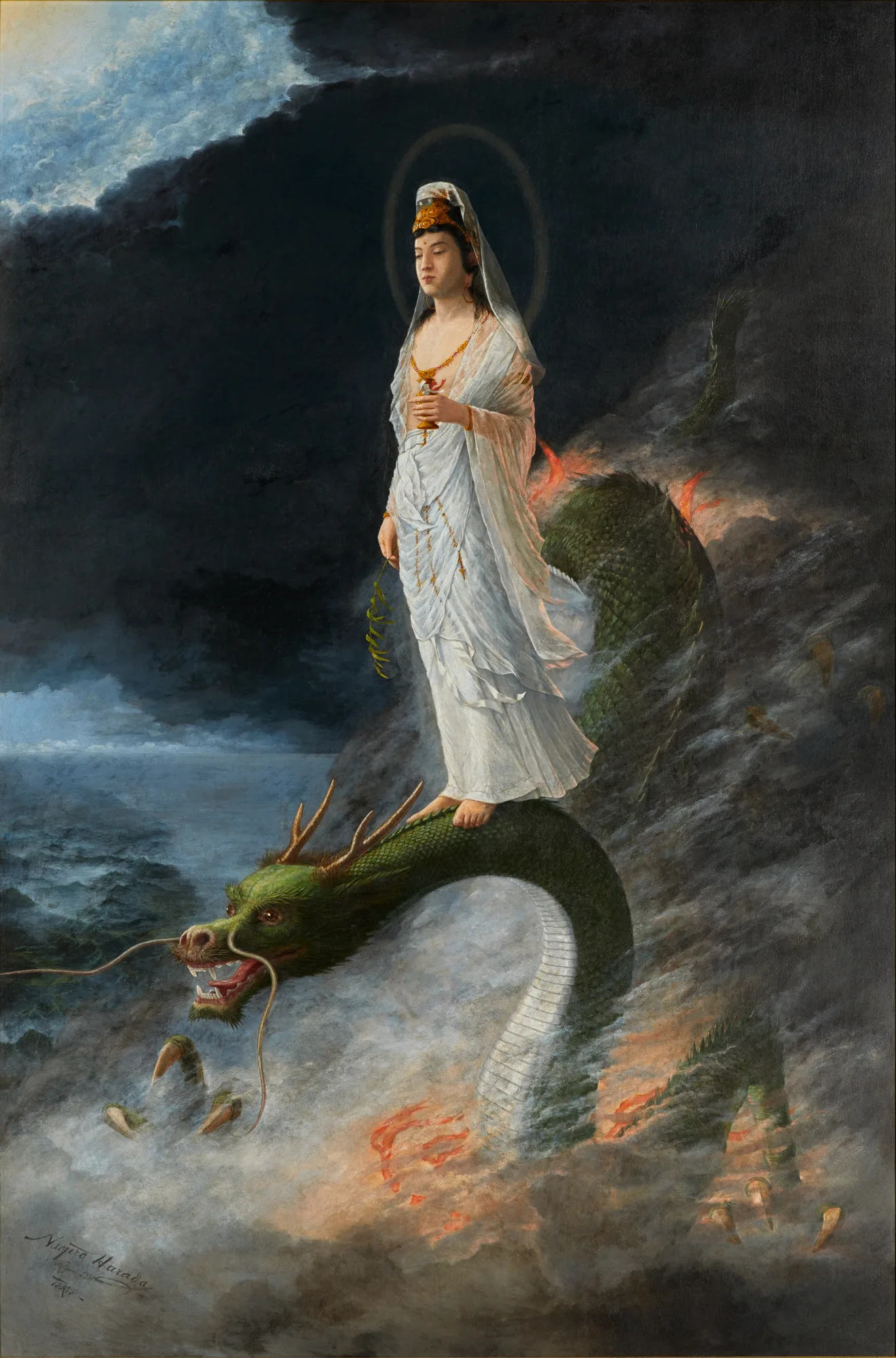
Story黒い雲がうずまく荒れた海の上を、緑色の龍が身をくねらせて進みます。その背中に立つのは、白い衣をまとった観音さま。頭の後ろには光の輪がかがやいています。描いたのは原田直次郎。日本や東洋の仏画の題材を、西洋の油絵の技法で、高さ2メートル70センチをこえる大きな画面に描きました。1890年(明治23年)の作品です。
A green dragon twists its way over a stormy sea under dark, swirling clouds. On its back stands Kannon in a white robe, with a ring of light behind the head. The artist, Harada Naojirō, took a subject from Buddhist painting and painted it with Western oil techniques. The canvas is more than 2.7 meters tall. He finished it in 1890.
原田は1884年にドイツへ渡り、ミュンヘンで画家ガブリエル・フォン・マックスに学びました。そこで親しくなったのが、陸軍から留学していた森鷗外です。帰国した原田は、この絵を1890年の第3回内国勧業博覧会に出品しました。大作として注目を集めましたが、賞はとれませんでした。
In 1884, Harada went to Germany and studied in Munich with the painter Gabriel von Max. There he became close friends with Mori Ōgai, who was studying in Germany for the army. After returning to Japan, Harada showed this painting at the third National Industrial Exhibition in 1890. It got a lot of attention as a huge work, but it did not win a prize.
同じ年、帝国大学(いまの東京大学)の教授・外山正一が講演で、今の日本の絵は題材が貧しく思想がたりないと批判しました。名前は出さなかったものの、この絵への遠回しな批判と受けとられ、鷗外が強く反論して大きな論争になりました。原田は1899年に36歳で亡くなりますが、絵はのちに東京の護国寺に納められ、2007年に国の重要文化財になりました。
That same year, Toyama Masakazu, a professor at the Imperial University (now the University of Tokyo), gave a talk. He said that Japanese painting lacked good subjects and ideas. He did not name this work, but people took his words as an indirect attack on it. Mori Ōgai strongly argued back, and a big debate began. Harada died in 1899 at the age of 36. The painting later went to Gokoku-ji Temple in Tokyo, and in 2007 it became an Important Cultural Property.
緑の龍が荒れた海の上を飛んでいます。観音さまがその背中に立っています。観音さまは白い衣を着ています。画家はドイツで油絵を学びました。友だちの作家・森鷗外は、彼をモデルにお話を書きました!
A green dragon flies over a stormy sea. Kannon stands on its back. Kannon wears a white robe. The painter learned oil painting in Germany. His friend, the writer Mori Ogai, put him in a story!
英語のレベルは上の「やさしい/ふつう」で切りかえられます。
えっ!?な裏ネタ
Secrets鷗外の小説『うたかたの記』は、ミュンヘンを舞台に日本人画家・巨勢が登場するお話です。鷗外は、この巨勢のモデルが原田直次郎であることを生前から公言していました。友情が小説になったのです。
Mori Ōgai's story 'Utakata no Ki' takes place in Munich and has a Japanese painter named Kose. Ōgai said openly that Kose was based on Harada Naojirō. Their friendship became a story.
原田の先生ガブリエル・フォン・マックスは、家でたくさんのサルを飼い、サルを熱心に研究した画家として知られます。サルたちが絵を品定めする「美術批評家としてのサル」という作品まで描いています。
Harada's teacher, Gabriel von Max, is known for keeping many monkeys at home and studying them closely. He even painted 'Monkeys as Judges of Art,' which shows monkeys looking at a painting.
原田は1893年ごろから病気になり、しだいに歩くのが難しくなりました。それでも寝たままの姿勢で絵を描きつづけたといいます。1899年、わずか36歳で亡くなりました。この大作は、病気になる前の1890年に描かれたものです。
Around 1893, Harada became ill and slowly found it hard to walk. Even so, it is said that he kept painting while lying down. He died in 1899 at only 36. This huge painting was made in 1890, before he became ill.
この絵の持ち主は、東京・文京区のお寺、護国寺です。お寺が大きな油絵を持っているのはめずらしく、今は東京国立近代美術館に預けられていて、展示で見ることができます。
This painting belongs to Gokoku-ji, a temple in Bunkyō, Tokyo. It is unusual for a temple to own a large oil painting. Today it is kept at the National Museum of Modern Art, Tokyo, where people can see it on display.
ここを見て!
Look Closer1観音さまと光の輪Kannon and the halo
白いベールをかぶった観音さまの頭の後ろに、細い光の輪。油絵ならではの、本物の人のような顔立ちです。
A thin ring of light glows behind Kannon's white veil. Thanks to oil paint, the face looks like a real person's.
2龍の頭The dragon's head
大きく口を開け、長いひげをのばした緑の龍。うろこや角まで、立体的に描かれています。
The green dragon opens its mouth wide and stretches its long whiskers. Its scales and horns look solid and real.
3荒れた海Stormy sea
左には、白い波が立つ暗い海が広がります。黒い雲と合わせて、ドラマチックな場面を作っています。
On the left, a dark sea with white waves spreads out. With the black clouds, it makes the scene dramatic.
4ローマ字のサインSignature in Roman letters
左下にローマ字で原田の名前と1890の年が書かれています。仏画なのにサインは西洋式です。
In the lower left, Harada's name and the year 1890 are written in Roman letters. It is a Buddhist subject, but the signature is Western style.
英語で名画を語ろう
Talk about Art in EnglishKannon is standing on the back of a green dragon.
観音さまは緑の龍の背中に立っています。
💡 on the back of a horse(馬の背に)のように、乗っている様子を言うときに使えます。
英語で説明すると… Describe it
これは大きくて暗い色の絵です。まん中には、白い衣の観音さまが立っています。観音さまは緑の龍の背中に立っています。左には、荒れた海と黒い雲が見えます。
This is a large, dark painting. In the center, Kannon is standing in a white robe. Kannon is standing on the back of a green dragon. On the left, you can see a stormy sea and dark clouds.
考えてみよう Think & Talk
- 仏教の題材を西洋の油絵で描くのは、よい考えだと思いますか?それはなぜですか?Is it a good idea to paint a Buddhist subject with Western oil paint? Why or why not?
- 龍はどんな気持ちだと思いますか?What do you think the dragon is feeling?
この作品の英単語
WordsA green dragon flies over the sea.
緑の龍が海の上を飛んでいます。
Kannon is riding a dragon.
観音さまが龍に乗っています。
Some people criticized this painting.
この絵を批判する人もいました。
The sea is dark and stormy.
海は暗く荒れています。
ミニクイズ
QuizQ. 原田直次郎が油絵を学んだ国は?In which country did Harada study oil painting?
ドイツのミュンヘンで学び、そこで森鷗外と親しくなりました。
He studied in Munich, Germany, where he became friends with Mori Ōgai.
ウソ?ホント? この絵が批判されたとき、森鷗外が反論した。When this painting was criticized, Mori Ōgai argued back.
ホントです。外山正一の批判に鷗外が強く反論し、大論争になりました。
True. Ōgai strongly answered Toyama Masakazu's criticism, and a big debate followed.
ウソ?ホント? この絵は、日本の伝統的な絵の具で絹に描かれている。This painting is made with traditional Japanese paints on silk.
ウソです。西洋の油絵の具でカンヴァスに描かれています。そこが新しく、論争のもとにもなりました。
False. It is oil paint on canvas. That was new, and it was part of the debate.
 画像の出典とライセンス / Image credit
- PDKannon Riding a Dragon by Harada Naojiro (National Museum of Modern Art, Tokyo).jpg(Wikimedia Commons)
ライセンス:Public domain(パブリックドメイン)/作者・撮影者の表記:Harada Naojirō
この作品は、作者の死後長い年月がたち著作権の保護期間が終わった「パブリックドメイン」の作品です。画像は平面の作品を忠実に写したもので、新しい著作権は生じません(Wikimedia Commons の PD-Art の考え方)。 所蔵:護国寺(東京国立近代美術館に寄託)(Gokoku-ji Temple (on deposit at the National Museum of Modern Art, Tokyo))。画像は表示のために縮小・WebP 形式に変換しています。
