

 ワークシート
 ぬりえ
 迷路
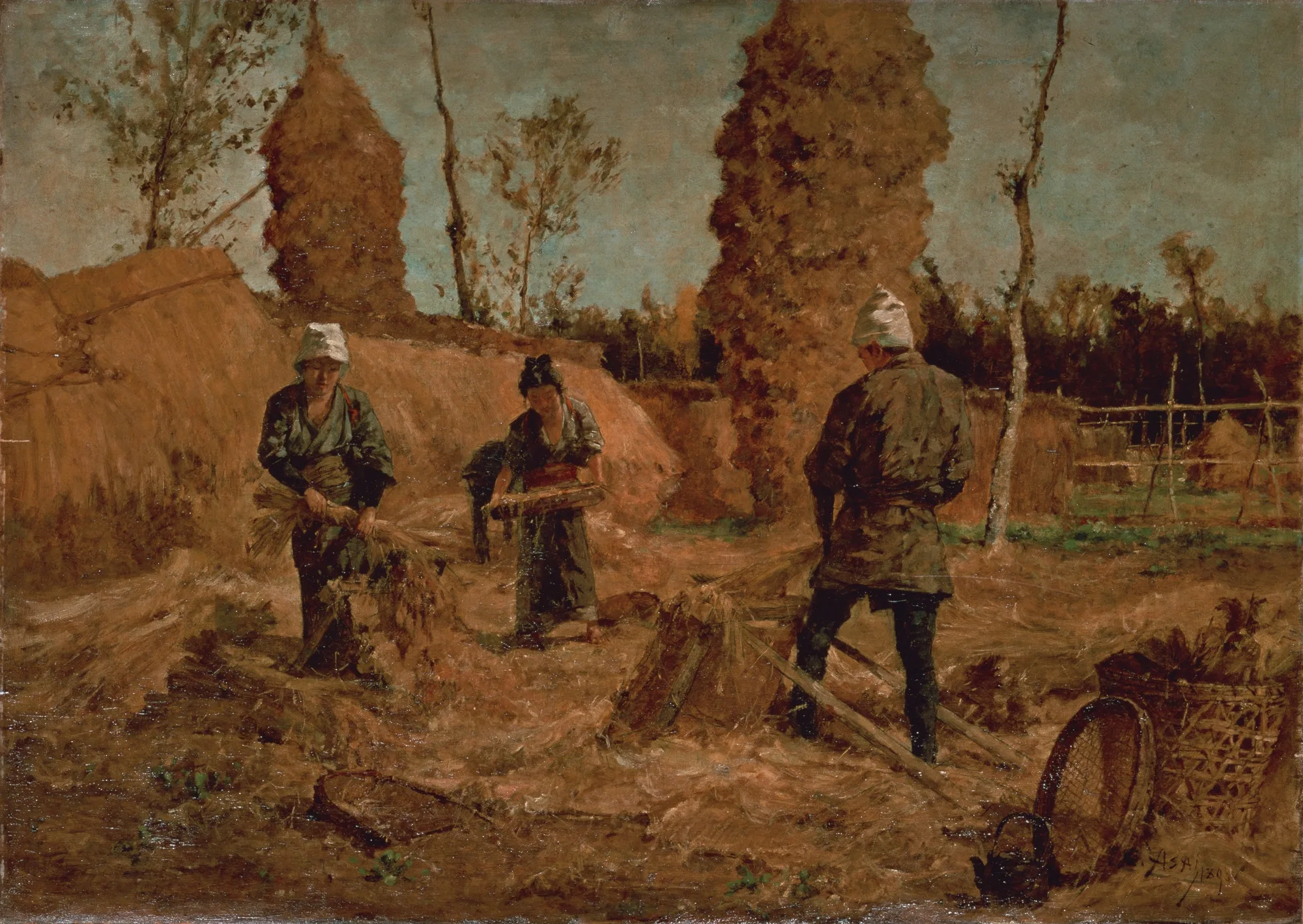
茶色い秋の畑で、取り入れ作業の真っ最中!明治の洋画家が描いた農村。Harvest time in a brown autumn field! A Meiji-era oil painter shows village life.
この作品のお話
Story秋の畑で、農家の人たちが稲の取り入れ作業をしています。後ろには、刈りとった稲わらを高く積み上げた山。右手前には、かごややかんが置かれています。画面全体が、わらと土の茶色につつまれています。描いたのは浅井忠。日本に油絵が根づき始めた明治時代の洋画家で、1890年(明治23年)の明治美術会第2回展に出品しました。
In an autumn field, farmers are bringing in the rice harvest. Behind them are tall stacks of rice straw. In the lower right corner, there are baskets and a kettle. The whole picture is filled with the brown of straw and earth. The artist is Asai Chū, an oil painter from the Meiji era, when oil painting was just taking root in Japan. He showed it at the Meiji Fine Arts Society's second exhibition in 1890.
浅井は工部美術学校で、イタリアから招かれた画家アントニオ・フォンタネージに油絵を学びました。フォンタネージは自然の光や空気を大切にする風景画家で、浅井はその教えを日本の農村の風景に生かしました。茶色を基調にした落ち着いた画風は「脂派(やには)」と呼ばれ、明治中ごろの洋画の主流になりました。
At the Technical Fine Arts School, Asai learned oil painting from Antonio Fontanesi, an Italian painter invited to Japan. Fontanesi was a landscape painter who cared about natural light and air. Asai used these lessons to paint the Japanese countryside. His calm, brown style was called the 'resin school,' and it was the main style of Western-style painting in the middle of the Meiji era.
やがて黒田清輝らが明るい色の「新派」を広めると、浅井たちは「旧派」と呼ばれるようになります。浅井は1900年にフランスへ留学し、帰国後は京都で教えて、梅原龍三郎や安井曾太郎ら次の時代の画家を育てました。この「収穫」は、明治の洋画の代表作として、1967年に国の重要文化財になっています。
Later, Kuroda Seiki and others spread a brighter 'new school,' and Asai's group came to be called the 'old school.' In 1900, Asai went to study in France. After he came back, he taught in Kyoto and trained young painters such as Umehara Ryūzaburō and Yasui Sōtarō. In 1967, 'Harvest' became an Important Cultural Property as a major work of Meiji oil painting.
秋の茶色い畑で、農家の人たちが働いています。お米の取り入れをしています。後ろには大きなわらの山があります。画家はイタリア人の先生から油絵を学びました。猫が主人公の有名な本のさし絵も描きました!
Farmers work in a brown field in autumn. They are bringing in the rice. Big stacks of straw stand behind them. The painter learned oil painting from an Italian teacher. He also drew pictures for a famous book about a cat!
英語のレベルは上の「やさしい/ふつう」で切りかえられます。
えっ!?な裏ネタ
Secrets明治政府は西洋の技術を学ぶため、外国から先生を招きました。浅井の油絵の先生フォンタネージもそのひとりで、イタリアの風景画家です。国がつくった日本初の美術学校・工部美術学校で、本格的な洋画の教育をになった先生のひとりでした。
The Meiji government invited teachers from abroad to learn Western skills. Asai's oil painting teacher, Antonio Fontanesi, was one of them. He was a landscape painter from Italy. At the Technical Fine Arts School, Japan's first government art school, he was one of the teachers who led its early training in Western-style painting.
夏目漱石は『吾輩は猫である』を本にするとき、西洋風の本にしたいと考え、フランス留学の経験がある洋画家、浅井忠と中村不折にさし絵をたのみました。あの有名な猫の本に、浅井の絵が入っているのです。
When Natsume Sōseki made 'I Am a Cat' into a book, he wanted a Western-style look. He asked two oil painters who had studied in France, Asai Chū and Nakamura Fusetsu, to draw the pictures. Asai's art is inside that famous cat book.
漱石の小説『三四郎』には、亡くなった画家「深見さん」の水彩画の展覧会が出てきます。この深見先生のモデルは、浅井忠だとされています。浅井は『三四郎』が書かれる前年の1907年に亡くなっていました。
In Sōseki's novel 'Sanshirō,' there is an exhibition of watercolors by a late painter, Mr. Fukami. Mr. Fukami is thought to be based on Asai Chū. Asai had died in 1907, the year before the novel was written.
浅井たちの茶色っぽい絵は、松やにの色にたとえて「脂派(やには)」と呼ばれました。いっぽう、黒田清輝らの新しい絵は、影を紫色で描いたことから「紫派」と呼ばれました。色のちがいが、そのままあだ名になったのです。
Asai's brownish paintings were called the 'resin school,' after the color of pine resin. Kuroda Seiki's new paintings used purple for shadows, so they were called the 'purple school.' The colors became the nicknames.
ここを見て!
Look Closer1稲わらの山Stacks of rice straw
刈りとった稲わらを、背の高い塔のように積み上げています。秋の農村らしい風景です。
The rice straw is piled up high like a tower. It is a typical sight in an autumn village.
2働く女性たちWomen at work
2人の女性が稲の束をかかえて作業しています。左の女性は白い手ぬぐいをかぶり、2人とも動きやすい仕事着を身につけています。
Two women are working with bundles of rice. The woman on the left wears a white cloth on her head. Both wear work clothes that let them move easily.
3背を向けた男性A man from behind
顔を見せず、背中を向けて作業する男性。ポーズをとった人ではなく、ふだんの仕事の一場面に見せる工夫です。
This man turns his back to us as he works. It makes the scene look like real, everyday work, not a posed picture.
4かごとやかんBaskets and a kettle
右下にはかごと黒いやかん。休けいのお茶に使うのでしょうか。その右にはローマ字のサインと「1890」の年も見えます。
In the lower right are baskets and a black kettle, maybe for a tea break. Next to them, you can see the signature in Roman letters and the year 1890.
英語で名画を語ろう
Talk about Art in EnglishThe farmers are busy bringing in the rice harvest.
農家の人たちは、米の取り入れにいそがしくしています。
💡 busy のあとに動詞の ing 形を続けます。働く人を描いた絵の説明に便利です。
英語で説明すると… Describe it
これは秋の農村の場面です。まん中では、2人の女性と1人の男性が稲わらを使って働いています。その後ろには、高く積まれたわらの山と木々があります。右下のすみには、かごとやかんがあります。
This is a farm scene in autumn. In the middle, two women and a man are working with rice straw. Behind them, there are tall stacks of straw and some trees. In the lower right corner, there are baskets and a kettle.
考えてみよう Think & Talk
- 浅井はなぜ、有名な人ではなく、農家のふだんの仕事を描いたと思いますか?Why do you think Asai painted farmers' everyday work instead of famous people?
- この絵はほとんど茶色です。この色からどんな気持ちを感じますか?The painting is mostly brown. What feeling does this color give you?
この作品の英単語
WordsThe farmers are busy with the rice harvest.
農家の人たちは米の取り入れでいそがしい。
Tall stacks of straw stand behind them.
後ろには高いわらの山があります。
The government invited a painter from Italy.
政府はイタリアから画家を招きました。
The whole painting has a brownish color.
絵全体が茶色っぽい色をしています。
ミニクイズ
QuizQ. 浅井忠に油絵を教えた先生は、どこの国の人?Where was Asai Chū's oil painting teacher from?
工部美術学校に招かれたイタリアの画家、アントニオ・フォンタネージです。
It was Antonio Fontanesi, an Italian painter invited to the Technical Fine Arts School.
ウソ?ホント? この絵は、明るい紫色の影が特徴の「紫派」の作品だ。This is a 'purple school' painting with bright purple shadows.
ウソです。茶色を基調にした「脂派(やには)」の代表作です。「紫派」は黒田清輝らの新派のことです。
False. It is a key work of the brownish 'resin school.' The 'purple school' was Kuroda Seiki's group.
ウソ?ホント? 浅井忠は『吾輩は猫である』の本にさし絵を描いた。Asai Chū drew pictures for the book 'I Am a Cat.'
ホントです。漱石にたのまれ、中村不折とともにさし絵を描きました。
True. Sōseki asked him and Nakamura Fusetsu to draw the pictures.
 画像の出典とライセンス / Image credit
- PDAsai Chu - Harvest.jpg(Wikimedia Commons)
ライセンス:Public domain(パブリックドメイン)/作者・撮影者の表記:Asai Chū
この作品は、作者の死後長い年月がたち著作権の保護期間が終わった「パブリックドメイン」の作品です。画像は平面の作品を忠実に写したもので、新しい著作権は生じません(Wikimedia Commons の PD-Art の考え方)。 所蔵:東京藝術大学大学美術館(The University Art Museum, Tokyo University of the Arts)。画像は表示のために縮小・WebP 形式に変換しています。
