monjayaki
the runny Tokyo griddle dish you eat straight off the hotplate
もんじゃ焼き(もんじゃやき)
In one line
The shortest answer that works
Monjayaki is a Tokyo griddle dish much runnier than okonomiyaki, eaten straight off the hotplate with small spatulas.
もんじゃ焼きとは、お好み焼きよりずっとゆるい東京の鉄板料理で、小さなヘラで鉄板から直接食べるものです。
In 30 seconds
The standard explanation
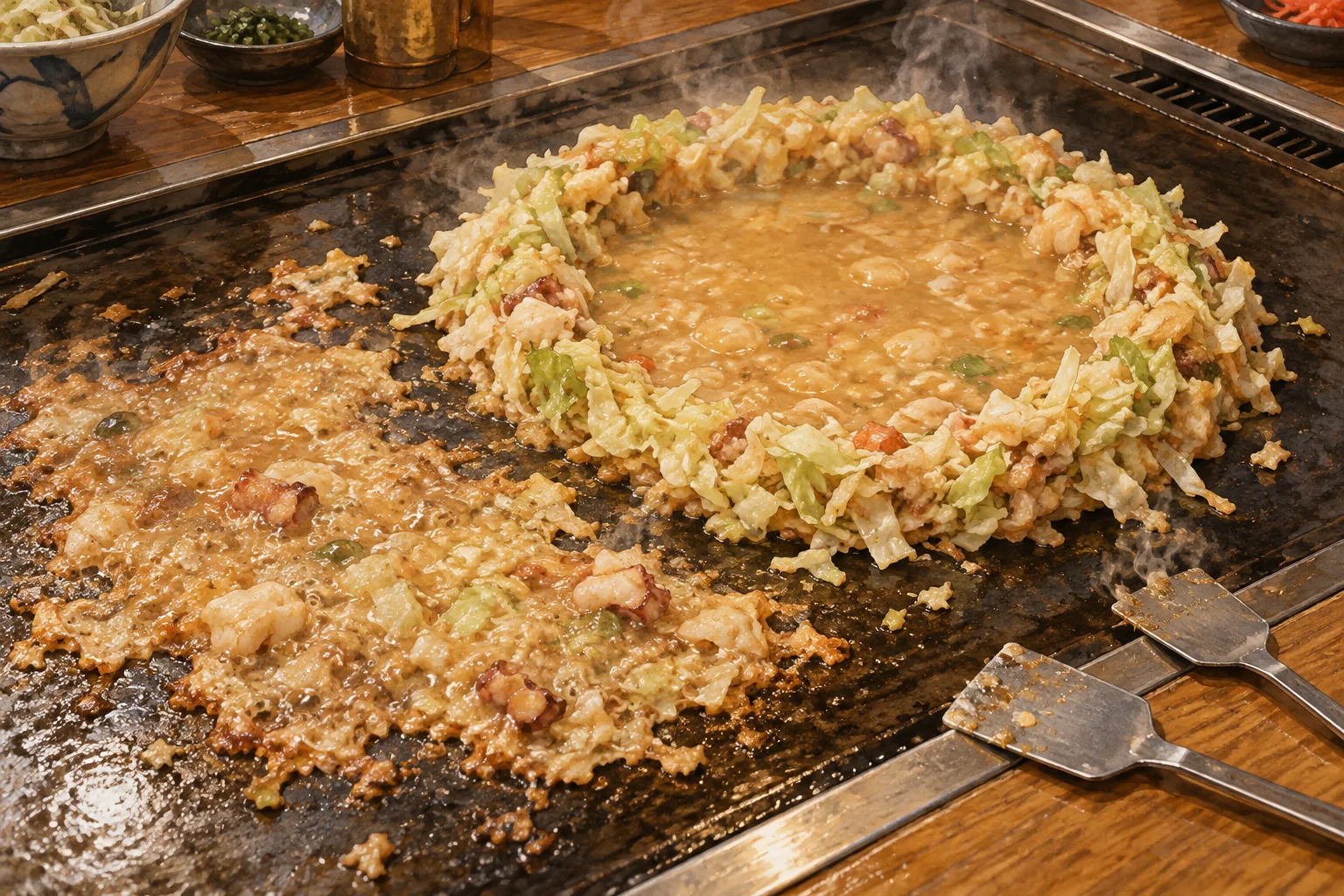
Monjayaki is made from a very thin flour batter with cabbage and other ingredients. You fry the solids first, build them into a ring on the griddle, pour the liquid into the middle, and then mix everything as it thickens. It never sets into a pancake. You eat it straight off the hotplate with a small metal spatula, pressing bits down until they crisp. It is closely associated with the Tsukishima district of Tokyo.
もんじゃ焼きは、とても薄い小麦粉の生地にキャベツなどを合わせて作ります。まず具を炒め、鉄板の上で土手のように輪を作り、その中に汁を流し込み、とろみがついてきたら全体を混ぜます。お好み焼きのように固まることはありません。小さな金属のヘラで鉄板から直接すくい、押しつけて焦がしながら食べます。東京の月島と強く結びついた料理です。
As a short speech
A full paragraph you can read aloud
Monjayaki is the dish that most confuses people who already know okonomiyaki, because it looks like it has gone wrong. The batter is mostly water — far thinner than okonomiyaki batter — with flour, dashi and Worcester-style sauce mixed in, and cabbage and whatever else you ordered. The method is specific.
You take the solid ingredients out of the bowl, fry them on the griddle, chop them with your spatulas, and push them into a ring like a low wall. Then you pour the liquid into the middle and let it bubble until it thickens, and only then mix everything together and spread it out. It never becomes a pancake and is not meant to.
You eat it with a hera, a small metal spatula about the size of a spoon, pressing a little down onto the hot iron, letting it crisp, and eating it straight from there. The crisped edge is the part people fight over. It is a Tokyo dish, strongly associated with Tsukishima, where one street has dozens of monja restaurants in a row.
もんじゃ焼きは、お好み焼きを知っている人ほど戸惑う料理です。失敗したように見えるからです。生地はほとんど水で、お好み焼きよりはるかに薄く、そこに小麦粉、出汁、ウスターソースなどを混ぜ、キャベツと頼んだ具が入ります。手順が決まっています。
まず器から具だけを取って鉄板で炒め、ヘラで刻み、低い壁のような輪に押し広げる。次にその真ん中へ汁を流し込み、泡立ちながらとろみがつくのを待つ。そこでようやく全体を混ぜ、平らに広げます。お好み焼きのようには固まりませんし、固めるものでもありません。
食べるにはヘラを使います。匙ほどの大きさの小さな金属の道具で、少しずつ熱い鉄板に押しつけ、焦げ目をつけて、そのまま口に運びます。この焦げた縁が、取り合いになる部分です。東京の料理で、とりわけ月島と結びついています。一本の通りに、もんじゃの店が何十軒も並んでいます。
Questions people actually ask
And how to answer them.
How is it different from okonomiyaki?
Okonomiyaki is a thick batter cooked into a pancake and cut into pieces. Monja stays liquid, is never flipped, and is eaten off the griddle rather than off a plate.
お好み焼きは濃い生地を焼いて丸くまとめ、切り分けます。もんじゃは汁のままで、ひっくり返さず、皿に取らずに鉄板から食べます。
Do I cook it myself?
Usually yes, and the staff will show you the first one if you ask. Saying you have never made it before is completely normal and gets you a demonstration.
たいていは自分で焼きます。頼めば店の人が最初の一枚を作ってくれます。作ったことがないと言えば、見本を見せてくれます。ごくふつうのことです。
Why is it in Tsukishima?
It began as a cheap children's snack sold at old-fashioned candy stores in downtown Tokyo, and Tsukishima's shopping street turned it into a local specialty in the postwar decades.
もとは東京の下町の駄菓子屋で売られた、子どもの安い間食でした。戦後、月島の商店街がこれを町の名物に育てました。
A common misunderstanding
MYTHMonjayaki is unfinished okonomiyaki.
FACTIt is a separate dish with its own method. The batter is deliberately thin so it stays loose and crisps at the edges on the griddle.
Phrases you can use
- It stays runny — that's how it's supposed to be.ゆるいままです。そういうものです。
- Fry the solid ingredients first, then make a ring.先に具を炒めて、輪を作ります。
- Pour the liquid into the middle.真ん中に汁を流し込みます。
- Eat it off the griddle with the little spatula.小さなヘラで鉄板から食べます。
- Press it down so the edges go crisp.押しつけて縁を焦がしてください。
Words you need
- griddle, hotplate鉄板
- small spatulaヘラ
- ring of ingredients土手
- thin batterゆるい生地
- crisped edgeおこげ
Watch
From YouTubeBackground (Japanese)
もんじゃ焼きは、東京の下町の駄菓子屋で子ども向けに焼かれていた「文字焼き」が元とされ、ゆるい生地で鉄板に文字を書いて遊んだことが名の由来と説明される。東京都中央区の月島西仲通り商店街は「もんじゃストリート」と呼ばれ、数十軒の専門店が集まる。具には明太子、餅、チーズなどが使われ、締めに残った生地で焼きそばを作る店もある。