

原田英語の多読ベストジュニア このサイトについてはじめて

the Building of a Spider’s Web

クモのあみづくり
★★★★☆12分2021語朗読 Michele Fry原文そのまま一致率 97.2%

オニグモは、でたらめに見えるやり方で「や」を張り、きちんとした円のあみを作ります。ねばねばのわなに、クモ自身がくっつかないのはなぜでしょう?

PDFで印刷(A4 13まい)

The smallest garden contains the Garden Spiders, all clever weavers.どんなに小さな庭にも、オニグモのなかまがいます。みんな、りこうな機織りです。

Let us go every evening, step by step, from one border of tall rosemaries to the next.毎晩、背の高いマンネンロウのしげみの一つのへりから次のへりへと、一歩一歩歩いてみましょう。 Should things move too slowly, we will sit down at the foot of the shrubs, where the light falls favorably, and watch with unwearying attention.なかなか進まないようなら、光がうまく当たるしげみの根もとにすわって、あきずにじっと見守りましょう。 Let us give ourselves a title, “Inspector of Spiders’ Webs!”自分たちに「クモの巣検査官!」という肩書きをつけましょう。 There are not many people in that profession, and we shan’t make any money by it; but never mind, we shall learn some very interesting things.そんな仕事をしている人はあまりいませんし、お金もうけにもなりません。でもかまいません。とてもおもしろいことがわかるのですから。

The Spiders I watch are young ones, much slenderer than they will be in the late autumn.わたしが観察するのは若いクモで、おそい秋になったころよりも、ずっとほっそりしています。 They work by day, work even in the sun, whereas the old ones weave only at night.若いクモは昼間に、日の当たる所でさえ働きます。年をとったクモは夜にしかあみを作りません。 Work starts in July, a couple of hours before sunset.仕事は七月、日がしずむ二時間ほど前に始まります。

The spinstresses of my inclosures then leave their daytime hiding-places, choose their posts and begin to spin, one here, another there.わたしの囲いの中の糸つむぎたちは、そのころ昼間のかくれ場所から出てきて、持ち場を決め、あちらこちらで糸をつむぎ始めます。 There are many of them; we can choose where we please.クモはたくさんいるので、好きなクモを選べます。 Let us stop in front of this one, whom we surprise in the act of laying the foundations of her web.ちょうどあみの土台を作っているところのこのクモの前で、立ち止まってみましょう。 She runs about the rosemary hedge, from the tip of one branch to another, within the limits of some eighteen inches.クモは、マンネンロウの生けがきの、ある枝の先から別の枝の先へと、四十五センチほどのはんいを走り回ります。 Gradually, she puts a thread in position, drawing it from her body with the combs attached to her hind-legs.クモは、うしろ足についているくしを使って、自分の体から糸を引き出し、少しずつはっていきます。 She comes and goes impetuously, as though at random; she goes up, comes down, goes up again, dives down again and each time strengthens the points of contact with threads distributed here and there.クモは、でたらめのように見える動きで、いきおいよく行ったり来たりします。上がって、下りて、また上がって、またとび下りて、そのたびに、あちこちに糸を張って、くっついている所を強くしていきます。 The result is a sort of frame.そうしてできあがるのは、わくのようなものです。 The shapeless structure is what she wishes; it marks out a flat, free, and perpendicular space.形がととのっていないこの組み立てこそ、クモがほしかったものです。これで、平らで、じゃまのない、まっすぐ立った空間が区切られるのです。 This is all that is necessary.必要なのは、これだけです。

A special thread, the foundation of the stronger net which will be built later, is stretched across the area of the other.あとで作るもっとじょうぶなあみの土台になる特別な糸が、その空間を横切って張られます。 It can be told from the others by its isolation, its position at a distance from any twig that might interfere with its swaying length.この糸は、ほかの糸からはなれていて、ゆれる長い糸のじゃまになりそうな小枝から遠い所にあるので、見分けることができます。 It never fails to have, in the middle, a thick white point, formed of a little silk cushion.この糸のまん中には、かならず白くて太い点があります。小さな絹のクッションでできているのです。

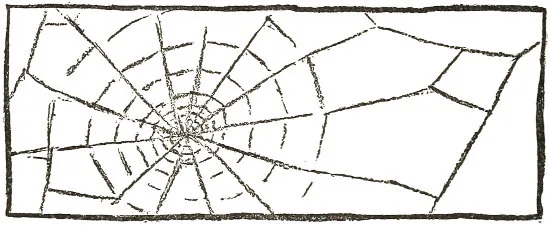
The time has come to weave the hunting-snare.いよいよ、狩りのわなを織る時です。 The Spider starts from the center, which bears the white signpost, and, running along the cross-thread, hurriedly reaches the circumference, that is to say, the irregular frame inclosing the free space.クモは、白い目じるしのあるまん中から出発し、横切っている糸を走って、大急ぎでまわりのふち、つまり、じゃまのない空間をかこむ形のふぞろいなわくまで行きます。 Still with the same sudden movement, she rushes from the outside to the center; she starts again backwards and forwards, makes for the right, the left, the top, the bottom; she hoists herself up, dives down, climbs up again, runs down and always returns to the central landmark by roads that slant in the most unexpected manner.そして同じようにいきなりの動きで、外がわからまん中へとかけもどります。また行ったり来たりして、右へ、左へ、上へ、下へと向かいます。体を引き上げ、とび下り、またよじのぼり、かけ下りて、思いがけないほどななめの道を通って、いつもまん中の目じるしにもどってくるのです。 Each time a radius or spoke is laid, here, there, or elsewhere, in what looks like mad disorder.そのたびに半径、つまりあみの「や」が一本、こちらに、あちらに、またほかの所にと、めちゃくちゃに見える順番で張られていきます。
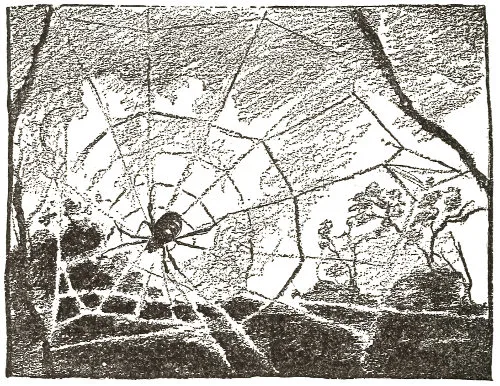
the Building of a Spider’s Web の挿絵((1919 edition))

Any one looking at the finished web, so neat and regular in appearance, would think that the Spider laid the spokes in an orderly fashion, one after the other.できあがった、きちんとして整ったあみを見た人は、クモが「や」を一本ずつ順番に、きちんと張っていったと思うでしょう。 She does nothing of the sort, but she knows what she is about, all the same.クモはそんなことはまったくしません。それでも、自分のしていることはちゃんとわかっているのです。 After setting a few spokes in one direction, the Spider runs across to the other side to draw some in the opposite direction.クモは、ある方向に「や」を何本か張ると、反対側へ走っていって、反対の方向にも何本か張ります。 These sudden changes have a reason; they show us how clever the Spider is in her business.このとつぜんの方向転かんには、わけがあります。クモが自分の仕事にどれほどりこうかを教えてくれるのです。 If she began by laying all the spokes on one side, she would pull the web out of shape or even destroy it.もし片側だけに「や」を全部張ることから始めたら、あみの形がくずれたり、こわれたりしてしまうでしょう。 She must put some on the other side to balance.つり合いをとるために、反対側にも張らなければならないのです。 She is a past mistress of the secrets of rope-building, without serving an apprenticeship.クモは、弟子入りして修業したこともないのに、綱を張るひみつをすっかり知っている名人なのです。

One would think that this interrupted and apparently disordered labor must result in a confused piece of work.とぎれとぎれで、ばらばらに見えるこの作業からは、ごちゃごちゃの作品ができるだろうと思うかもしれません。 Wrong: the rays are equidistant and form a beautifully regular circle.ところが、ちがいます。「や」は等しい間かくでならび、みごとに整った円になるのです。 Their number is a characteristic mark of the different species.「や」の数は、クモの種類ごとのとくちょうです。 The Angular Epeira places twenty-one in her web, the Banded Epeira thirty-two, the Silky Epeira forty-two.カドオニグモは自分のあみに二十一本、ナガコガネグモは三十二本、シロカネグモのなかまは四十二本の「や」を張ります。 These numbers are not absolutely fixed; but the variation is very slight.この数は、かならず決まっているわけではありませんが、ちがいはごくわずかです。

Now which of us would undertake, offhand, without much preliminary experiment and without measuring-instruments, to divide a circle into a given quantity of sectors or parts of equal width?さて、わたしたちのうちだれが、前もってたくさん試したり、はかる道具を使ったりせずに、いきなり円を決まった数の同じはばの部分に分けることができるでしょう? The Garden Spider, though weighted with a wallet and tottering on threads shaken by the wind, performs the delicate division without stopping to think.オニグモは、大きな腹をかかえ、風にゆれる糸の上でよろよろしながら、考えこむこともなく、このむずかしい分け方をやってのけます。 She achieves it by a method which seems mad according to our notions of geometry.しかも、わたしたちの幾何学の考えでは、めちゃくちゃに見えるやり方でなしとげるのです。 Out of disorder she brings order.でたらめの中から、きちんとした順序を生み出すのです。 We are amazed at the result obtained.その結果に、わたしたちはおどろかされます。 How does this Spider come to succeed with her difficult problem, so strangely managed?このクモは、こんなに不思議なやり方で、どうしてむずかしい問題をうまくとけるのでしょう? I am still asking myself the question.わたしは今でも、そのことを自分にたずねつづけています。

The laying of the radii or spokes is finished.半径、つまり「や」を張る仕事は終わりました。 The Spider takes her place in the center, on the little cushion.クモはまん中の小さなクッションの上に陣取ります。 Stationed on this support, she slowly turns round and round.このささえの上で、クモはゆっくりとぐるぐる回ります。 She is engaged on a delicate piece of work.クモは、細かい仕事に取りかかっているのです。 With an extremely thin thread, she describes from spoke to spoke, starting from the center, a spiral line with very close coils.とても細い糸で、まん中から始めて、「や」から「や」へと、まき目がとてもつまったうずまきをえがきます。 This is the center of the web.これがあみの中心です。 I will call it the “resting-floor.”わたしはここを「休み場」とよぶことにしましょう。

The thread now becomes thicker.ここから、糸は太くなります。 The first could hardly be seen; the second is plainly visible.最初の糸はほとんど見えませんでしたが、二番目の糸ははっきり見えます。 The Spider shifts her position with great slanting strides, turns a few times, moving farther and farther from the center, fixes her line each time to the spoke which she crosses, and at last comes to a stop at the lower edge of the frame.クモは大またでななめに進みながら位置をかえ、何回か回って、まん中からどんどんはなれていき、横切る「や」に毎回糸をとめて、とうとうわくの下のふちで止まります。 She has described a spiral with coils of rapidly-increasing width.まき目の間かくがどんどん広がっていくうずまきをえがいたのです。 The average distance between the coils, even in the webs of the young Spiders, is about one third of an inch.まき目とまき目の間かくは、若いクモのあみでも、平均して八ミリほどです。

This spiral is not a curved line.このうずまきは、曲線ではありません。 All curves are banished from the Spiders’ work; nothing is used but the straight line and its combinations.クモの仕事からは曲線はすべてしめ出されています。使うのは直線と、直線の組み合わせだけです。 This line forms the cross-bars, or supporting rungs, connecting the spokes, or radii.この線は、「や」と「や」をつなぐ横木、つまりささえのはしごの段になります。

All this is but a support for the snaring-web.これはすべて、えものをとるあみのささえにすぎません。 Clinging on the one hand to the radii, on the other to the cross-bars, the Spider covers the same ground as when laying the first spiral, but in the opposite direction: formerly, she moved away from the center; now she moves towards it and with closer and more numerous circles.クモは、一方では「や」に、もう一方では横木につかまりながら、最初のうずまきを張ったときと同じ所を、こんどは反対向きに進みます。前はまん中からはなれていきましたが、こんどはまん中に向かって、もっとつまった、もっとたくさんの輪をえがいていきます。 She starts from the end of the first spiral, near the outside of the web.クモは最初のうずまきの終わり、あみの外がわに近い所から始めます。

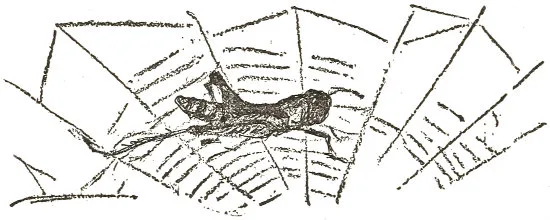
What follows is hard to observe, for the movements are very quick and jerky, consisting of a series of sudden little rushes, sways, and bends that bewilder the eye.ここからあとは観察するのがむずかしいのです。動きがとても速くて、ぎくしゃくしていて、小さくとっしんしたり、ゆれたり、曲がったりが次々につづき、目がまわってしまうからです。 The two hind-legs, the weaving implements, keep going constantly.機織りの道具である二本のうしろ足は、休みなく動きつづけます。 One draws out the thread from the spinneret, and passes it to the other, which lays it on the radius.一本が糸いぼから糸を引き出し、もう一本にわたします。わたされた足は、その糸を「や」の上に置きます。 As soon as the radius is touched, the thread sticks to it by its own glue.「や」にふれたとたん、糸は自分ののりで「や」にくっつきます。

the Building of a Spider’s Web の挿絵((1919 edition))

The Spider, without a stop of any kind, turns and turns and turns, drawing nearer to the center and always fixing her thread at each spoke which she crosses.クモは一度も止まらずに、ぐるぐるぐるぐる回り、まん中に近づきながら、横切る「や」ごとに、かならず糸をとめていきます。 At last, at some distance from the center, on the edge of what I have called the resting-floor, the Spider suddenly ends her spiral.とうとう、まん中から少しはなれた所、わたしが休み場とよんだ所のふちで、クモはいきなりうずまきを終わらせます。 She next eats the little cushion in the center, which is a mat of ends of saved silk.次に、クモはまん中の小さなクッションを食べます。それは、とっておいた糸のはしを集めたマットなのです。 She does this to economize silk, for after she has eaten it the cushion will be turned into silk for the next web she spins.糸をむだにしないためにそうするのです。食べてしまえば、そのクッションは次にあみを作るときの糸に変わるからです。

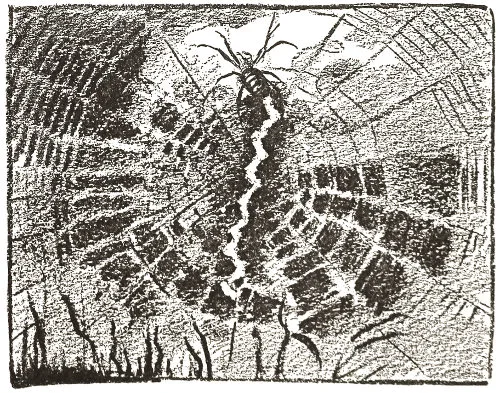
Two Spiders, the Banded and the Silky, sign their work by laying a broad white ribbon in a thick zigzag from the center to the lower edge of the web.ナガコガネグモとシロカネグモのなかまの二種類は、まん中からあみの下のふちまで、太いジグザグの白くて広いリボンをつけて、自分の作品にサインをします。 Sometimes they put a second band of the same shape, but a little shorter, opposite the first, on the upper part of the web.ときには、同じ形でもう少し短い二本目の帯を、一本目の反対側、あみの上の部分につけることもあります。

the Building of a Spider’s Web の挿絵((1919 edition))

THE STICKY SNAREねばねばのわな

The spiral part of the Garden Spider’s web is a wonderful contrivance.オニグモのあみのうずまきの部分は、すばらしい仕かけです。 The thread that forms it may be seen with the naked eye to be different from that of the framework and the spokes.これを作っている糸は、わくや「や」の糸とはちがうことが、肉眼でもわかります。 It glitters in the sun, and looks as though it were knotted.日の光にきらきら光り、結び目があるように見えます。 I cannot examine it through the microscope outdoors because the web shakes so, but by passing a sheet of glass under the web and lifting it I can take away a few pieces of thread to study.外ではあみがゆれるので、けんび鏡で調べることはできません。でも、ガラスの板をあみの下に入れて持ち上げると、糸を少し取ってきて調べることができます。 The microscope now shows me an astounding sight.けんび鏡で見ると、おどろくようなものが見えます。

Those threads, so slender as to be almost invisible, are very closely twisted twine, something like the gold cord of officers’ sword-knots.ほとんど見えないほど細いその糸は、とてもかたくよじり合わせたひもで、将校の刀のふさにつける金のひものようなのです。 Moreover, they are hollow.そのうえ、糸の中は空どうになっています。 They contain a sticky moisture resembling a strong solution of gum arabic.中には、こいアラビアゴムのとかし液ににた、ねばねばした液が入っています。 I can see it trickling from the broken ends.切れた所から、その液がしみ出てくるのが見えます。 This moisture must ooze through the threads, making them sticky.この液が糸の外へしみ出して、糸をねばねばにしているにちがいありません。 Indeed, they are sticky.本当に、糸はねばねばしています。 When I lay a straw flat upon them, it adheres at once.わらを糸の上に平らに置くと、すぐにくっつきます。 We see now that the Garden Spider hunts, not with springs, but with sticky snares that catch everything, down to the dandelion-plume that barely brushes against the web.これで、オニグモはばねで狩りをするのではなく、ねばねばのわなで狩りをすることがわかりました。そのわなは、あみにかすっただけのタンポポのわた毛まで、何でもつかまえてしまいます。 Nevertheless, the Spider herself is not caught in her own snare.それなのに、クモ自身は自分のわなにかかりません。 Why?なぜでしょう?

For one thing, she spends most of her time on her resting-floor in the middle of the web, which the spiral does not enter.一つには、クモはたいてい、あみのまん中の休み場ですごすからです。そこには、うずまきが入っていません。 The resting-floor is not at all sticky, as I find when I pass a straw against it.休み場がちっともねばらないことは、わらを当ててみるとわかります。 But sometimes when a victim is caught, perhaps right at the end of the web, the Spider has to rush up quickly to bind it and overcome its attempts to free itself.けれども、ときにはえものがかかったとき、それがあみのはしの所だったりすると、クモは急いでかけつけて、えものをしばり、にげようとするのをおさえなければなりません。 She seems to be able to walk upon her network perfectly well then.そんなときでも、クモは自分のあみの上を平気で歩けるようです。 Has she something on her feet which makes them slip over the glue?足に、のりの上をすべるようにする何かがついているのでしょうか? Has she perhaps oiled them?もしかして、足に油をぬっているのでしょうか? Oil, you know, is the best thing to prevent surfaces from sticking.知っていますね。物がくっつかないようにするには、油がいちばんです。

I pull out the leg of a live Spider and put it to soak for an hour in disulphide of carbon, which dissolves fat.わたしは、生きたクモから足を一本取り、油をとかすにりゅうかたんそというえきに一時間ひたします。 I wash it carefully with a brush dipped in the same fluid.同じ液にひたしたはけで、ていねいにあらいます。 When the washing is finished, the leg sticks to the spiral of the web!あらい終わると、その足はあみのうずまきにくっつくのです! We see now that the Spider varnishes herself with a special sweat so that she can go on any part of her web without difficulty.これで、クモは特別なあせで自分の体にニスをぬっていて、そのおかげであみのどこでも楽に歩けるのだとわかります。 However, she does not wish to remain on the spiral too long, or the oil might wear away, so most of the time she stays on her safe resting-floor.でも、うずまきの上に長くいすぎると油がすり切れてしまうかもしれないので、クモはたいてい安全な休み場にいるのです。

This spiral thread of the Spider’s is very quick to absorb moisture, as I find out by experiment.このクモのうずまきの糸は、とても早く水分をすいこみます。実験してみてわかりました。 For this reason the Garden Spiders, when they weave their webs in the early morning, leave that part of the work unfinished, if the air turns misty.そのため、オニグモは朝早くにあみを作るとき、きりが出てくると、その部分の仕事をやりかけのままにしておきます。 They build the general framework, they lay the spokes, they make the resting-floor, for all these parts are not affected by excess moisture; but they are very careful not to work at the sticky spiral, which, if soaked by the fog, would dissolve into sticky threads and lose its usefulness by being wet.わくを作り、「や」を張り、休み場を作ります。これらの部分は、水分が多すぎても困らないからです。けれども、ねばねばのうずまきには決して手をつけません。きりにぬれると、とけてねばねばの糸になり、しめって役に立たなくなってしまうからです。 The net that was started will be finished to-morrow, if the weather is right.作りかけのあみは、天気がよければ明日できあがるでしょう。 But on hot days this property of the spiral is a fine thing; it does not dry up, but absorbs all the moisture in the atmosphere and remains, at the most scorching times of day, supple, elastic, and more and more sticky.でも暑い日には、うずまきのこの性質がとても役に立ちます。かわいてしまわずに、空気の中の水分をすっかりすいこんで、一日でいちばん焼けつくように暑い時間にも、しなやかで、のびちぢみがきき、ますますねばねばしているのです。 What bird-catcher could compete with the Garden Spider in the art of laying snares?わなを仕かける腕前で、オニグモにかなう鳥とりがいるでしょうか? And all this industry and cunning for the capture of a Moth!しかも、これほどの働きとちえが、ガ一ぴきをつかまえるためなのです!

Then, too, what a passion the Spider has for production.それに、クモは、なんとねっしんにものを作るのでしょう! I calculated that, in one sitting, each time that she remakes her web, the Angular Spider produces some twenty yards of gummy thread.計算してみると、カドオニグモは、あみを作り直すたびに、一回で十八メートルほどのねばねばの糸を作り出します。 The more skillful Silky Spider produces thirty.もっと腕のいいシロカネグモのなかまは、二十七メートルも作ります。 Well, during two months, the Angular Spider, my neighbor, renewed her snare nearly every evening.さて、わたしのおとなりさんのカドオニグモは、二か月のあいだ、ほとんど毎晩わなを作り直しました。 During that time she manufactured something like three quarters of a mile of this tubular thread, rolled into a tight twist and bulging with glue.そのあいだに、かたくよじられ、のりでふくらんだこの管のような糸を、一キロメートル以上も作ったことになります。

We cannot but wonder how she ever carries so much in her little body, how she manages to twist her silk into this tube, how she fills it with glue!あの小さな体に、どうしてそんなにたくさんの糸を持っていられるのか、どうやって糸をよじって管にするのか、どうやってのりをつめるのか、ふしぎに思わずにはいられません! And how does she first turn out plain threads, then russet foam, for her nest, then black stripes to adorn the nest?それに、まずはふつうの糸を、それから巣のための赤茶色のふわふわを、さらに巣をかざる黒いしまを、どうやって作り分けるのでしょう? I see the results, but I cannot understand the working of her factory.できあがったものは見えても、その工場のしくみは、わたしにはわかりません。

the Building of a Spider’s Web の挿絵((1919 edition))

さいごまで よめたね!

「よめた!」をおすと、スタンプがもらえて おはなしの森 に木や動物がふえるよ。

PDFで印刷(A4 13まい)

おうちの方・大人の学習者へ
でたらめに見えて正確な円を等分するクモの技に注目。自分の糸にくっつかない理由は、今では足の毛のつくりや糸の上での動き方も関係していると考えられています。

出典台帳 — このページの「本物」の証明

英文
原文そのまま(1語も書きかえていません)。Project Gutenberg 電子書籍 #45812(J. Henri Fabre (adapted by Louise Seymour Hasbrouck)、1919年の本)
挿絵
(1919 edition)(同じ本の初版の挿絵。パブリックドメイン)
朗読
Michele Fry(LibriVox のボランティア。Insect Adventures「The Building of a Spider’s Web」)。録音はパブリックドメインで、元のファイルをそのまま使っています(音質を落とす加工なし)。
照合
朗読を音声認識(Whisper)で文字起こしし、原文と1語ずつ照らし合わせました。一致率 97.2%
文が光るタイミングはこの照合で決めています。
和訳
和訳はAIと人が作成。AIは3重チェック。人の目でも順次確認しています。英文には一切手を入れていません。