
 11分
 朗読 Patricia Oakley
 原文そのまま

 PDFで印刷(A4 9まい)
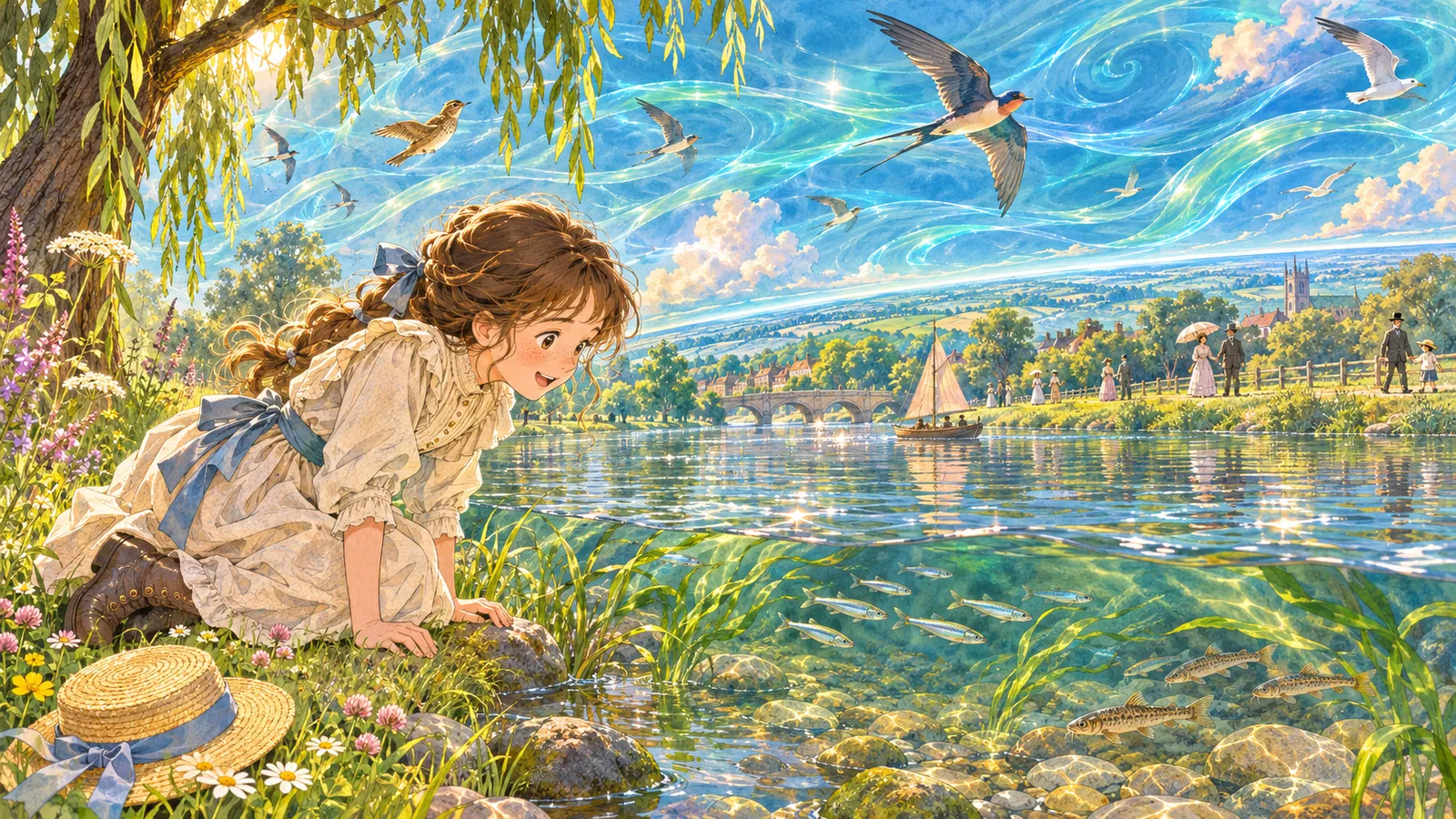
Did you ever sit on the bank of a river in some quiet spot where the water was deep and clear, and watch the fishes swimming lazily along?どこか静かな所で、水が深くすきとおっている川の岸にすわって、魚たちがのんびり泳いでいくのをながめたことはありますか。 When I was a child this was one of my favourite occupations in the summertime on the banks of the Thames, and there was one question which often puzzled me greatly, as I watched the minnows and gudgeon gliding along through the water.子どものころ、夏にテムズ川の岸でそうするのが、わたしの大好きなことのひとつでした。そして、ミノーやガジョン(どちらも小さな川魚)が水の中をすいすい泳いでいくのを見ながら、よくとてもふしぎに思った問いがひとつありました。 Why should fishes live in something and be often buffeted about by waves and currents, while I and others lived on the top of the earth and not in anything?魚は何かの中にすんでいて、よく波や流れにもまれているのに、わたしやほかの人たちは、どうして地面の上にすんでいて、何の中にもいないのだろう、と。 I do not remember ever asking anyone about this; and if I had, in those days people did not pay much attention to children's questions, and probably nobody would have told me, what I now tell you, that we do live in something quite as real and often quite as rough and stormy as the water in which the fishes swim.このことをだれかにたずねた覚えはありません。たとえたずねたとしても、そのころの人たちは子どもの質問にあまり耳をかさなかったので、たぶんだれも教えてはくれなかったでしょう。今わたしがみなさんに教えること、つまり、わたしたちも、魚が泳いでいる水と同じくらいほんものの、そしてよく同じくらいあれくるう何かの中にすんでいるのだ、ということを。 The something in which we live is air, and the reason that we do not perceive it, is that we are in it, and that it is a gas, and invisible to us; while we are above the water in which the fishes live, and it is a liquid which our eyes can perceive.わたしたちがすんでいる何かとは空気です。わたしたちがそれに気づかないのは、わたしたちがその中にいて、しかも空気は気体で目に見えないからです。いっぽう、わたしたちは魚がすむ水の上にいて、水は目に見える液体なのです。
But let us suppose for a moment that a being, whose eyes were so made that he could see gases as we see liquids, was looking down from a distance upon our earth.でも少しのあいだ、気体を、わたしたちが液体を見るように見ることのできる目をもった生き物が、遠くから地球を見下ろしていると考えてみましょう。 He would see an ocean of air, or aerial ocean, all round the globe, with birds floating about in it, and people walking along the bottom, just as we see fish gliding along the bottom of a river.その生き物には、地球をぐるりととりまく空気の海が見えるでしょう。わたしたちが川の底を魚がすいすい泳いでいくのを見るのと同じように、その中を鳥がただよい、人が底を歩いているのが見えるでしょう。 It is true, he would never see even the birds come near to the surface, for the highest- flying bird, the condor, never soars more than five miles from the ground, and our atmosphere, as we shall see, is at least 100 miles high.もっとも、鳥でさえ、海面の近くまでのぼってくるのは見られないでしょう。いちばん高く飛ぶ鳥のコンドルでさえ、地面から5マイル(約8キロメートル)より高くまいあがることはありませんが、わたしたちの大気は、あとで見るように、少なくとも100マイルの高さがあるのですから。 So he would call us all deep-air creatures, just as we talk of deep-sea animals; and if we can imagine that he fished in this air-ocean, and could pull one of us out of it into space, he would find that we should gasp and die just as fishes do when pulled out of the water.ですから、その生き物はわたしたちみんなを、わたしたちが「深海の動物」とよぶのと同じように、「深い空気の生き物」とよぶでしょう。そしてもし、その生き物がこの空気の海でつりをして、わたしたちのだれかを宇宙へつり上げることができたとしたら、魚が水からつり上げられたときと同じように、わたしたちがあえいで死んでしまうのを見ることでしょう。
He would also observe very curious things going on in our air- ocean; he would see large streams and currents of air, which we call winds, and which would appear to him as ocean-currents do to us, while near down to the earth he would see thick mists forming and then disappearing again, and these would be our clouds.その生き物には、わたしたちの空気の海で起こっている、とてもふしぎなことも見えるでしょう。わたしたちが風とよぶ、空気の大きな流れが見えて、それはその生き物には、海流がわたしたちに見えるのと同じように見えるでしょう。また地面の近くでは、こいきりができては消えるのが見えるでしょう。それがわたしたちの雲なのです。 From them he would see rain, hail and snow falling to the earth, and from time to time bright flashes would shoot across the air- ocean, which would be our lightning.雲からは雨やあられや雪が地面にふるのが見え、ときどき空気の海をまばゆい光がつっ走るのが見えるでしょう。それがわたしたちのいなずまです。 Nay even the brilliant rainbow, the northern aurora borealis, and the falling stars, which seem to us so high up in space, would be seen by him near to our earth, and all within the aerial ocean.それどころか、かがやくにじも、北のオーロラも、わたしたちにはずっと高い宇宙にあるように思える流れ星も、その生き物には地球のすぐ近くに、みな空気の海の中にあるように見えるでしょう。
But as we know of no such being living in space, who can tell us what takes place in our invisible air, and we cannot see it ourselves, we must try by experiments to see it with our imagination, though we cannot with our eyes.でも、宇宙にそんな生き物がすんでいて、目に見えない空気の中で何が起こっているかを教えてくれるという話は聞きませんし、わたしたち自身にも空気は見えません。ですから、目では見えなくても、実験によって、想像力で空気を見るようにしなければなりません。
First, then, can we discover what air is?では、まず、空気とは何なのかを見つけられるでしょうか。 At one time it was thought that it was a simple gas and could not be separated into more than one kind.昔は、空気は単純な気体で、二つ以上のしゅるいに分けることはできないと考えられていました。 But we are now going to make an experiment by which it has been shown that air is made of two gases mingled together, and that one of these gases, called oxygen, is used up when anything burns, while the other nitrogen is not used, and only serves to dilute the minute atoms of oxygen.でもこれから、空気が二つの気体がまざり合ってできていることを明らかにした実験をしてみましょう。その気体の一つは酸素とよばれ、何かがもえるときに使われます。もう一つのちっ素は使われず、酸素の小さな原子をうすめるはたらきをしているだけなのです。 I have here a glass bell-jar, with a cork fixed tightly in the neck, and I place the jar over a pan of water, while on the water floats a plate with a small piece of phosphorus upon it.ここに、首の所にコルクのせんをしっかりはめたガラスのつりがね形のびんがあります。このびんを、水を入れたなべの上にかぶせます。水の上には皿がうかんでいて、その上に小さなリンのかけらがのっています。 You will see that by putting the bell-jar over the water, I have shut in a certain quantity of air, and my object now is to use up the oxygen out of this air and leave only nitrogen behind.つりがね形のびんを水の上にかぶせたので、決まった量の空気がとじこめられたのがわかるでしょう。これからこの空気の中の酸素を使いきって、ちっ素だけを残そうというわけです。 To do this I must light the piece of phosphorus, for you will remember it is in burning that oxygen is used up.そのためには、リンのかけらに火をつけなければなりません。おぼえているでしょうが、酸素が使われるのは、ものがもえるときですから。 I will take the cork out, light the phosphorus, and cork up the jar again.コルクをぬいて、リンに火をつけ、またびんにコルクをはめます。 See! as the phosphorus burns white fumes fill the jar.ほら!リンがもえると、白いけむりがびんの中にいっぱいになります。 These fumes are phosphoric acid which is a substance made of phosphorous and the oxygen of the air together.このけむりはリン酸で、リンと空気中の酸素がいっしょになってできた物質です。
Now, phosphoric acid melts in water just as sugar does, and in a few minutes these fumes will disappear.さて、リン酸はさとうと同じように水にとけるので、数分もすれば、このけむりは消えてしまうでしょう。 They are beginning to melt already, and the water from the pan is rising up in the bell-jar.もうとけはじめていて、なべの水がつりがね形のびんの中をのぼってきています。 Why is this?これはなぜでしょう。 Consider for a moment what we have done.わたしたちがしたことを、少し考えてみましょう。 First, the jar was full of air, that is, of mixed oxygen and nitrogen; then the phosphorus used up the oxygen making white fumes; afterwards, the water sucked up these fumes; and so, in the jar now nitrogen is the only gas left, and the water has risen up to fill all the rest of the space that was once taken up with oxygen.はじめ、びんの中は空気、つまり酸素とちっ素のまざったものでいっぱいでした。次に、リンが酸素を使って白いけむりをつくりました。それから水がそのけむりをすいとりました。ですから、今びんの中に残っている気体はちっ素だけで、もとは酸素がしめていた残りの場所をすべてうめるように、水がのぼってきたのです。
We can easily prove that there is no oxygen now in the jar.今びんの中に酸素がないことは、かんたんにたしかめられます。 I take out the cork and let a lighted taper down into the gas.コルクをぬいて、火のついた細いろうそくを気体の中へ下ろしてみます。 If there were any oxygen the taper would burn, but you see it goes out directly proving that all the oxygen has been used up by the phosphorous.もし酸素が少しでもあれば、ろうそくはもえるはずです。でも、ほら、すぐに消えてしまいます。酸素がすっかりリンに使われてしまったしょうこです。 When this experiment is made very accurately, we find that for every pint of oxygen in air there are four pints of nitrogen, so that the active oxygen-atoms are scattered about, floating in the sleepy, inactive nitrogen.この実験をとても正確にすると、空気の中には、酸素1パイントにつきちっ素が4パイントあることがわかります。ですから、活発な酸素の原子は、ねむたげで、はたらかないちっ素の中に、ちらばってうかんでいるのです。
It is these oxygen-atoms which we use up when we breathe.わたしたちが息をするときに使うのは、この酸素の原子です。 If I had put a mouse under the bell-jar, instead of the phosphorus, the water would have risen just the same, because the mouse would have breathed in the oxygen and used it up in its body, joining it to carbon and making a bad gas, carbonic acid, which would also melt in the water, and when all the oxygen was used, the mouse would have died.もしリンのかわりにネズミをつりがね形のびんの中に入れていたら、水はやはり同じようにのぼってきたでしょう。ネズミが酸素をすいこんで、体の中で炭素とむすびつけて使い、悪い気体である炭酸ガス(二酸化炭素)をつくるからです。炭酸ガスもまた水にとけます。そして、酸素がすっかりなくなると、ネズミは死んでしまったでしょう。
Do you see now how foolish it is to live in rooms that are closely shut up, or to hide your head under the bedclothes when you sleep?これで、まどをぴったりしめきった部屋でくらしたり、ねるときにふとんの中に頭をかくしたりするのが、どんなにおろかなことか、わかったでしょう。 You use up all the oxygen-atoms, and then there are none left for you to breathe; and besides this, you send out of your mouth bad fumes, though you cannot see them, and these, when you breathe them in again, poison you and make you ill.酸素の原子をすっかり使ってしまうと、すうための酸素がひとつも残っていなくなります。そのうえ、目には見えなくても、口から悪いけむりを出していて、それをまたすいこむと、体に毒になって、病気になってしまうのです。
Perhaps you will say, If oxygen is so useful, why is not the air made entirely of it?もしかすると、酸素がそんなに役に立つのなら、どうして空気がぜんぶ酸素でできていないの、と言うかもしれませんね。 But think for a moment.でも、ちょっと考えてごらんなさい。 If there was such an immense quantity of oxygen, how fearfully fast everything would burn!もし酸素がそんなにものすごくたくさんあったら、何もかもがおそろしく速くもえてしまうでしょう! Our bodies would soon rise above fever heat from the quantity of oxygen we should take in, and all fires and lights would burn furiously.わたしたちの体は、すいこむ酸素の量のせいで、すぐに熱が出たときよりも熱くなってしまい、火や明かりはみなはげしくもえさかるでしょう。 In fact, a flame once lighted would spread so rapidly that no power on earth could stop it, and everything would be destroyed.じっさい、いったん火がつくと、あっというまに広がって、地球上のどんな力でも止められず、何もかもがほろぼされてしまうでしょう。 So the lazy nitrogen is very useful in keeping the oxygen-atoms apart; and we have time, even when a fire is very large and powerful, to put it out before it has drawn in more and more oxygen from the surrounding air.ですから、のんびり屋のちっ素は、酸素の原子をはなしておくのに、とても役に立っているのです。そのおかげで、火がとても大きくて強いときでも、まわりの空気からどんどん酸素を引きこんでしまう前に、消す時間があるのです。 Often, if you can shut a fire into a closed space, as in a closely-shut room or the hold of a ship, it will go out, because it has used up all the oxygen in the air.火をとじた場所、たとえばぴったりしめきった部屋や船のそこの荷物置き場にとじこめることができると、火は消えてしまうことがよくあります。空気の中の酸素をすっかり使ってしまうからです。
So, you see, we shall be right in picturing this invisible air all around us as a mixture of two gases.ですから、わたしたちのまわりの目に見えない空気を、二つの気体のまざったものとして心にえがくのは正しいのです。 But when we examine ordinary air very carefully, we find small quantities of other gases in it, besides oxygen and nitrogen.でも、ふつうの空気をとてもていねいに調べると、酸素とちっ素のほかに、ほかの気体も少しずつふくまれていることがわかります。 First, there is carbonic acid gas.まず、炭酸ガスがあります。 This is the bad gas which we give out of our mouths after we have burnt up the oxygen with the carbon of our bodies inside our lungs; and this carbonic acid is also given out from everything that burns.これは、わたしたちが肺の中で酸素を体の炭素ともやしたあとに、口から出す悪い気体です。この炭酸ガスは、もえるものからもすべて出てきます。 If only animals lived in the world, this gas would soon poison the air; but plants get hold of it, and in the sunshine they break it up again, as we shall see in Lecture VII, and use up the carbon, throwing the oxygen back into the air for us to use.もし世界に動物だけがすんでいたら、この気体はすぐに空気を毒にしてしまうでしょう。でも植物がそれをつかまえて、日の光の中でまた分解し(第7回の講義で見ます)、炭素を使って、酸素をわたしたちが使えるように空気の中へもどしてくれるのです。 Secondly, there are very small quantities of ammonia, or the gas which almost chokes you in smelling-salts, and which, when liquid is commonly called "spirits of hartshorn."第二に、ほんの少しのアンモニアがあります。気つけ薬のにおいをかぐと、むせそうになる、あの気体です。液体にしたものは、ふつう「ハーツホーン(シカの角)のエキス」とよばれています。 This ammonia is useful to plants, as we shall see by and by.このアンモニアは、あとで見るように、植物の役に立つのです。 Lastly, there is a great deal of water in the air, floating about as invisible vapour or water-dust, and this we shall speak of in the next lecture.最後に、空気の中にはたくさんの水があって、目に見えない水じょう気、つまり水のちりとしてただよっています。これについては次の講義でお話しします。 Still, all these gases and vapours in the atmosphere are in very small quantities, and the bulk of the air is composed of oxygen and nitrogen.それでも、大気の中のこうした気体や水じょう気はみなほんの少しで、空気の大部分は酸素とちっ素でできているのです。