

 PDF をダウンロード
Let's Look at Art!
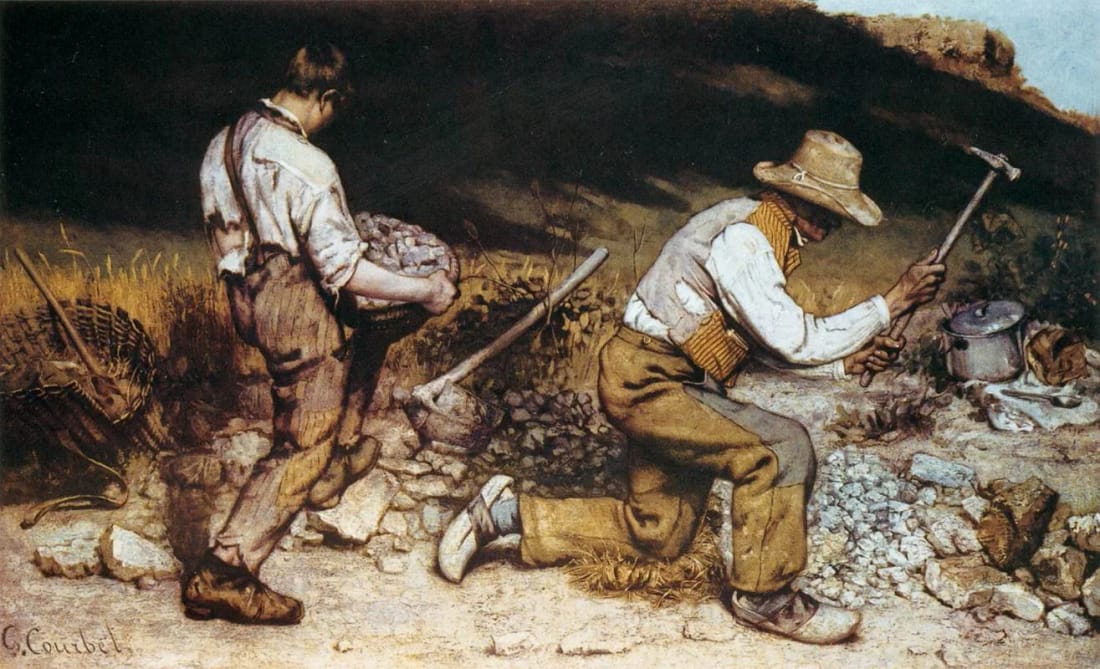
Title: The Stone Breakers
Artist: Gustave Courbet (1819–1877)
Year: 1849
Medium: Oil on canvas
Museum: Lost in World War II (formerly in the Dresden State Art Collections), Dresden (formerly)
1 Find it! 絵の中から見つけて、○でかこもう。
- ☐ The old man with a hammer
- ☐ The young man carrying stones
- ☐ A pot and bread
2 First look 最初に見たときの感想を書こう。
When I first saw this painting, I felt ______________ because ______________________.
Three colors I can see: ①__________ ②__________ ③__________
3 Words — Match them. 英語と日本語を線で結ぼう。
- labor ●
- break ●
- torn ●
- destroy ●
- ● 労働
- ● 破れた
- ● 割る・こわす
- ● 破壊する
The Stone Breakers
4 Fill in the blanks. 下の箱から選んで、( )に入れよう。形を変えるものもあります。
- The painting shows hard .
- The old man stones with a hammer.
- The young man wears a shirt.
- The painting was probably in 1945.
5 Read and answer — True or False? 英文を読んで、正しければ T、ちがえば F。
Two men work by a road. An old man breaks stones with a hammer. A young man carries a heavy basket. We cannot see their faces. Sadly, this painting was lost in a war.
By the side of a road, an old man raises his hammer to break stones, and a young man carries a heavy basket of rocks. We can hardly see their faces. Gustave Courbet painted it. It became a landmark of Realism, which showed real life as it is, not myths or heroes.
- Courbet used real road workers as models. T / F
- The two men are smiling at us. T / F
6 Quiz — Choose the best answer. 正しいものを選ぼう。
What happened to this painting?
- It is in a Paris museum
- It was lost during a war
- It is still in Courbet's house
- It was sent to the moon
The Stone Breakers
7 Put the words in order. 語を正しく並べかえて、文を書こう。
- We / from / see / young / see / man / face / the / so / cannot / behind, / we / his .
- road / workers / a / This / by / shows / two / painting .
8 Complete the description. 箱の語を(1)〜(4)に入れて、絵の説明を完成させよう。
This painting (1) two workers by a road. On the left, a young man is (2) a (3) of stones. On the right, an old man is (4). He is breaking stones with a hammer.
9 Describe the painting in English. この絵を英語で説明しよう(3文以上)。
10 Think & Talk 考えて、ペアやグループで話し合おう。
Why do you think Courbet did not show their faces?
Should everyday work be a subject for great art? Why?
11 My favorite part いちばん好きなところを英語で。
I like the ____________ because ____________________________.
Answers & Notes
1 Find it!
The old man with a hammer=ハンマーをふる老人/The young man carrying stones=石を運ぶ若者/A pot and bread=なべとパン
2 First look
自由に書けたら正解。I felt calm / surprised / happy … などの形容詞を使おう。
3 Words
1–a(labor=労働) 2–c(break=割る・こわす) 3–b(torn=破れた) 4–d(destroy=破壊する)
4 Fill in the blanks
- labor The painting shows hard labor.
この絵はつらい労働を描いています。 - breaks The old man breaks stones with a hammer.
老人はハンマーで石を割っています。 - torn The young man wears a torn shirt.
若者は破れたシャツを着ています。 - destroyed The painting was probably destroyed in 1945.
その絵は1945年に破壊されたと考えられています。
5 Read — T / F
【本文の訳】2人の男の人が道ばたで働いています。老人はハンマーで石を割っています。若者は重いかごを運んでいます。2人の顔は見えません。残念なことに、この絵は戦争で失われてしまいました。
【本文の訳】道ばたで、老人がハンマーをふり上げて石を割り、若者が重い石のかごを運んでいます。2人とも顔はほとんど見えません。描いたのはクールベ。神話や英雄ではなく、目の前の現実をありのままに描く「写実主義(リアリズム)」を代表する作品のひとつとなりました。
- T クールベは実際に道で働く人をモデルにした。
解説:道で見かけた2人に、アトリエでポーズをとってもらいました。 - F 絵の中の2人は、こちらを向いてほほえんでいる。
解説:2人とも顔はほとんど見えず、黙々と働いています。
6 Quiz
B 問:この絵は今どうなっている?
選択肢:A パリの美術館にある/B 戦争中に失われた/C クールベの家に残る/D 月に送られた
解説:1945年、第二次世界大戦中のドレスデンで失われたとされます。
7 Put the words in order
- We see the young man from behind, so we cannot see his face.
若者は後ろ姿なので、顔は見えません。 - This painting shows two workers by a road.
これは道ばたの2人の労働者を描いた絵です。
💡 from behind(後ろから・後ろ姿で):後ろ姿は from behind、横顔は in profile。人物の向きを説明するときに使い分けよう。
8 Complete the description
(1) shows (2) carrying (3) basket (4) kneeling
9 Describe(模範解答)
This painting shows two workers by a road. On the left, a young man is carrying a basket of stones. On the right, an old man is kneeling. He is breaking stones with a hammer.
これは道ばたの2人の労働者を描いた絵です。左では、若者が石のかごを運んでいます。右では、老人がひざをついています。ハンマーで石を割っています。
10 Think & Talk(問いの訳)
- Why do you think Courbet did not show their faces?
クールベはなぜ2人の顔を見せなかったのだと思いますか? - Should everyday work be a subject for great art? Why?
毎日の仕事は、すばらしい芸術の題材になると思いますか?なぜ?
正解のない問いです。理由をつけて話せたら◎。
Fun Fact(訳)
ほかの153点といっしょに消えた? 1945年2月、ドレスデンの空襲のとき、美術品を避難させていたトラックが爆撃され、この絵とほかの153点の絵が失われたと言われています。ただし、それより前から行方不明だったという研究者の説もあります。
