

 PDF をダウンロード
Let's Look at Art!
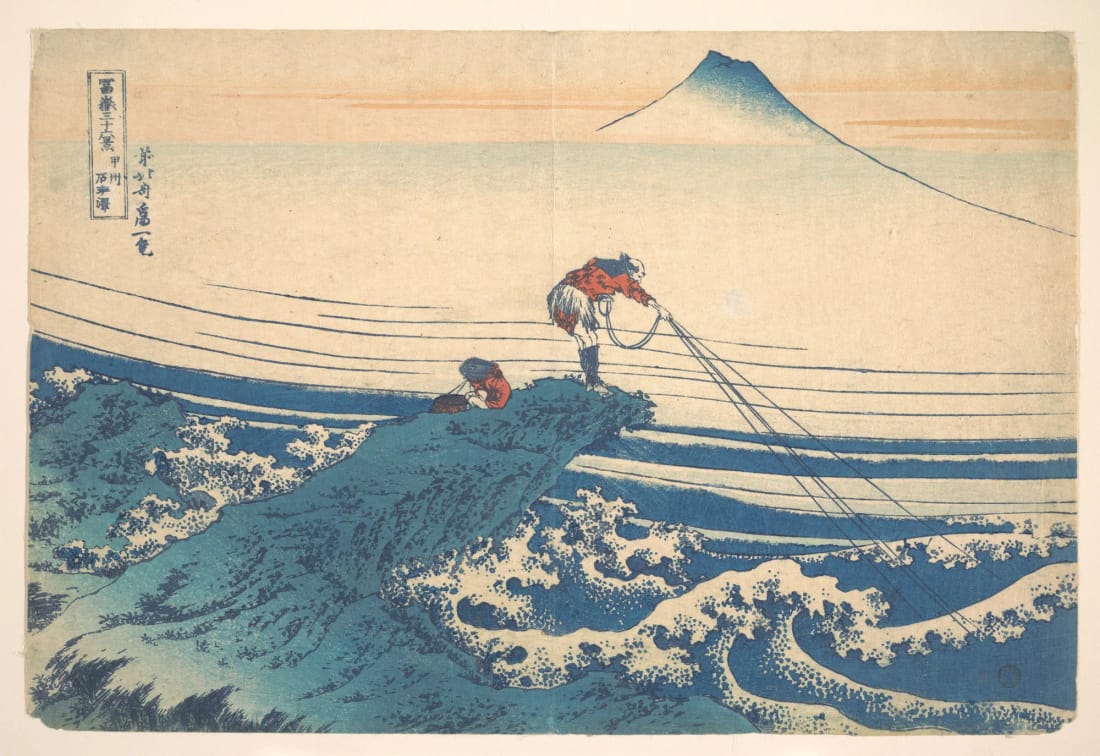
Title: Kajikazawa in Kai Province (Thirty-six Views of Mount Fuji)
Artist: Katsushika Hokusai (1760–1849)
Year: c. 1830–1832
Medium: Polychrome woodblock print; ink and color on paper
Museum: The Metropolitan Museum of Art, New York
1 Find it! 絵の中から見つけて、○でかこもう。
- ☐ The fisherman
- ☐ The child with a basket
- ☐ Mount Fuji
- ☐ Rough waves
2 First look 最初に見たときの感想を書こう。
When I first saw this painting, I felt ______________ because ______________________.
Three colors I can see: ①__________ ②__________ ③__________
3 Words — Match them. 英語と日本語を線で結ぼう。
- fisherman ●
- pull ●
- triangle ●
- rough ●
- ● 引く
- ● 漁師
- ● 三角形
- ● 荒れた
Kajikazawa in Kai Province (Thirty-six Views of Mount Fuji)
4 Fill in the blanks. 下の箱から選んで、( )に入れよう。形を変えるものもあります。
- A stands on the edge of a rock.
- He the lines of his net.
- The man and the mountain make the same .
- The river is and fast.
5 Read and answer — True or False? 英文を読んで、正しければ T、ちがえば F。
A fisherman stands on a rock. He pulls his fishing net. A child crouches behind him. Big waves are under the rock. Look at the man and the lines. They make a triangle, like Mount Fuji behind them!
On a rock sticking out over a rough river, a fisherman pulls the lines of his net. Behind him, a child crouches over a fish basket. Far away, Mount Fuji rises quietly above the clouds. This is from Hokusai's Thirty-six Views of Mount Fuji. It shows Kajikazawa in Kai Province, now Yamanashi Prefecture, a place known for the fast waters of the Fuji River.
- Thirty-six Views of Mount Fuji ended with exactly 36 prints. T / F
- Early prints of this design were made almost only in blue. T / F
6 Quiz — Choose the best answer. 正しいものを選ぼう。
What shape do the fisherman and his lines make?
- A circle
- A square
- A triangle
- A star
Kajikazawa in Kai Province (Thirty-six Views of Mount Fuji)
7 Put the words in order. 語を正しく並べかえて、文を書こう。
- pose / Fuji / of / The / Mount / echoes / shape / fisherman's / the .
- is / a / of / This / picture / mountain / and / a / river / a .
8 Complete the description. 箱の語を(1)〜(4)に入れて、絵の説明を完成させよう。
This is a picture of a river and a mountain. In the middle, a fisherman is (1) on a rock. He is (2) a net. There are big blue and (3) (4) below him. In the background, there is Mount Fuji.
9 Describe the painting in English. この絵を英語で説明しよう(3文以上)。
10 Think & Talk 考えて、ペアやグループで話し合おう。
Why do you think Hokusai put a tiny person and a big mountain in the same shape?
Which version do you like better, blue only or many colors? Why?
11 My favorite part いちばん好きなところを英語で。
I like the ____________ because ____________________________.
Answers & Notes
1 Find it!
The fisherman=網を引く漁師/The child with a basket=かごのそばの子ども/Mount Fuji=富士山/Rough waves=さかまく波
2 First look
自由に書けたら正解。I felt calm / surprised / happy … などの形容詞を使おう。
3 Words
1–b(fisherman=漁師) 2–a(pull=引く) 3–c(triangle=三角形) 4–d(rough=荒れた)
4 Fill in the blanks
- fisherman A fisherman stands on the edge of a rock.
漁師が岩のはしに立っています。 - pulls He pulls the lines of his net.
彼は網の綱を引いています。 - triangle The man and the mountain make the same triangle.
男と山が同じ三角形を作っています。 - rough The river is rough and fast.
川は荒れていて流れが速いです。
5 Read — T / F
【本文の訳】漁師が岩の上に立っています。漁の網を引いています。うしろには子どもがしゃがんでいます。岩の下には大きな波があります。男の人と網の綱を見てください。うしろの富士山と同じ三角形になっています!
【本文の訳】荒れた川の流れに突き出た岩の先で、漁師が網の綱を引いています。うしろでは、子どもが魚を入れるかごのそばにしゃがみこんでいます。遠くには、雲の上に静かにそびえる富士山。葛飾北斎の「冨嶽三十六景」の一枚で、甲斐の国(今の山梨県)の鰍沢(かじかざわ)を描いています。富士川の急流で知られる場所です。
- F 「冨嶽三十六景」は、ちょうど36枚で終わった。
解説:人気が出て10枚追加され、46枚になりました。 - T この絵の初期の摺りは、ほとんど藍色だけで摺られていた。
解説:「藍摺」とよばれる摺り方で、のちに色が加えられました。
6 Quiz
C 問:漁師の体と網の綱が作っている形は?
選択肢:A 円/B 四角形/C 三角形/D 星形
解説:奥の富士山と同じ三角形になっています。
7 Put the words in order
- The fisherman's pose echoes the shape of Mount Fuji.
漁師の姿は、富士山の形と響き合っています。 - This is a picture of a river and a mountain.
これは川と山の絵です。
💡 echo the shape of(〜の形と響き合う・〜の形をくり返す):echo は「こだま」。形や色をくり返して呼応させる構図の説明に使えます。
8 Complete the description
(1) standing (2) pulling (3) white (4) waves
9 Describe(模範解答)
This is a picture of a river and a mountain. In the middle, a fisherman is standing on a rock. He is pulling a net. There are big blue and white waves below him. In the background, there is Mount Fuji.
これは川と山の絵です。真ん中で、漁師が岩の上に立っています。彼は網を引いています。その下には、青と白の大きな波があります。奥には富士山があります。
10 Think & Talk(問いの訳)
- Why do you think Hokusai put a tiny person and a big mountain in the same shape?
北斎はなぜ、小さな人と大きな山を同じ形にしたのだと思いますか? - Which version do you like better, blue only or many colors? Why?
青一色の版と色の多い版、どちらが好きですか?なぜでしょう?
正解のない問いです。理由をつけて話せたら◎。
Fun Fact(訳)
最初は「ほぼ青一色」だった! この絵の初めのころの摺りは、ほとんどが藍色の濃い・うすいだけで摺られた「藍摺(あいずり)」でした。のちの摺りでは、漁師の服などに色が加えられました。この画像の摺りでも、漁師と子どもの服に赤が入っています。摺られた時期で印象ががらりと変わるのです。
