

 PDF をダウンロード
Let's Look at Art!
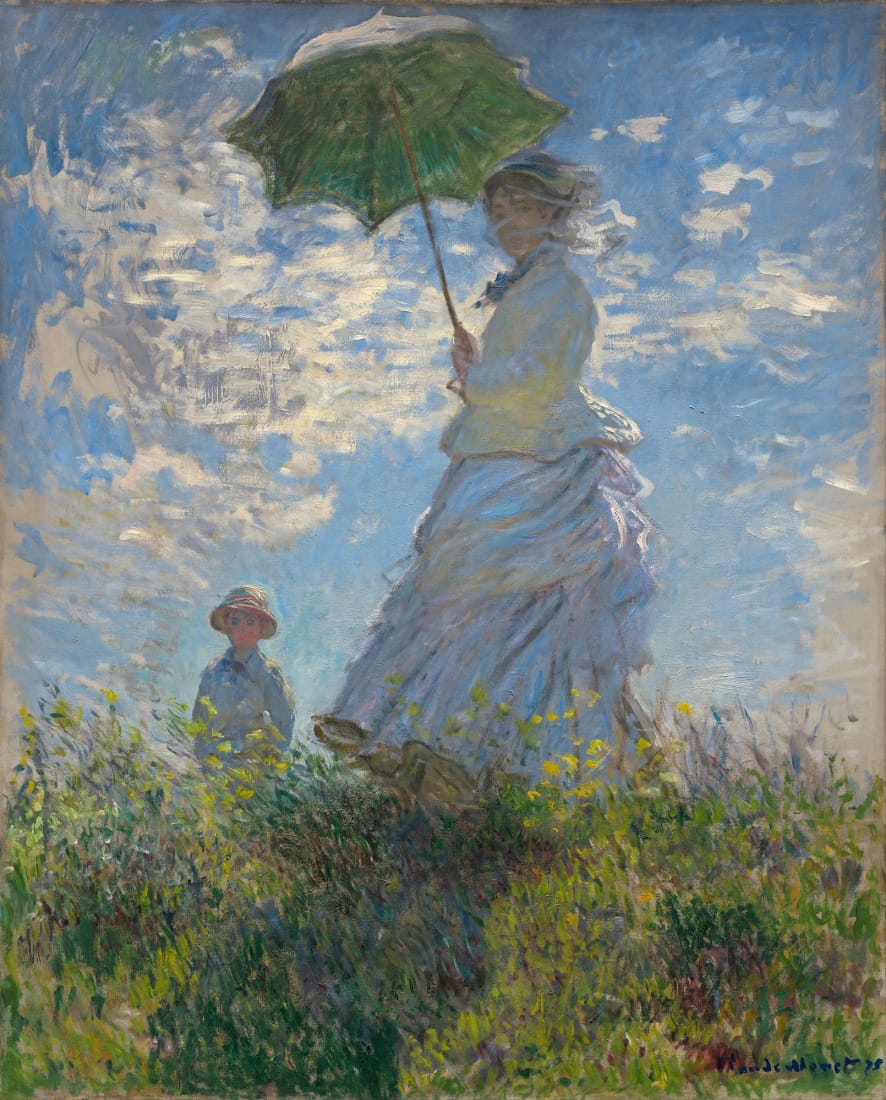
Title: Woman with a Parasol – Madame Monet and Her Son
Artist: Claude Monet (1840–1926)
Year: 1875
Medium: Oil on canvas
Museum: National Gallery of Art, Washington, D.C.
1 Find it! 絵の中から見つけて、○でかこもう。
- ☐ Green parasol
- ☐ Camille's face and veil
- ☐ Her son, Jean
- ☐ Grass in the wind
2 First look 最初に見たときの感想を書こう。
When I first saw this painting, I felt ______________ because ______________________.
Three colors I can see: ①__________ ②__________ ③__________
3 Words — Match them. 英語と日本語を線で結ぼう。
- parasol ●
- breezy ●
- veil ●
- blow ●
- ● ベール
- ● (風が)吹く、なびく
- ● 風のある、そよ風の吹く
- ● 日傘
Woman with a Parasol – Madame Monet and Her Son
4 Fill in the blanks. 下の箱から選んで、( )に入れよう。形を変えるものもあります。
- She is holding a green .
- It is a summer day.
- Her is blowing in the wind.
- The wind her dress to the side.
5 Read and answer — True or False? 英文を読んで、正しければ T、ちがえば F。
It is a windy summer day. A woman stands on a hill with a green parasol. She is Monet's wife, and the boy is their son. Look at her white dress. The shadows are blue and green, not black!
On a hill in summer, a woman in a white dress holds a green parasol and looks down at us. A little behind her stands a boy in a hat. The models are Monet's wife, Camille, and their son Jean, who was about seven or eight. Monet painted it in 1875, when the family lived in Argenteuil near Paris. They seem to be on a family walk.
- Monet painted the figures from a low angle. T / F
- The shadows on the dress are painted only in black. T / F
6 Quiz — Choose the best answer. 正しいものを選ぼう。
Who are the woman and the boy?
- Monet's sister and brother
- Monet's wife and son
- A neighbor and her son
- A French queen and prince
Woman with a Parasol – Madame Monet and Her Son
7 Put the words in order. 語を正しく並べかえて、文を書こう。
- wife / a / painted / Monet / sky / low / his / the / angle, / from / against .
- a / on / This / a / on / takes / scene / place / sunny / hill / day .
8 Complete the description. 箱の語を(1)〜(4)に入れて、絵の説明を完成させよう。
This scene (1) place on a hill on a sunny day. In the middle, a woman in a white dress is (2) a (3) parasol. On the left, there is a little boy in a hat. The sky is blue with (4) clouds, and the grass is moving in the wind.
9 Describe the painting in English. この絵を英語で説明しよう(3文以上)。
10 Think & Talk 考えて、ペアやグループで話し合おう。
What do you think the woman is saying to the painter?
How can a painter show the wind in a picture?
11 My favorite part いちばん好きなところを英語で。
I like the ____________ because ____________________________.
Answers & Notes
1 Find it!
Green parasol=緑の日傘/Camille's face and veil=カミーユの顔とベール/Her son, Jean=息子ジャン/Grass in the wind=風にゆれる草花
2 First look
自由に書けたら正解。I felt calm / surprised / happy … などの形容詞を使おう。
3 Words
1–d(parasol=日傘) 2–c(breezy=風のある、そよ風の吹く) 3–a(veil=ベール) 4–b(blow=(風が)吹く、なびく)
4 Fill in the blanks
- parasol She is holding a green parasol.
彼女は緑の日傘をさしている。 - breezy It is a breezy summer day.
風のある夏の日だ。 - veil Her veil is blowing in the wind.
彼女のベールが風になびいている。 - blows The wind blows her dress to the side.
風が彼女のドレスを横になびかせる。
5 Read — T / F
【本文の訳】風のある夏の日です。女の人が緑の日傘をさして丘の上に立っています。彼女はモネの妻で、男の子はモネ夫妻の息子です。白いドレスを見てください。影は黒ではなく、青や緑なのです!
【本文の訳】夏の丘の上で、白いドレスの女性が緑の日傘をさしてこちらを見下ろしています。少し後ろには帽子をかぶった男の子。モデルはモネの妻カミーユと、7〜8歳ごろの息子ジャンです。パリ近郊のアルジャントゥイユに住んでいたころ、1875年に描かれました。家族で散歩をしている途中のようです。
- T モネは人物を、下から見上げる角度で描いた。
解説:見上げる角度にしたことで、人物が青空の前に大きく立っています。 - F ドレスの影は、黒い絵の具だけで描かれている。
解説:青や緑、紫、黄色がまじっています。影にも色があるのです。
6 Quiz
B 問:この絵の女性と男の子はだれ?
選択肢:A モネの姉と弟/B モネの妻と息子/C 近所の親子/D フランスの王妃と王子
解説:モネの妻カミーユと、息子のジャンです。
7 Put the words in order
- Monet painted his wife from a low angle, against the sky.
モネは妻を、空を背に下から見上げる角度で描きました。 - This scene takes place on a hill on a sunny day.
これは晴れた日の丘の上の場面です。
💡 from a low angle(下から見上げる角度で):カメラや絵の「視点」を説明する表現。上から見下ろすなら from a high angle。
8 Complete the description
(1) takes (2) holding (3) green (4) white
9 Describe(模範解答)
This scene takes place on a hill on a sunny day. In the middle, a woman in a white dress is holding a green parasol. On the left, there is a little boy in a hat. The sky is blue with white clouds, and the grass is moving in the wind.
これは晴れた日の丘の上の場面です。真ん中で、白いドレスの女性が緑の日傘をさしています。左側には帽子をかぶった小さな男の子がいます。空は青く白い雲があり、草が風にゆれています。
10 Think & Talk(問いの訳)
- What do you think the woman is saying to the painter?
女性は画家に何と言っていると思いますか? - How can a painter show the wind in a picture?
画家は、目に見えない風をどうやって絵に描けるでしょう?
正解のない問いです。理由をつけて話せたら◎。
Fun Fact(訳)
11年後の「日傘の女」には顔がない!? 1886年、モネはのちに義理の娘となるシュザンヌをモデルに、左向き・右向きの2枚の『日傘の女』を描きました(オルセー美術館)。どちらも顔はほとんど描かれず、目も口もはっきりしません。人物より光と風を描こうとしたからだと考えられています。
