

 PDF をダウンロード
Let's Look at Art!
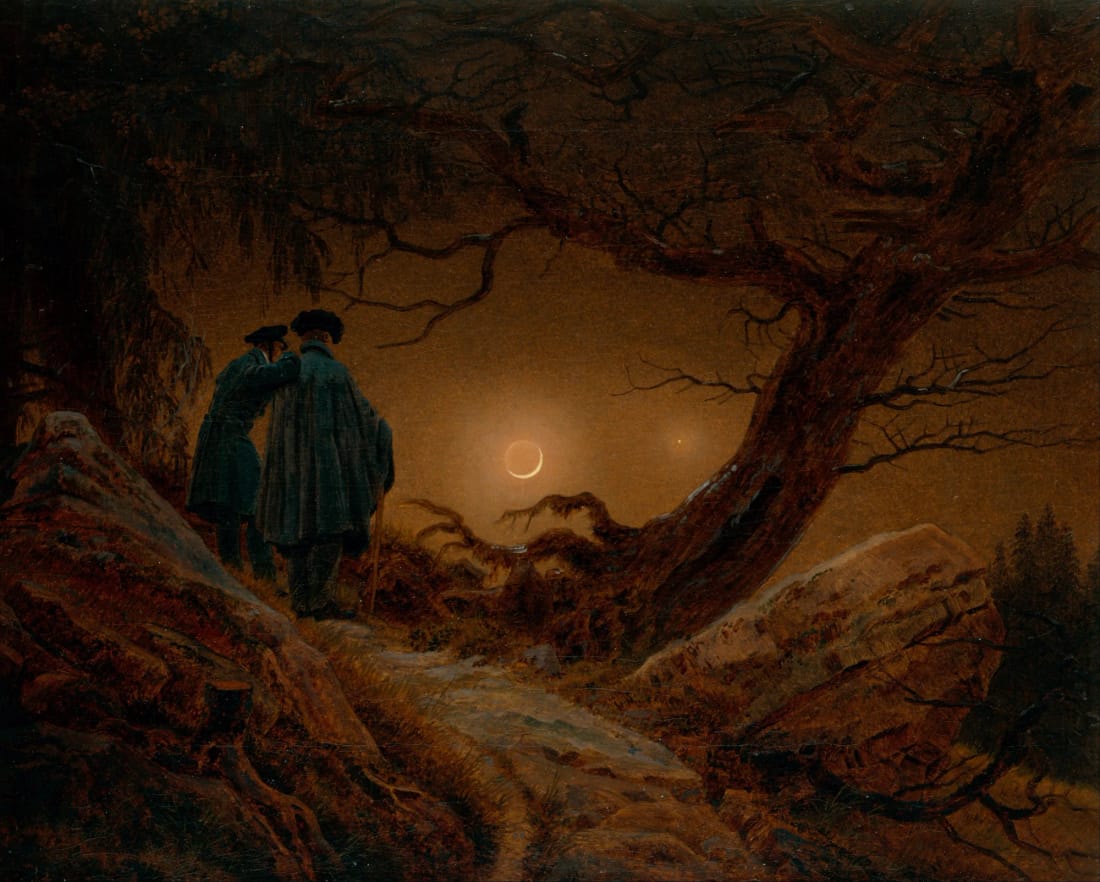
Title: Two Men Contemplating the Moon
Artist: Caspar David Friedrich (1774–1840)
Year: 1819–1820
Medium: Oil on canvas
Museum: Galerie Neue Meister, Staatliche Kunstsammlungen Dresden, Dresden
1 Find it! 絵の中から見つけて、○でかこもう。
- ☐ Crescent moon
- ☐ The two men
- ☐ The oak tree
- ☐ A bright star
2 First look 最初に見たときの感想を書こう。
When I first saw this painting, I felt ______________ because ______________________.
Three colors I can see: ①__________ ②__________ ③__________
3 Words — Match them. 英語と日本語を線で結ぼう。
- crescent ●
- contemplate ●
- mysterious ●
- branch ●
- ● じっくり考えながら見る
- ● 三日月
- ● なぞめいた・神秘的な
- ● 枝
Two Men Contemplating the Moon
4 Fill in the blanks. 下の箱から選んで、( )に入れよう。形を変えるものもあります。
- A moon shines in the sky.
- The two men the moon.
- The evening light feels .
- The look like arms.
5 Read and answer — True or False? 英文を読んで、正しければ T、ちがえば F。
Two men stand on a rocky path. We see only their backs. They look at a thin moon. A big old tree is next to them. It is very quiet.
On a rocky path at dusk, two men stand close together and look at a thin crescent moon. An oak tree with bare roots frames the moon like a window. The German Romantic painter Friedrich painted this small picture in 1819–1820. It is in the Galerie Neue Meister in Dresden.
- The two men's faces are clearly painted. T / F
- Friedrich painted other pictures with a similar design. T / F
6 Quiz — Choose the best answer. 正しいものを選ぼう。
Which play's author is said to have named this painting as a source?
- Romeo and Juliet
- Hamlet
- Waiting for Godot
- Peter Pan
Two Men Contemplating the Moon
7 Put the words in order. 語を正しく並べかえて、文を書こう。
- are / gazing / at / men / the / moon / Two / together .
- Two / rocky / path / are / standing / on / a / men .
8 Complete the description. 箱の語を(1)〜(4)に入れて、絵の説明を完成させよう。
Two men are (1) on a rocky path. We can only see their backs. They are looking at a thin (2) moon. On the (3), there is a big old tree with twisted (4).
9 Describe the painting in English. この絵を英語で説明しよう(3文以上)。
10 Think & Talk 考えて、ペアやグループで話し合おう。
What do you think the two men are talking about?
Why do you think Friedrich did not show their faces?
11 My favorite part いちばん好きなところを英語で。
I like the ____________ because ____________________________.
Answers & Notes
1 Find it!
Crescent moon=三日月/The two men=二人の男/The oak tree=カシの木/A bright star=明るい星
2 First look
自由に書けたら正解。I felt calm / surprised / happy … などの形容詞を使おう。
3 Words
1–b(crescent=三日月) 2–a(contemplate=じっくり考えながら見る) 3–c(mysterious=なぞめいた・神秘的な) 4–d(branch=枝)
4 Fill in the blanks
- crescent A crescent moon shines in the sky.
空に三日月が光っています。 - contemplate The two men contemplate the moon.
二人の男が月をじっとながめています。 - mysterious The evening light feels mysterious.
夕方の光は神秘的に感じられます。 - branches The branches look like arms.
枝はまるで腕のように見えます。
5 Read — T / F
【本文の訳】二人の男が岩の多い道に立っています。背中しか見えません。二人は細い月を見ています。そばには大きな古い木。とても静かです。
【本文の訳】夕暮れの岩の多い道で、二人の男が肩をよせ合い、細い三日月をながめています。根がむき出しのカシの木が、窓わくのように月を囲みます。ドイツ・ロマン主義の画家フリードリヒが1819〜20年に描いた小さな絵で、ドレスデンのノイエ・マイスター絵画館にあります。
- F 二人の男の顔がはっきり描かれている。
解説:二人とも後ろ姿で、顔は見えません。 - T フリードリヒは、似た構図の絵をほかにも描いている。
解説:男女で月を見る版(ベルリン)や、メトロポリタン美術館の版があります。
6 Quiz
C 問:この絵がもとになったと、作者が語ったと伝えられる劇は?
選択肢:A 『ロミオとジュリエット』/B 『ハムレット』/C 『ゴドーを待ちながら』/D 『ピーター・パン』
解説:サミュエル・ベケットが、この絵が『ゴドーを待ちながら』のもとだと語ったと伝えられます。
7 Put the words in order
- Two men are gazing at the moon together.
二人の男が、いっしょに月をじっと見つめています。 - Two men are standing on a rocky path.
二人の男が岩の多い道に立っています。
💡 gaze at(〜をじっと見つめる):gaze at は「じっと見つめる」。look at より長く、心をこめて見る感じです。
8 Complete the description
(1) standing (2) crescent (3) right (4) branches
9 Describe(模範解答)
Two men are standing on a rocky path. We can only see their backs. They are looking at a thin crescent moon. On the right, there is a big old tree with twisted branches.
二人の男が岩の多い道に立っています。背中しか見えません。二人は細い三日月を見ています。右には、ねじれた枝の大きな古い木があります。
10 Think & Talk(問いの訳)
- What do you think the two men are talking about?
二人の男は何を話していると思いますか? - Why do you think Friedrich did not show their faces?
フリードリヒはなぜ、二人の顔を見せなかったのだと思いますか?
正解のない問いです。理由をつけて話せたら◎。
Fun Fact(訳)
『ゴドーを待ちながら』のもと!? 劇作家ベケットは1937年にドレスデンでこの絵を見ています。のちにベルリンで、よく似た『月を眺める男と女』の前で「これがゴドーのもとだ」と語ったと伝えられ、どちらの絵を指したかは説が分かれます。
