

 PDF をダウンロード
Let's Look at Art!
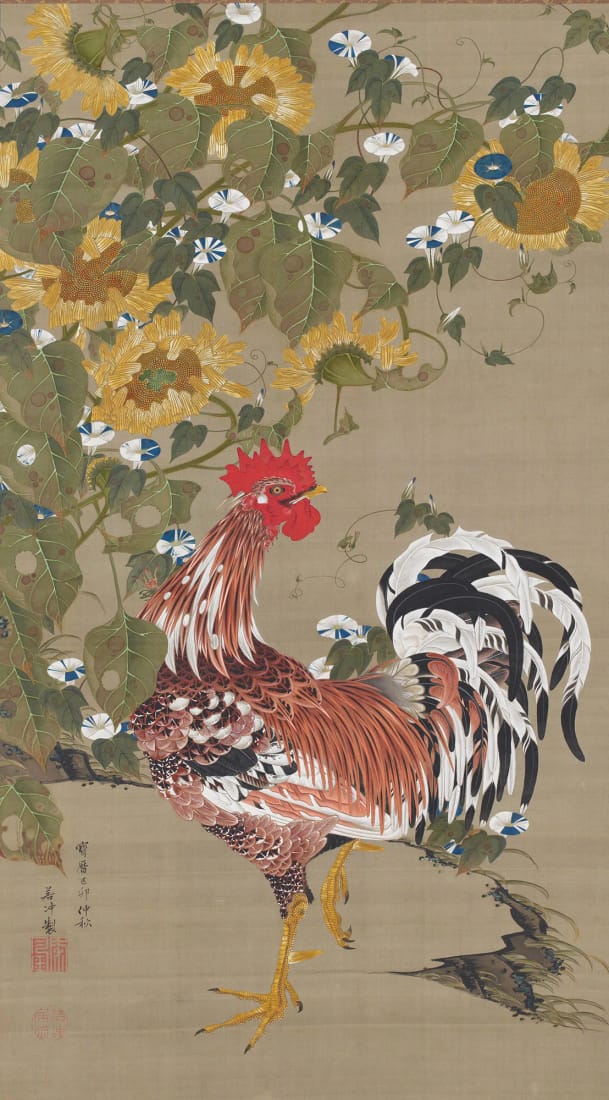
Title: Rooster and Sunflowers, from Colorful Realm of Living Beings
Artist: Itō Jakuchū (1716–1800)
Year: 1759
Medium: Hanging scroll (one of 30); color on silk
Museum: The Museum of the Imperial Collections, Sannomaru Shōzōkan, Tokyo
1 Find it! 絵の中から見つけて、○でかこもう。
- ☐ The bright red comb
- ☐ Black-and-white tail
- ☐ A sunflower
- ☐ A morning glory
2 First look 最初に見たときの感想を書こう。
When I first saw this painting, I felt ______________ because ______________________.
Three colors I can see: ①__________ ②__________ ③__________
3 Words — Match them. 英語と日本語を線で結ぼう。
- rooster ●
- sunflower ●
- proud ●
- bloom ●
- ● 誇らしげな・堂々とした
- ● ヒマワリ
- ● オンドリ
- ● 花が咲く
Rooster and Sunflowers, from Colorful Realm of Living Beings
4 Fill in the blanks. 下の箱から選んで、( )に入れよう。形を変えるものもあります。
- A proud stands under the flowers.
- were still rare in Jakuchū's time.
- The rooster looks of its long tail.
- Morning glories early in the day.
5 Read and answer — True or False? 英文を読んで、正しければ T、ちがえば F。
This is a summer garden. A big rooster stands under sunflowers. It has a red comb and a long tail. Look at the leaves. They have holes, like bugs ate them!
This painting shows a rooster standing under sunflowers and morning glories in a summer garden. It is one of the thirty scrolls of Itō Jakuchū's 'Colorful Realm of Living Beings,' dated autumn 1759. The red comb, the long black-and-white tail and the raised foot are all painted in fine detail. It is now in the Museum of the Imperial Collections, Sannomaru Shōzōkan.
- Sunflowers are native to Japan. T / F
- This painting shows leaves with holes, as if eaten by insects. T / F
6 Quiz — Choose the best answer. 正しいものを選ぼう。
How many of the thirty scrolls star chickens?
- One
- Three
- Eight
- All thirty
Rooster and Sunflowers, from Colorful Realm of Living Beings
7 Put the words in order. 語を正しく並べかえて、文を書こう。
- in / are / the / above / full / rooster / The / sunflowers / bloom .
- This / summer / a / is / garden .
8 Complete the description. 箱の語を(1)〜(4)に入れて、絵の説明を完成させよう。
This is a (1) garden. At the top, there are big yellow sunflowers and blue (2) (3). In the lower part, a (4) is standing proudly. It has a red comb and a long black-and-white tail.
9 Describe the painting in English. この絵を英語で説明しよう(3文以上)。
10 Think & Talk 考えて、ペアやグループで話し合おう。
Why do you think Jakuchū painted leaves with holes?
What sound do you think this rooster is making?
11 My favorite part いちばん好きなところを英語で。
I like the ____________ because ____________________________.
Answers & Notes
1 Find it!
The bright red comb=真っ赤なトサカ/Black-and-white tail=白と黒の尾羽/A sunflower=ヒマワリ/A morning glory=アサガオ
2 First look
自由に書けたら正解。I felt calm / surprised / happy … などの形容詞を使おう。
3 Words
1–c(rooster=オンドリ) 2–b(sunflower=ヒマワリ) 3–a(proud=誇らしげな・堂々とした) 4–d(bloom=花が咲く)
4 Fill in the blanks
- rooster A proud rooster stands under the flowers.
堂々としたオンドリが花の下に立っています。 - Sunflowers Sunflowers were still rare in Jakuchū's time.
若冲のころ、ヒマワリはまだめずらしい花でした。 - proud The rooster looks proud of its long tail.
オンドリは長い尾羽が自慢そうです。 - bloom Morning glories bloom early in the day.
アサガオは朝早くに咲きます。
5 Read — T / F
【本文の訳】これは夏の庭です。大きなオンドリがヒマワリの下に立っています。赤いトサカと長い尾羽があります。葉っぱを見てください。虫が食べたような穴があります!
【本文の訳】夏の庭で、ヒマワリとアサガオの下に立つオンドリを描いた絵です。伊藤若冲の『動植綵絵』30幅のうちの1幅で、絵の中に1759年(宝暦9年)秋の年記があります。赤いトサカ、白と黒の長い尾羽、片足を上げたポーズまで、細かく描きこまれています。今は皇居三の丸尚蔵館にあります。
- F ヒマワリは日本生まれの花だ。
解説:北アメリカ生まれで、日本には江戸時代の前半に伝わりました。 - T この絵には、虫に食われたような穴のある葉も描かれている。
解説:葉の穴やしみまで、若冲は細かく描いています。
6 Quiz
C 問:動植綵絵30幅のうち、ニワトリが主役の絵はいくつ?
選択肢:A 1幅/B 3幅/C 8幅/D 30幅すべて
解説:8幅あります。若冲はニワトリをとくに好んで描きました。
7 Put the words in order
- The sunflowers are in full bloom above the rooster.
オンドリの上で、ヒマワリが満開です。 - This is a summer garden.
これは夏の庭です。
💡 is in full bloom(満開である):in full bloom で「満開」。花の絵を説明するときの定番表現です。
8 Complete the description
(1) summer (2) morning (3) glories (4) rooster
9 Describe(模範解答)
This is a summer garden. At the top, there are big yellow sunflowers and blue morning glories. In the lower part, a rooster is standing proudly. It has a red comb and a long black-and-white tail.
これは夏の庭です。上のほうには、大きな黄色いヒマワリと青いアサガオがあります。下のほうでは、オンドリが堂々と立っています。赤いトサカと、白と黒の長い尾羽があります。
10 Think & Talk(問いの訳)
- Why do you think Jakuchū painted leaves with holes?
若冲はなぜ、穴のあいた葉を描いたのだと思いますか? - What sound do you think this rooster is making?
このオンドリは、どんな声で鳴いていると思いますか?
正解のない問いです。理由をつけて話せたら◎。
Fun Fact(訳)
ニワトリが主役の絵は8幅 動植綵絵の題名を見ると、「群鶏図」「南天雄鶏図」「紫陽花双鶏図」など、ニワトリが主役の絵が8幅あります。30幅の4分の1以上です。ニワトリは、若冲がとくに好んでくり返し描いた生きものでした。
