

 PDF をダウンロード
Let's Look at Art!
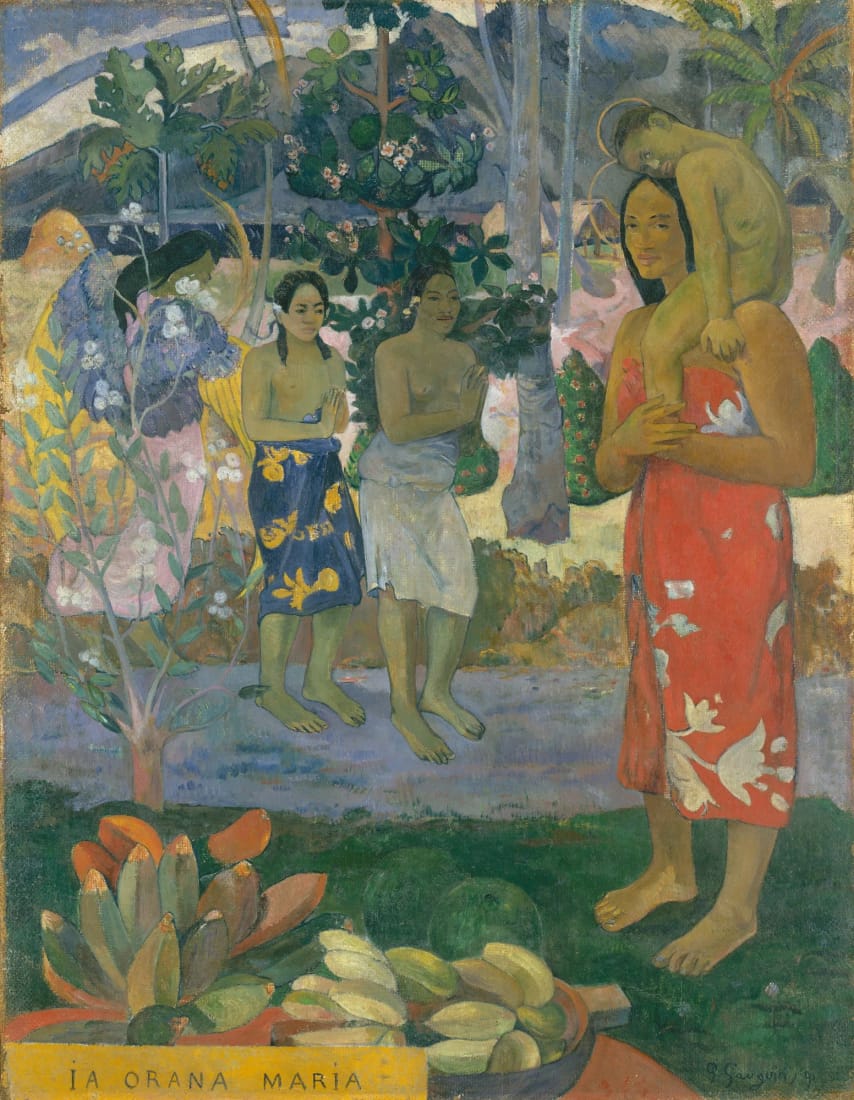
Title: Ia Orana Maria (Hail Mary)
Artist: Paul Gauguin (1848–1903)
Year: 1891
Medium: Oil on canvas
Museum: The Metropolitan Museum of Art, New York
1 Find it! 絵の中から見つけて、○でかこもう。
- ☐ Mother and child with halos
- ☐ The angel with yellow wings
- ☐ Two women praying
- ☐ Offered fruit
2 First look 最初に見たときの感想を書こう。
When I first saw this painting, I felt ______________ because ______________________.
Three colors I can see: ①__________ ②__________ ③__________
3 Words — Match them. 英語と日本語を線で結ぼう。
- halo ●
- angel ●
- greet ●
- offer ●
- ● 供える・差し出す
- ● 光の輪
- ● あいさつする
- ● 天使
Ia Orana Maria (Hail Mary)
4 Fill in the blanks. 下の箱から選んで、( )に入れよう。形を変えるものもあります。
- There is a around the child's head.
- An with yellow wings stands on the left.
- In Tahiti, people each other with 'Ia orana.'
- Fruit is in front of them.
5 Read and answer — True or False? 英文を読んで、正しければ T、ちがえば F。
A mother carries her child on her shoulder. They have golden halos behind their heads. They are Mary and Jesus, but they look like people from Tahiti. 'Ia orana' means 'hello' in Tahiti.
A woman wrapped in red cloth stands with a child on her shoulder. Behind their heads are halos. Gauguin painted the Virgin Mary and the child Jesus as a Tahitian mother and child. On the left is an angel with yellow wings, and in the center, two women put their hands together. Gauguin painted it in 1891, and it is now in the Metropolitan Museum of Art in New York.
- The title is 'Hail Mary' in the Tahitian language. T / F
- This painting never sold, and Gauguin kept it all his life. T / F
6 Quiz — Choose the best answer. 正しいものを選ぼう。
Where did the praying pose of the two women come from?
- A Japanese print
- An Egyptian wall painting
- Stained glass in Paris
- Carvings at a Buddhist temple in Java
Ia Orana Maria (Hail Mary)
7 Put the words in order. 語を正しく並べかえて、文を書こう。
- shoulder / on / child / mother / her / The / her / carries .
- Tahiti / in / scene / This / is / a .
8 Complete the description. 箱の語を(1)〜(4)に入れて、絵の説明を完成させよう。
This is a (1) in Tahiti. On the right, a (2) in a red cloth is carrying a child on her shoulder. In the middle, two women are (3) their hands together. In the foreground, there are bananas and other (4).
9 Describe the painting in English. この絵を英語で説明しよう(3文以上)。
10 Think & Talk 考えて、ペアやグループで話し合おう。
Why do you think Gauguin painted Mary and Jesus as Tahitian people?
How might Tahitian people of that time have felt about this picture?
11 My favorite part いちばん好きなところを英語で。
I like the ____________ because ____________________________.
Answers & Notes
1 Find it!
Mother and child with halos=光の輪の母子/The angel with yellow wings=黄色い羽の天使/Two women praying=手を合わせる二人/Offered fruit=供えられた果物
2 First look
自由に書けたら正解。I felt calm / surprised / happy … などの形容詞を使おう。
3 Words
1–b(halo=光の輪) 2–d(angel=天使) 3–c(greet=あいさつする) 4–a(offer=供える・差し出す)
4 Fill in the blanks
- halo There is a halo around the child's head.
子どもの頭のまわりに光の輪があります。 - angel An angel with yellow wings stands on the left.
左に黄色い羽の天使が立っています。 - greet In Tahiti, people greet each other with 'Ia orana.'
タヒチでは「イア・オラナ」とあいさつします。 - offered Fruit is offered in front of them.
彼らの前に果物が供えられています。
5 Read — T / F
【本文の訳】お母さんが子どもを肩にのせています。二人の頭のうしろには金色の輪があります。マリアとイエスですが、タヒチの人の姿をしています。「イア・オラナ」はタヒチの言葉で「こんにちは」という意味です。
【本文の訳】赤い布を巻いた女性が、子どもを肩にのせて立っています。二人の頭のうしろには光の輪。キリスト教の聖母マリアと幼いイエスを、タヒチの母と子の姿で描いているのです。左には黄色い羽の天使、中央には手を合わせる二人の女性。ゴーギャンが1891年に描き、今はニューヨークのメトロポリタン美術館にあります。
- T 題名は「アヴェ・マリア」をタヒチの言葉にしたものだ。
解説:「イア・オラナ」は今もタヒチで使われるあいさつの言葉です。 - F この絵はまったく売れず、ゴーギャンが一生手もとに置いた。
解説:2000フランで売れ、それまでで最も高い値段になりました。
6 Quiz
D 問:中央の二人の、手を合わせるポーズの元になったのは?
選択肢:A 日本の浮世絵/B エジプトの壁画/C パリのステンドグラス/D ジャワの仏教寺院の浮き彫り
解説:ボロブドゥール寺院の浮き彫りの写真をもとにしています。
7 Put the words in order
- The mother carries her child on her shoulder.
母親は子どもを肩にのせています。 - This is a scene in Tahiti.
これはタヒチの場面です。
💡 carry ... on one's shoulder(~を肩にのせて運ぶ):carry A on one's shoulder は「Aを肩にのせる」。荷物にも人にも使えます。
8 Complete the description
(1) scene (2) woman (3) holding (4) fruit
9 Describe(模範解答)
This is a scene in Tahiti. On the right, a woman in a red cloth is carrying a child on her shoulder. In the middle, two women are holding their hands together. In the foreground, there are bananas and other fruit.
これはタヒチの場面です。右では、赤い布を巻いた女性が子どもを肩にのせています。真ん中では、二人の女性が手を合わせています。手前には、バナナなどの果物があります。
10 Think & Talk(問いの訳)
- Why do you think Gauguin painted Mary and Jesus as Tahitian people?
ゴーギャンはなぜマリアとイエスをタヒチの人の姿で描いたのだと思いますか? - How might Tahitian people of that time have felt about this picture?
当時のタヒチの人たちは、この絵を見てどう感じたと思いますか?
正解のない問いです。理由をつけて話せたら◎。
Fun Fact(訳)
手を合わせるポーズは仏教寺院から! 中央の二人の女性のポーズは、インドネシア・ジャワ島の仏教寺院ボロブドゥールの浮き彫りから借りたものです。ゴーギャンはその写真を持っていて、仏陀にあいさつする僧の姿をまねました。キリスト教の絵に仏教のポーズなのです。
