

 PDF をダウンロード
Let's Look at Art!
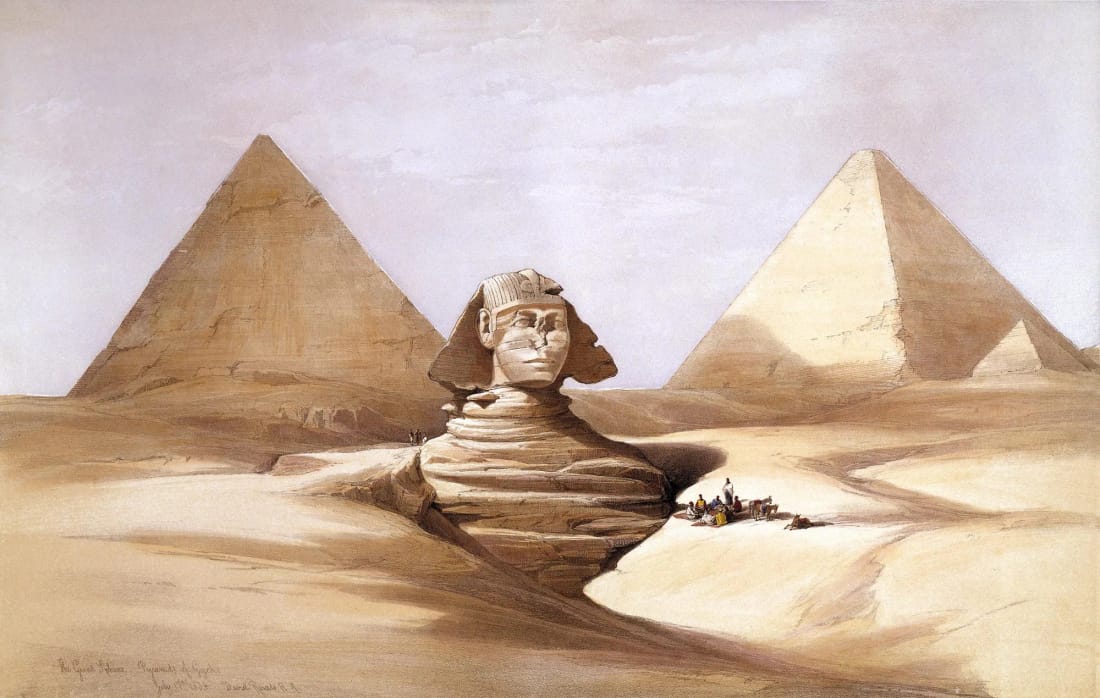
Title: The Great Sphinx, Pyramids of Gizeh
Artist: David Roberts (artist); Louis Haghe (lithographer) (Roberts 1796–1864; Haghe 1806–1885)
Year: 1846 (after a drawing dated 1839)
Medium: Tinted lithograph after the artist's drawing
Museum: Collection of this impression unknown (other impressions exist)
1 Find it! 絵の中から見つけて、○でかこもう。
- ☐ The noseless face
- ☐ Pyramid on the left
- ☐ Resting travelers
- ☐ Title and signature-style inscription
2 First look 最初に見たときの感想を書こう。
When I first saw this painting, I felt ______________ because ______________________.
Three colors I can see: ①__________ ②__________ ③__________
3 Words — Match them. 英語と日本語を線で結ぼう。
- sphinx ●
- pyramid ●
- bury ●
- ancient ●
- ● ピラミッド
- ● うめる
- ● スフィンクス
- ● 古代の
The Great Sphinx, Pyramids of Gizeh
4 Fill in the blanks. 下の箱から選んで、( )に入れよう。形を変えるものもあります。
- The has a lion's body and a human face.
- Two stand behind the Sphinx.
- Sand the body of the Sphinx.
- The Sphinx is an statue.
5 Read and answer — True or False? 英文を読んで、正しければ T、ちがえば F。
This is the Great Sphinx in Egypt. It has a lion's body and a human face. In this picture, sand covers its body. There are two big pyramids behind it. The Sphinx is about 4,500 years old!
This lithograph is based on a sketch by the Scottish painter David Roberts, made on his travels in Egypt in the 19th century. Behind the Great Sphinx, its body mostly buried in sand, stand two huge pyramids. In the right foreground, travelers and camels are resting. Before photography became common, Europeans learned what faraway Egypt looked like from pictures like this.
- It is certain that Napoleon's soldiers broke the Sphinx's nose. T / F
- When Roberts visited, the Sphinx's body was buried in sand. T / F
6 Quiz — Choose the best answer. 正しいものを選ぼう。
How was the Great Sphinx made?
- It was cast in metal
- It was built with bricks
- It was made of wood
- It was carved out of the rock
The Great Sphinx, Pyramids of Gizeh
7 Put the words in order. 語を正しく並べかえて、文を書こう。
- in / its / up / to / almost / buried / sand / The / Sphinx / neck / is .
- is / in / Egypt / a / This / desert .
8 Complete the description. 箱の語を(1)〜(4)に入れて、絵の説明を完成させよう。
This is a (1) in Egypt. In the middle, there is the Great Sphinx. Most of its body is (2) in sand, but its head, neck and part of its upper body can be seen. Behind it, there are two huge pyramids. On the (3), some travelers are (4).
9 Describe the painting in English. この絵を英語で説明しよう(3文以上)。
10 Think & Talk 考えて、ペアやグループで話し合おう。
Before photos, how did people learn about faraway places?
Why do you think people made a statue with a lion's body and a human face?
11 My favorite part いちばん好きなところを英語で。
I like the ____________ because ____________________________.
Answers & Notes
1 Find it!
The noseless face=鼻のない顔/Pyramid on the left=左のピラミッド/Resting travelers=休む旅人たち/Title and signature-style inscription=題名とサイン風の文字
2 First look
自由に書けたら正解。I felt calm / surprised / happy … などの形容詞を使おう。
3 Words
1–c(sphinx=スフィンクス) 2–a(pyramid=ピラミッド) 3–b(bury=うめる) 4–d(ancient=古代の)
4 Fill in the blanks
- Sphinx The Sphinx has a lion's body and a human face.
スフィンクスはライオンの体に人の顔をもっています。 - pyramids Two pyramids stand behind the Sphinx.
スフィンクスのうしろにピラミッドが2つ立っています。 - buried Sand buried the body of the Sphinx.
砂がスフィンクスの体をうめてしまいました。 - ancient The Sphinx is an ancient statue.
スフィンクスは古代の像です。
5 Read — T / F
【本文の訳】これはエジプトの大スフィンクスです。ライオンの体に人の顔をしています。この絵では、体が砂にうもれています。うしろには大きなピラミッドが2つ。スフィンクスは約4500歳です!
【本文の訳】19世紀、スコットランドの画家デイヴィッド・ロバーツがエジプトを旅して描いたスケッチをもとに作られた石版画です。体の大部分が砂にうもれた大スフィンクスの向こうに、2つの大きなピラミッド。右手前には休む旅人たちとラクダ。写真がまだ広まっていなかった時代、ヨーロッパの人びとはこうした絵で遠いエジプトの姿を知りました。
- F スフィンクスの鼻をこわしたのは、ナポレオンの兵士だとはっきりわかっている。
解説:ナポレオンより前のスケッチで、すでに鼻はありません。これは俗説です。 - T ロバーツが訪れたころ、スフィンクスの体は砂にうもれていた。
解説:体がすっかりほり出されたのは20世紀に入ってからです。
6 Quiz
D 問:大スフィンクスはどうやって作られた?
選択肢:A 金属を流しこんで作った/B レンガを積んで作った/C 木を組んで作った/D 岩をそのままほって作った
解説:ギザの台地の石灰岩の岩をそのままほり出して作られました。
7 Put the words in order
- The Sphinx is buried almost up to its neck in sand.
スフィンクスは首近くまで砂にうまっています。 - This is a desert in Egypt.
これはエジプトの砂漠です。
💡 up to its neck in(首まで〜にうまって):人なら up to my neck in work(仕事に首までつかって=大忙し)のようにも使えます。
8 Complete the description
(1) desert (2) buried (3) right (4) resting
9 Describe(模範解答)
This is a desert in Egypt. In the middle, there is the Great Sphinx. Most of its body is buried in sand, but its head, neck and part of its upper body can be seen. Behind it, there are two huge pyramids. On the right, some travelers are resting.
これはエジプトの砂漠です。真ん中に大スフィンクスがいます。体の大部分は砂にうもれていますが、頭と首、上半身の一部が見えています。そのうしろには、巨大なピラミッドが2つあります。右では、旅人たちが休んでいます。
10 Think & Talk(問いの訳)
- Before photos, how did people learn about faraway places?
写真がなかったころ、人びとはどうやって遠い場所のことを知ったのでしょう? - Why do you think people made a statue with a lion's body and a human face?
昔の人はなぜ、ライオンの体に人の顔をもつ像を作ったのだと思いますか?
正解のない問いです。理由をつけて話せたら◎。
Fun Fact(訳)
鼻をこわしたのはナポレオン軍? 「ナポレオンの兵士が大砲で鼻をうち落とした」という話がありますが、これは俗説です。ナポレオンが来る前の18世紀の旅行者のスケッチに、すでに鼻のない姿が描かれています。15世紀のエジプトの歴史家は、14世紀にある人物が顔をこわしたと書き残しています。
