

 PDF をダウンロード
Let's Look at Art!
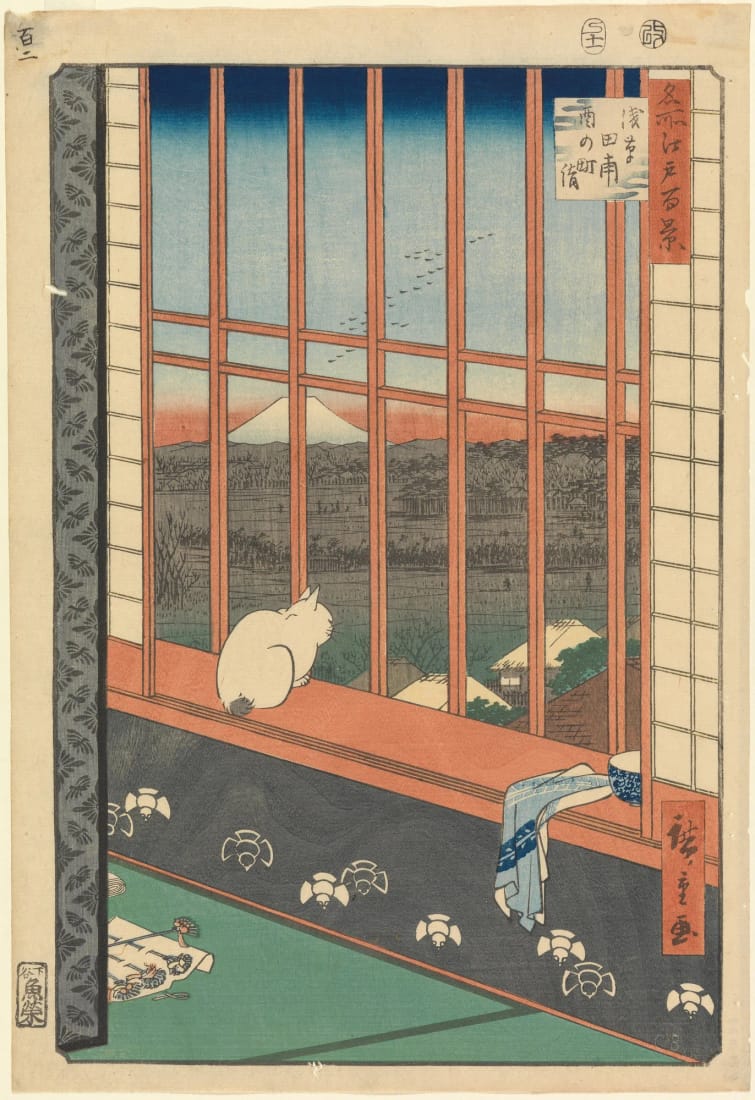
Title: Asakusa Ricefields and Torinomachi Festival (One Hundred Famous Views of Edo)
Artist: Utagawa Hiroshige (1797–1858)
Year: 1857
Medium: Woodblock print; ink and color on paper
Museum: Chester Beatty, Dublin (this impression), Dublin
1 Find it! 絵の中から見つけて、○でかこもう。
- ☐ The cat at the window
- ☐ Mount Fuji
- ☐ A flock of birds
- ☐ Rake-shaped hairpins
2 First look 最初に見たときの感想を書こう。
When I first saw this painting, I felt ______________ because ______________________.
Three colors I can see: ①__________ ②__________ ③__________
3 Words — Match them. 英語と日本語を線で結ぼう。
- windowsill ●
- festival ●
- souvenir ●
- imagine ●
- ● 想像する
- ● 祭り
- ● おみやげ・記念品
- ● 窓辺・窓の下枠
Asakusa Ricefields and Torinomachi Festival (One Hundred Famous Views of Edo)
4 Fill in the blanks. 下の箱から選んで、( )に入れよう。形を変えるものもあります。
- A white cat sits on the .
- People are walking to the .
- The hairpins may be festival .
- We can the person who lives here.
5 Read and answer — True or False? 英文を読んで、正しければ T、ちがえば F。
A white cat sits by a big window. It looks outside. We can see rice fields and Mount Fuji. Small people walk to a festival. The cat's owner is not in the picture. Where is she?
A white cat sits neatly on a windowsill and looks outside. Beyond the window lie the rice fields of Asakusa, and far away stands the white Mount Fuji. On the paths between the fields, a line of tiny people walks to the Torinomachi festival. This print is from Hiroshige's One Hundred Famous Views of Edo, published in 1857.
- The person who lives in the room is clearly shown in the print. T / F
- The Torinomachi festival is still held in November. T / F
6 Quiz — Choose the best answer. 正しいものを選ぼう。
What do people buy at the festival they are walking to?
- Goldfish
- Masks
- Wind chimes
- Lucky rakes (kumade)
Asakusa Ricefields and Torinomachi Festival (One Hundred Famous Views of Edo)
7 Put the words in order. 語を正しく並べかえて、文を書こう。
- rice / fields / at / the / the / window / looking / is / white / of / cat / out / A .
- This / room / big / with / a / is / a / window .
8 Complete the description. 箱の語を(1)〜(4)に入れて、絵の説明を完成させよう。
This is a room with a big window. A white cat is (1) on the windowsill. Outside, there are rice (2) and a white (3). Some birds are flying in the sky. On the floor, there are some hairpins on (4).
9 Describe the painting in English. この絵を英語で説明しよう(3文以上)。
10 Think & Talk 考えて、ペアやグループで話し合おう。
What do you think the cat is thinking about?
Why do you think Hiroshige did not show the person in this room?
11 My favorite part いちばん好きなところを英語で。
I like the ____________ because ____________________________.
Answers & Notes
1 Find it!
The cat at the window=窓辺のネコ/Mount Fuji=富士山/A flock of birds=鳥の群れ/Rake-shaped hairpins=熊手のかんざし
2 First look
自由に書けたら正解。I felt calm / surprised / happy … などの形容詞を使おう。
3 Words
1–d(windowsill=窓辺・窓の下枠) 2–b(festival=祭り) 3–c(souvenir=おみやげ・記念品) 4–a(imagine=想像する)
4 Fill in the blanks
- windowsill A white cat sits on the windowsill.
白いネコが窓辺に座っています。 - festival People are walking to the festival.
人々がお祭りに向かって歩いています。 - souvenirs The hairpins may be festival souvenirs.
そのかんざしは、お祭りのおみやげかもしれません。 - imagine We can imagine the person who lives here.
ここに住む人のことを想像できます。
5 Read — T / F
【本文の訳】白いネコが大きな窓のそばに座っています。外をながめています。田んぼと富士山が見えます。小さな人々がお祭りへ歩いていきます。ネコの飼い主は絵の中にいません。どこにいるのでしょう?
【本文の訳】格子窓の窓辺に、白いネコがちょこんと座り、外をながめています。窓の向こうには浅草の田んぼが広がり、遠くに白い富士山。田んぼのあぜ道には、酉の市(とりのいち)へお参りに行く人々の列が小さく見えます。歌川広重の「名所江戸百景」の一枚で、1857年に出版されました。
- F この部屋の主は、絵の中にはっきり描かれている。
解説:部屋の主は描かれず、ネコと小物だけが置かれています。 - T 酉の市は、今も11月に開かれている。
解説:浅草の鷲神社などで、毎年11月の酉の日に開かれます。
6 Quiz
D 問:窓の外の人々がお参りに向かうお祭りで買うものは?
選択肢:A 金魚/B お面/C 風鈴/D 熊手
解説:酉の市では、商売繁盛を願って縁起物の熊手を買います。
7 Put the words in order
- A white cat is looking out of the window at the rice fields.
白いネコが、窓の外の田んぼをながめています。 - This is a room with a big window.
これは大きな窓のある部屋です。
💡 is looking out of the window(窓の外をながめている):look out of 〜 で「〜から外を見る」。look at(〜を見る)とセットで覚えましょう。
8 Complete the description
(1) sitting (2) fields (3) mountain (4) paper
9 Describe(模範解答)
This is a room with a big window. A white cat is sitting on the windowsill. Outside, there are rice fields and a white mountain. Some birds are flying in the sky. On the floor, there are some hairpins on paper.
これは大きな窓のある部屋です。白いネコが窓辺に座っています。外には田んぼと白い山があります。空には鳥が何羽か飛んでいます。床の上には、紙にのせたかんざしがあります。
10 Think & Talk(問いの訳)
- What do you think the cat is thinking about?
ネコは何を考えていると思いますか? - Why do you think Hiroshige did not show the person in this room?
広重はなぜ、部屋の主を描かなかったのだと思いますか?
正解のない問いです。理由をつけて話せたら◎。
Fun Fact(訳)
主役の人間が、どこにもいない! この部屋の主は絵に一度も登場しません。かわりに、ネコ、熊手のかんざし、手ぬぐいと小さな磁器の茶碗が置かれています。見る人は、小物を手がかりに、この部屋の物語を自分で想像するのです。
