

 PDF をダウンロード
Let's Look at Art!
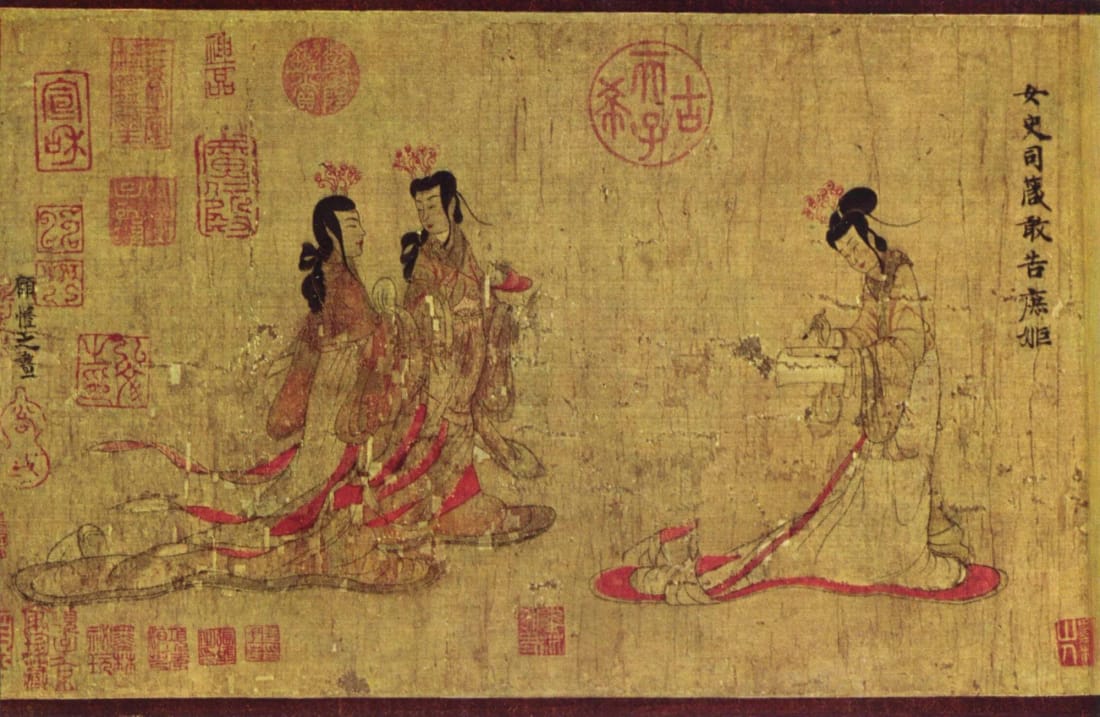
Title: The Admonitions Scroll (final scene)
Artist: Unknown artist, after Gu Kaizhi (c. 344–406)
Year: 5th–7th century (copy)
Medium: Ink and color on silk (handscroll)
Museum: The British Museum, London
1 Find it! 絵の中から見つけて、○でかこもう。
- ☐ The Instructress writing
- ☐ The inscription
- ☐ Two walking ladies
- ☐ Big round seal
2 First look 最初に見たときの感想を書こう。
When I first saw this painting, I felt ______________ because ______________________.
Three colors I can see: ①__________ ②__________ ③__________
3 Words — Match them. 英語と日本語を線で結ぼう。
- scroll ●
- silk ●
- advise ●
- ancient ●
- ● 忠告する・助言する
- ● 絹
- ● 古代の・とても古い
- ● 巻物
The Admonitions Scroll (final scene)
4 Fill in the blanks. 下の箱から選んで、( )に入れよう。形を変えるものもあります。
- The is more than three meters long.
- It is painted on .
- The poem the palace ladies.
- This is a copy of an Chinese painting.
5 Read and answer — True or False? 英文を読んで、正しければ T、ちがえば F。
This is an old Chinese scroll. It is painted on silk. A teacher writes advice for palace ladies. A Chinese emperor loved it and put many stamps on it. Now it is in London.
This is a scene from the Admonitions Scroll, an early copy by an unknown artist after a lost design traditionally said to be by Gu Kaizhi of China's Eastern Jin dynasty. It is the very last scene. On the right, the Instructress, a teacher of the palace ladies, writes with a brush. On the left, two ladies walk toward her. The words at the upper right mean that the Instructress speaks these words of advice to the palace ladies.
- It has been proven that Gu Kaizhi himself painted this scroll. T / F
- Because it is sensitive to light, it is shown only for a short time. T / F
6 Quiz — Choose the best answer. 正しいものを選ぼう。
How much did the British Museum pay for this scroll in 1903?
- 2.5 million pounds
- 25,000 pounds
- It was free
- 25 pounds
The Admonitions Scroll (final scene)
7 Put the words in order. 語を正しく並べかえて、文を書こう。
- The / Instructress / a / brush / with / is / writing .
- is / an / Chinese / old / of / scroll / part / This .
8 Complete the description. 箱の語を(1)〜(4)に入れて、絵の説明を完成させよう。
This is part of an old Chinese (1). On the left, two (2) in long robes are (3). On the right, a (4) is standing and writing with a brush. There are many red stamps on the picture.
9 Describe the painting in English. この絵を英語で説明しよう(3文以上)。
10 Think & Talk 考えて、ペアやグループで話し合おう。
Is it a good idea for owners to put stamps on a painting? Why or why not?
What advice would you write for people today?
11 My favorite part いちばん好きなところを英語で。
I like the ____________ because ____________________________.
Answers & Notes
1 Find it!
The Instructress writing=書きものをする女史/The inscription=題の文字/Two walking ladies=歩む2人の女性/Big round seal=大きな丸い印
2 First look
自由に書けたら正解。I felt calm / surprised / happy … などの形容詞を使おう。
3 Words
1–d(scroll=巻物) 2–b(silk=絹) 3–a(advise=忠告する・助言する) 4–c(ancient=古代の・とても古い)
4 Fill in the blanks
- scroll The scroll is more than three meters long.
その巻物は3メートル以上の長さがあります。 - silk It is painted on silk.
それは絹に描かれています。 - advises The poem advises the palace ladies.
その詩は宮廷の女性たちに忠告しています。 - ancient This is a copy of an ancient Chinese painting.
これは古代中国の絵の写しです。
5 Read — T / F
【本文の訳】これは中国の古い巻物です。絹に描かれています。先生が宮廷の女性たちのために心得を書いています。中国の皇帝がこの巻物を愛し、たくさんの印を押しました。今はロンドンにあります。
【本文の訳】東晋の画家・顧愷之の作と伝えられる失われた原画をもとに、作者不明の画家が描いた絵巻「女史箴図」の一場面です。巻物のいちばん最後の場面で、右には筆を持って書きものをする「女史(宮廷の女性の教育係)」、左にはそちらへ歩いていく2人の女性。右上の文字は、教育係が宮廷の女性たちに心得を告げる、という意味です。
- F 今の巻物は、顧愷之本人が描いたものだと確かめられている。
解説:5〜7世紀ごろの写しだと考えられ、作者や年代には今も議論があります。 - T 光に弱いので、展示される期間は限られている。
解説:1年に6週間ほどしか展示されません。
6 Quiz
D 問:1903年、大英博物館はこの巻物をいくらで買った?
選択肢:A 250万ポンド/B 2万5000ポンド/C 無料でもらった/D 25ポンド
解説:たった25ポンドでした。今では値段がつけられないほどの宝です。
7 Put the words in order
- The Instructress is writing with a brush.
教育係の女性は筆で書いています。 - This is part of an old Chinese scroll.
これは中国の古い巻物の一部です。
💡 is writing with a brush(筆で書いている):with+道具で「〜を使って」。write with a pen、eat with chopsticks も同じ形です。
8 Complete the description
(1) scroll (2) women (3) walking (4) woman
9 Describe(模範解答)
This is part of an old Chinese scroll. On the left, two women in long robes are walking. On the right, a woman is standing and writing with a brush. There are many red stamps on the picture.
これは中国の古い巻物の一部です。左では、長い衣を着た2人の女性が歩いています。右では、1人の女性が立って筆で書いています。絵の上には赤い印がたくさんあります。
10 Think & Talk(問いの訳)
- Is it a good idea for owners to put stamps on a painting? Why or why not?
持ち主が絵に印を押すのはよいことだと思いますか?それはなぜ? - What advice would you write for people today?
今の人たちに心得を書くとしたら、あなたはどんなことを書きますか?
正解のない問いです。理由をつけて話せたら◎。
Fun Fact(訳)
玉の留め具の鑑定のつもりが… 巻物を持ち帰ったジョンソン大尉は、1902年、巻物についていた玉(ヒスイ)の留め具の値段を調べてもらうため、大英博物館にやって来たといわれます。ところが本当の宝は絵のほうでした。博物館は翌1903年、たった25ポンドで買い取りました。
