Omisoka (New Year's Eve in Japan) · Worksheet 1
Read the story. 英文を読もう。

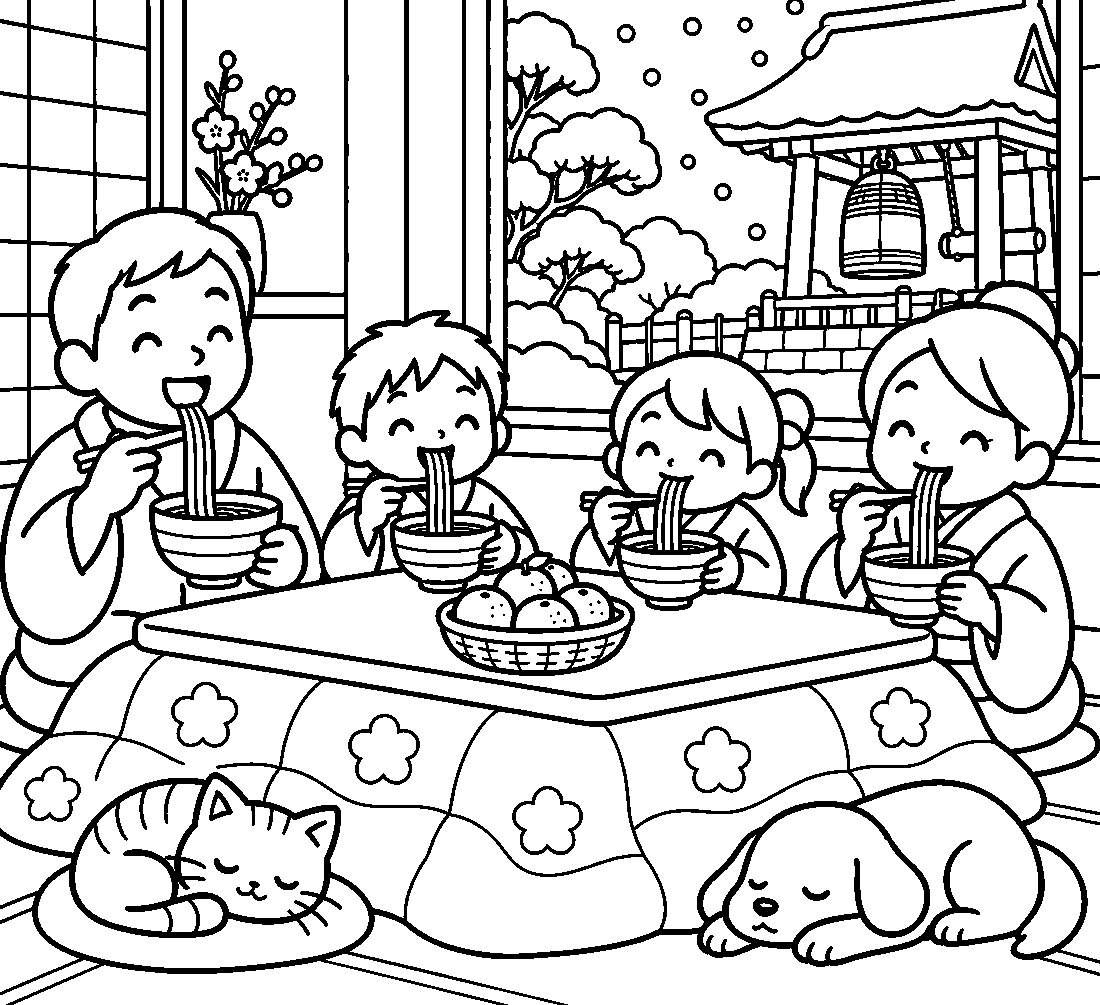
1In many countries, New Year's Eve is loud, with parties, music, and fireworks. In Japan, it is often quiet. Families stay home, eat together, and wait for the new year. This day is called Omisoka. Misoka once meant the 30th day, the last day of a month in the old calendar.
2On this night, many people eat toshikoshi soba, or year-crossing noodles. Why soba? Some say the long noodles mean a long life. Others say soba breaks easily, so it cuts away the bad luck of the year. Nobody knows which story is true.
3After dinner, many families watch Kohaku, a big singing show on TV. A red team of women and a white team of men sing against each other. The first Kohaku was not on New Year's Eve. It was on January 3, 1951. Since 1953, it has been on December 31 every year.
4Near midnight, Buddhist temples begin to ring their big bells. Most temples ring them 108 times. Many people believe 108 is the number of human desires that cause trouble. With each deep sound, they try to let go of one. Radio programs in the 1920s helped this custom spread across Japan.
5When the last bell rings, people say Akemashite omedeto, or Happy New Year. Some walk to a shrine in the cold night air. Others go straight to bed, warm and full. It is a quiet party, but it is full of hope.
Omisoka (New Year's Eve in Japan) · Worksheet 2
Choose the best answer. 正しいものを選ぼう。
What is the passage mainly about?
What does misoka mean?
When was the first Kohaku show?
How many times do most temples ring their bells?
In paragraph 4, the word spread is closest in meaning to ____.
Which is true about the passage?
Why does the writer call it the quietest party of the year?
In the dialogue, what does Mei tell Tom to bring?
Omisoka (New Year's Eve in Japan) · Worksheet 3
Words & phrases. 単語のれんしゅう。
Kenta's Last Night of the Year
It was December (1) . Kenta helped his mother clean the (2) . In the evening, the family ate hot (3) together. Grandpa said, Long noodles mean a long (4) . After dinner, they watched a singing (5) on TV. Near (6) , they walked to the temple in the (7) air. Kenta rang the big (8) one time. It made a deep sound. Then everyone said, Happy New (9) ! Kenta felt (10) about the new year.
Omisoka (New Year's Eve in Japan) · Worksheet 4
Read the clues and fill in the puzzle. ヒントを読んで、クロスワードを完成させよう。
Omisoka (New Year's Eve in Japan) · Worksheet 5
Find the hidden words. かくれた単語を探そう(→ ↓ ↘ ↗)。
Omisoka (New Year's Eve in Japan) · Worksheet 6
Collect the letters on the right path. What is the secret word? 正しい道の文字を集めると、ひみつの言葉になるよ。
Secret word:
Omisoka (New Year's Eve in Japan) · Worksheet 7
| Find someone who … | Name |
|---|---|
| … has eaten toshikoshi soba | |
| … has rung a temple bell | |
| … has stayed up until midnight on New Year's Eve | |
| … likes watching music shows | |
| … knows what misoka means | |
| … can say Happy New Year in two languages | |
| … helps clean the house at the end of the year | |
| … has seen fireworks on New Year's Eve |
On New Year's Eve, my family usually ______.
This year, I want to let go of ______ because ______.
My wish for next year is ______.
Omisoka (New Year's Eve in Japan) · Worksheet 8
Trace the words. Then color the picture! なぞって書こう。絵に色を塗ろう。