New Year's Day in Japan (Shogatsu) · Worksheet 1
Read the story. 英文を読もう。

1On January 1, the busy cities of Japan become very quiet. Government offices close from December 29 to January 3, and many families stay home together. This is Shogatsu, the Japanese New Year. For most people, it is the biggest holiday of the year.
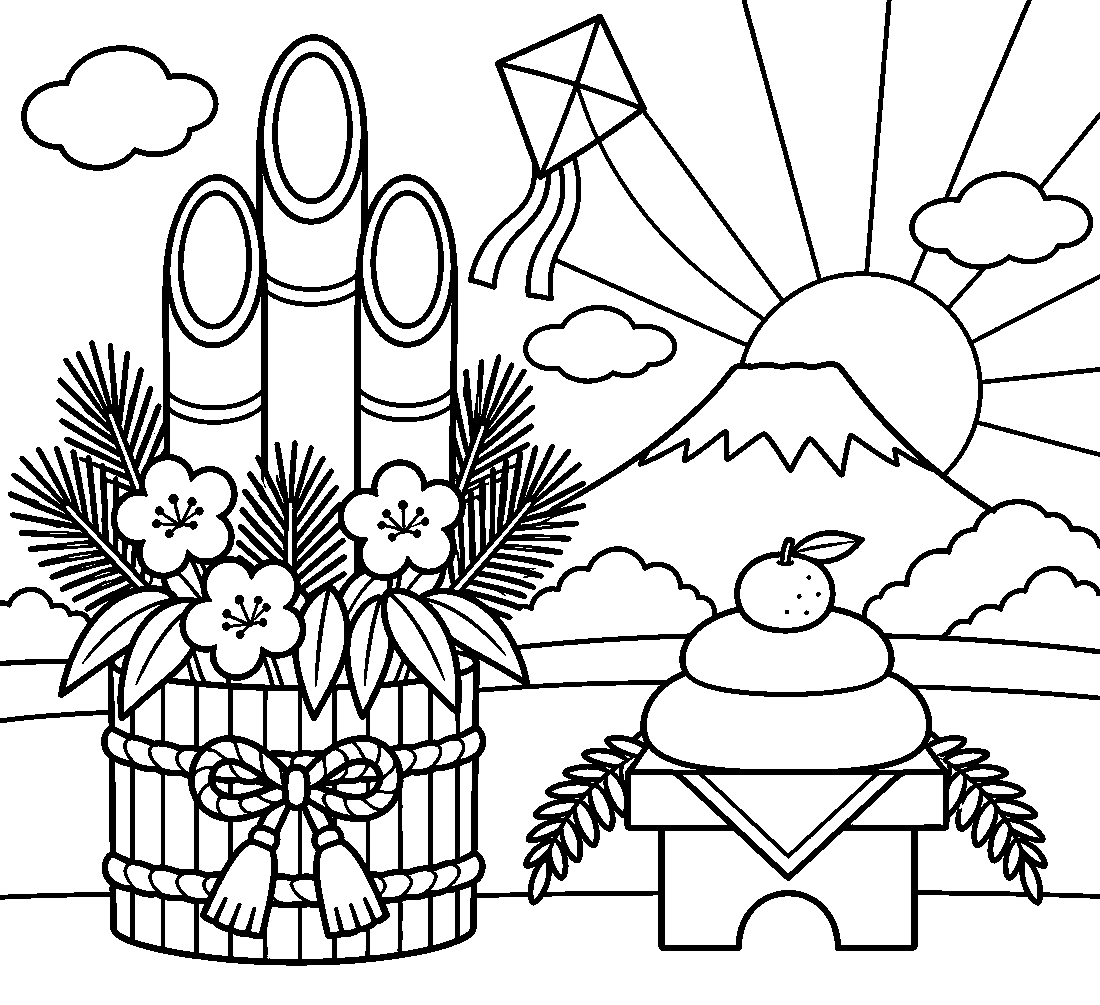
2Long ago, people believed that a god of the new year visited every home. To welcome this god, families put pine and bamboo decorations by the door. These decorations are called kadomatsu, and they help the god find the house. Families also make kagami mochi, two round rice cakes, one on top of the other.
3On New Year's morning, some people get up early to see the first sunrise. Some climb mountains, and some walk to the beach in the cold. Then families eat osechi, special food in beautiful boxes. Each food has a wish. Black beans are for good health, and shrimp are for a long life. People also eat ozoni, a soup with mochi, but the recipe changes from region to region.
4Many people send New Year cards called nengajo. The post office keeps the cards and delivers them all on January 1. Children love this day for another reason. Adults give them otoshidama, money in small and colorful envelopes.
5Before 1873, Japan used a moon calendar, and New Year came in late January or February. That is why many cards still say 'New Spring' in the middle of winter. So if a Japanese friend says 'Akemashite omedeto,' just smile and say it back. It means 'Happy New Year!'
New Year's Day in Japan (Shogatsu) · Worksheet 2
Choose the best answer. 正しいものを選ぼう。
What is the main idea of the reading?
When do government offices close for New Year?
Why do families put kadomatsu by the door?
What is the wish of the shrimp in osechi?
In paragraph 3, 'the recipe changes from region to region' means:
Which is true about nengajo?
Why do New Year cards say 'New Spring' in winter?
In the dialogue, what kind of mochi does Kenta's grandma use?
New Year's Day in Japan (Shogatsu) · Worksheet 3
Words & phrases. 単語のれんしゅう。
Yuna's First Sunrise
On (1) 1, Yuna got up at five. It was dark and very (2) . She walked to the beach with her dad. Many people were waiting. At last, the (3) came up over the sea. Everyone said, "Happy New (4) !" At home, her mom opened the (5) of osechi. Yuna ate black (6) for good health. Then she ate ozoni with two pieces of (7) . After lunch, her grandpa gave her a small (8) . There was (9) inside! Yuna wrote a (10) to her best friend.
New Year's Day in Japan (Shogatsu) · Worksheet 4
Read the clues and fill in the puzzle. ヒントを読んで、クロスワードを完成させよう。
New Year's Day in Japan (Shogatsu) · Worksheet 5
Find the hidden words. かくれた単語を探そう(→ ↓ ↘ ↗)。
New Year's Day in Japan (Shogatsu) · Worksheet 6
Collect the letters on the right path. What is the secret word? 正しい道の文字を集めると、ひみつの言葉になるよ。
Secret word:
New Year's Day in Japan (Shogatsu) · Worksheet 7
| Find someone who … | Name |
|---|---|
| … has seen the first sunrise of the year | |
| … likes black beans | |
| … can name three osechi foods in English | |
| … has flown a kite at New Year | |
| … knows how to make ozoni | |
| … has sent a New Year card to a friend | |
| … likes square mochi more than round mochi | |
| … knows what kadomatsu is for |
On January 1, my family usually ______.
My New Year wish is ______ because ______.
If I explain Shogatsu to a friend from abroad, I will say ______.
New Year's Day in Japan (Shogatsu) · Worksheet 8
Trace the words. Then color the picture! なぞって書こう。絵に色を塗ろう。