平安時代
壱In one line一言で言うと
Heian jidai, or the Heian period, is four centuries of court rule in Kyoto that produced Japan's first great literature.
弐In 30 seconds30秒で説明する
The Heian period runs from 794, when the capital moved to what is now Kyoto, to the late twelfth century. Power lay with the court aristocracy, above all the Fujiwara family, who governed through marriage into the imperial line. It was a peaceful age for the capital, and the period when the Japanese writing system matured and Japanese-language literature appeared.
参As a short speechスピーチ・英作文
The Heian period began in 794, when the capital moved to Heian-kyo, the city we now call Kyoto, and it lasted until the late twelfth century. Government was in the hands of the court nobility rather than warriors.
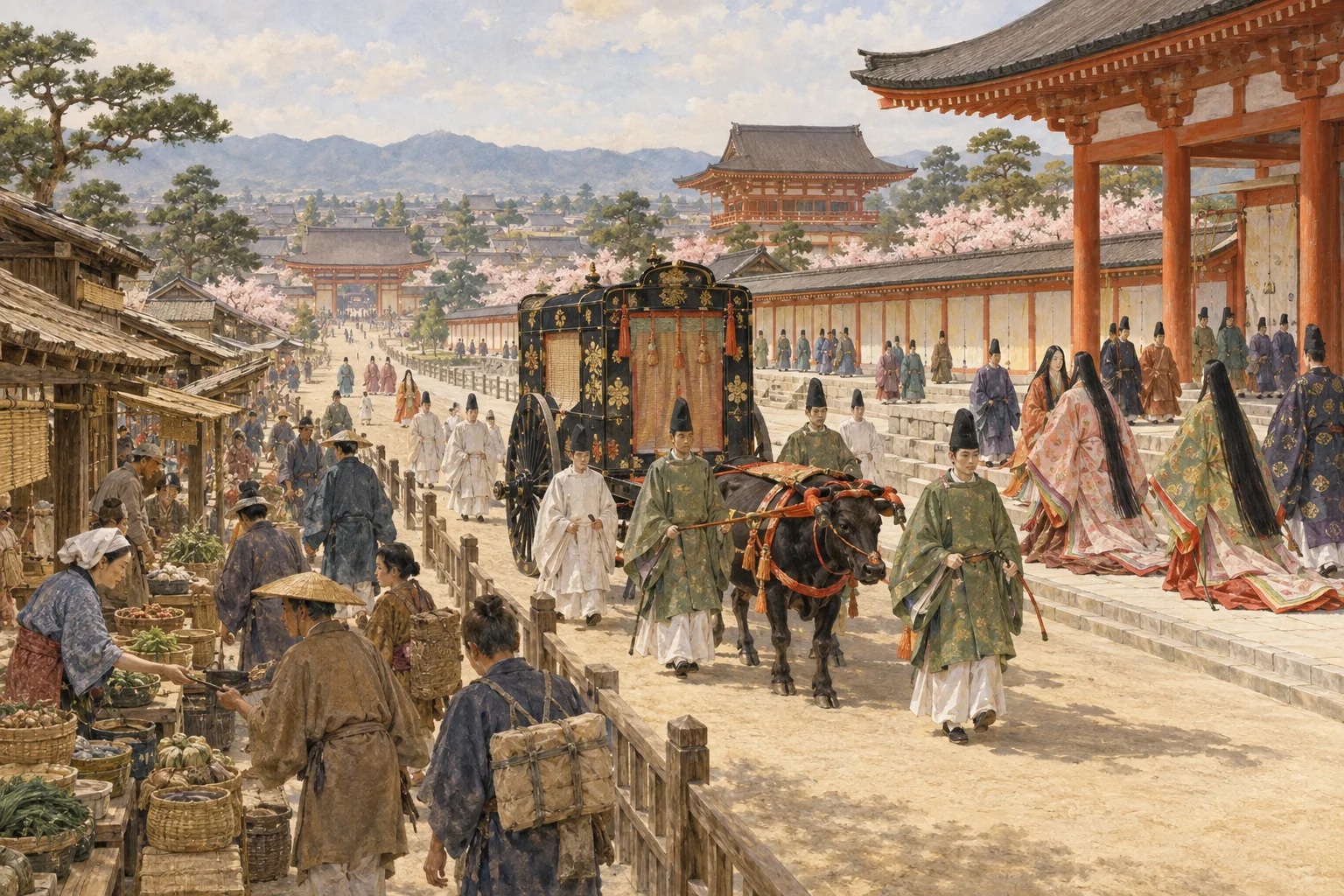
The Fujiwara family perfected a method of control that did not need an army: marry your daughters into the imperial house, and rule as the grandfather of the emperor. Because the court was not at war, its energy went into ceremony, poetry, incense, clothing and taste.
This is when kana writing developed, which let people write Japanese as they spoke it, and that is part of why the great works of the age, including The Tale of Genji and The Pillow Book, were written by women of the court. By the end of the period the provinces were held by armed landholders, and those families became the samurai who took power next.
平安時代へいあんじだいHeian jidaithe age of the court aristocracy
武士が出る前の四百年。日本語の文学はここで生まれた。
壱一言で言うとIn one line
平安時代とは、京都の朝廷が政治を担った約四百年で、日本の最初の偉大な文学を生んだ時代です。
弐30秒で説明するIn 30 seconds
平安時代は、都が今の京都に移った794年から12世紀の終わりまでを指します。権力は宮廷の貴族、とりわけ天皇家と婚姻を結んで政治を行った藤原氏にありました。都にとっては平穏な時代で、日本語の表記が成熟し、日本語で書かれた文学が現れた時期でもあります。
参スピーチ・英作文As a short speech
平安時代は794年、都が平安京、つまり今の京都に移って始まり、12世紀の終わりまで続きました。政治を担ったのは武人ではなく宮廷の貴族です。藤原氏は軍を必要としない支配の方法を完成させました。
娘を天皇家に嫁がせ、天皇の祖父として政治を行うのです。朝廷が戦っていなかったため、その力は儀式、和歌、香、装束、趣味に注がれました。この時代に仮名が発達し、話すとおりに日本語を書けるようになりました。
『源氏物語』や『枕草子』といったこの時代の名作は、宮廷に仕えた女性たちの手で書かれたのも、一つにはそのためです。時代の終わりには地方を武装した領主たちが握り、その一族がやがて武士となって次の権力を担いました。
こう聞かれたらQuestions people actually ask
QWhy were so many famous writers women?
ABecause men's official writing was in Chinese, which carried prestige, while kana was seen as a more everyday script, used by men mainly for poetry and closely associated with women. Writing Japanese in kana turned out to be far better for describing feeling, so the literature that survives best is the women's.
どうして有名な書き手に女性が多かったのですか。男性の公的な文章は権威のある漢文で書かれ、仮名はより日常的な文字とみなされて、男性は主に和歌に使い、女性と強く結びついていたからです。仮名で日本語を書くほうが心の動きを描くのにはるかに向いていたため、今よく読まれる文学は女性のものになりました。
QWas it really a peaceful golden age?
AFor the few hundred families at court, largely yes. Outside the capital there was banditry, famine and disease, and provincial government was often weak or predatory. The elegance we remember belonged to a very small group.
本当に平和な黄金時代だったのですか。宮廷の数百の家にとっては、おおむねそうでした。都の外では盗賊や飢饉、疫病があり、地方の政治は弱いか、収奪的であることも多くありました。私たちが思い浮かべる優雅さは、ごく少数のものでした。
そのまま使えるフレーズPhrases you can use
- The capital moved to Kyoto in 794.794年に都が京都に移りました。
- The court nobles held power, not warriors.権力を握っていたのは武士ではなく貴族です。
- This is when kana writing developed.仮名が発達したのはこの時代です。
- Most of the great literature was written by women.名作の多くは女性が書きました。
豆知識Background
「平安」は平和で安らかという意味で、都の名の平安京から時代の名がつきました。藤原道長が詠んだとされる「この世をば我が世とぞ思ふ」の歌は、藤原氏の権勢を示す言葉として教科書に載ります。貴族の女性が着た十二単は、実際に十二枚と決まっていたわけではなく、重ねた色の取り合わせに季節感を表す約束事がありました。平安京の区画は今の京都の碁盤目状の街路に残っています。
出典日本文化ナビ(原田英語.com)「平安時代を英語で説明する(Heian jidai)」https://www.haradaeigo.com/japanese-culture/w/the-heian-period
- 文
- 日本文化ナビ編集部(原田英語.com)— 英文・和訳・解説はすべて独自に作成
- イラスト
- 日本文化ナビ オリジナル
- 発行
- 原田英語.com https://www.haradaeigo.com/
- 印刷日
- 2026.10.17
© 2026 Harada Eigo (原田英語.com). Text and illustration: Japan Culture Navi.
ページはこちら