鎖国
壱In one line一言で言うと
Sakoku refers to the Edo period policy restricting foreign contact, though Japan was never entirely closed.
弐In 30 seconds30秒で説明する
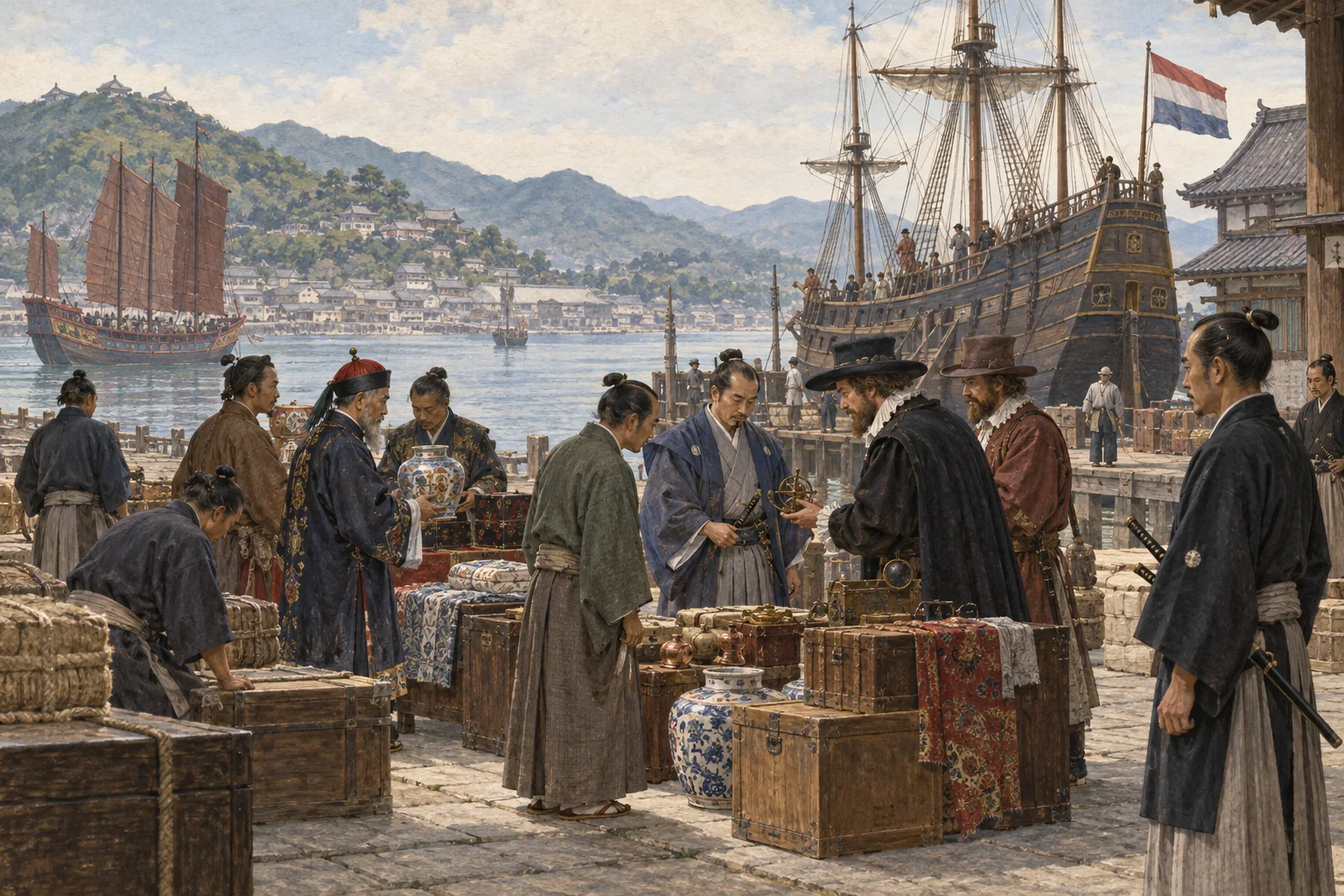
From the 1630s the shogunate banned Japanese from leaving, expelled the Portuguese, and confined European trade to a single Dutch post in Nagasaki. But trade continued with China, Korea, the Ryukyus and the Ainu. Historians now describe this as four controlled gateways rather than closure, and Japanese textbooks have changed their wording accordingly.
参As a short speechスピーチ・英作文
Sakoku is usually translated as the closed country policy, and both the translation and the concept need care. From the 1630s the Tokugawa shogunate banned Japanese people from traveling abroad or returning, expelled the Portuguese, suppressed Christianity, and restricted European trade to a single Dutch trading post on an artificial island in Nagasaki harbor.
That much is accurate. What is misleading is the word closed. Trade and diplomacy continued through four channels: Nagasaki for the Dutch and Chinese, Tsushima for Korea, Satsuma for the Ryukyu Kingdom, and Matsumae for trade with the Ainu in the north. Information came in too.
Dutch studies, rangaku, gave Japanese scholars access to European medicine and astronomy throughout the period. The word sakoku itself was coined in 1801 as a translation of a European writer's description, so the people living under the policy never used it.
鎖国さこくsakokuthe closed country policy
「鎖国」という言葉は、当時の日本では使われていなかった。教科書も書き換わっている。
壱一言で言うとIn one line
鎖国とは、江戸時代に対外接触を制限した政策を指しますが、日本が完全に閉じていたわけではありません。
弐30秒で説明するIn 30 seconds
1630年代から幕府は日本人の出国を禁じ、ポルトガル人を追放し、ヨーロッパとの交易を長崎のオランダ商館一か所に限りました。しかし中国・朝鮮・琉球・アイヌとの交易は続きました。歴史学では今、これを閉鎖ではなく「四つの管理された口」として説明し、日本の教科書の記述もそれに合わせて変わっています。
参スピーチ・英作文As a short speech
鎖国はふつう closed country policy と訳されますが、訳語も概念も注意が要ります。1630年代から徳川幕府は、日本人の海外渡航と帰国を禁じ、ポルトガル人を追放し、キリスト教を弾圧し、ヨーロッパとの交易を長崎湾の人工島にあるオランダ商館一か所に限りました。
ここまでは正確です。誤解を招くのは「閉じた」という語です。交易と外交は四つの窓口を通じて続きました。オランダと中国の長崎、朝鮮の対馬、琉球王国の薩摩、そして北のアイヌとの交易を担う松前です。情報も入ってきました。
蘭学を通じて、日本の学者はこの期間ずっとヨーロッパの医学や天文学に触れ続けました。「鎖国」という語自体、1801年にヨーロッパ人の記述の翻訳語として作られたもので、その政策の下で生きた人々は一度も使っていません。
こう聞かれたらQuestions people actually ask
QWhere does the word come from?
AIt was coined in 1801 by the translator Shizuki Tadao, rendering a passage by the German physician Engelbert Kaempfer who had lived at the Dutch post. It entered common use much later.
この言葉はどこから来たのですか。1801年、蘭学者の志筑忠雄が、オランダ商館に滞在したドイツ人医師ケンペルの記述を訳す際に作った語です。一般に広まったのはずっと後のことです。
QWhy did they do it?
AChiefly to control Christianity, which the shogunate saw as a threat to its authority, especially after a large rebellion in Shimabara, and to monopolize foreign trade and the information that came with it.
どうしてそんなことをしたのですか。主にキリスト教を統制するためです。幕府はそれを支配への脅威とみなし、とくに島原の大規模な一揆のあとはその見方を強めました。あわせて対外交易と、それに伴う情報を独占するためでもありました。
QHas the textbook wording really changed?
AYes. Japanese textbooks have shifted toward describing the four gateways and using sakoku with qualification, reflecting decades of research arguing that the term oversimplifies.
教科書の書き方は本当に変わったのですか。変わりました。日本の教科書は四つの口を説明し、「鎖国」の語を留保つきで使う方向に移っています。この語が単純化しすぎているという研究の蓄積を反映したものです。
誤解されやすいA common misunderstanding
MYTHJapan was completely sealed off from the world for over two hundred years.日本は200年以上、世界から完全に遮断されていたと思われがちです。
FACTFour controlled channels of trade and diplomacy operated throughout, and European scientific knowledge entered continuously through Dutch studies.四つの管理された交易・外交の窓口が機能し続け、蘭学を通じてヨーロッパの科学知識も入り続けていました。
そのまま使えるフレーズPhrases you can use
- It was controlled contact, not total closure.完全な閉鎖ではなく、管理された接触でした。
- There were four gateways, not none.窓口はゼロではなく、四つありました。
- The Dutch traded from an island in Nagasaki.オランダは長崎の人工島で交易していました。
- European science came in through Dutch studies.ヨーロッパの科学は蘭学を通じて入ってきました。
- The word itself was coined in 1801.「鎖国」という語自体、1801年に作られたものです。
豆知識Background
オランダ商館が置かれた出島は、長崎湾内に築かれた扇形の人工島で、面積は約1.5ヘクタール。もとはポルトガル人を隔離するために作られた。「四つの口」は長崎口・対馬口・薩摩口・松前口を指す枠組みで、1980年代以降の研究で定着した。「鎖国」の語は志筑忠雄が1801年、ケンペル『日本誌』の一部を『鎖国論』として訳した際に用いたのが最初とされる。蘭学では、杉田玄白らが1774年に『解体新書』を刊行し、オランダ語の解剖書を翻訳した。近年の高校教科書では「いわゆる鎖国」と表記したり、四つの口を明記したりする記述が増えている。
出典日本文化ナビ(原田英語.com)「鎖国を英語で説明する(sakoku)」https://www.haradaeigo.com/japanese-culture/w/sakoku
- 文
- 日本文化ナビ編集部(原田英語.com)— 英文・和訳・解説はすべて独自に作成
- イラスト
- 日本文化ナビ オリジナル
- 発行
- 原田英語.com https://www.haradaeigo.com/
- 印刷日
- 2026.10.17
© 2026 Harada Eigo (原田英語.com). Text and illustration: Japan Culture Navi.
ページはこちら