欄間
壱In one line一言で言うと
Ranma, a transom panel, is carved or latticed wood above sliding doors that lets light and air through.
弐In 30 seconds30秒で説明する
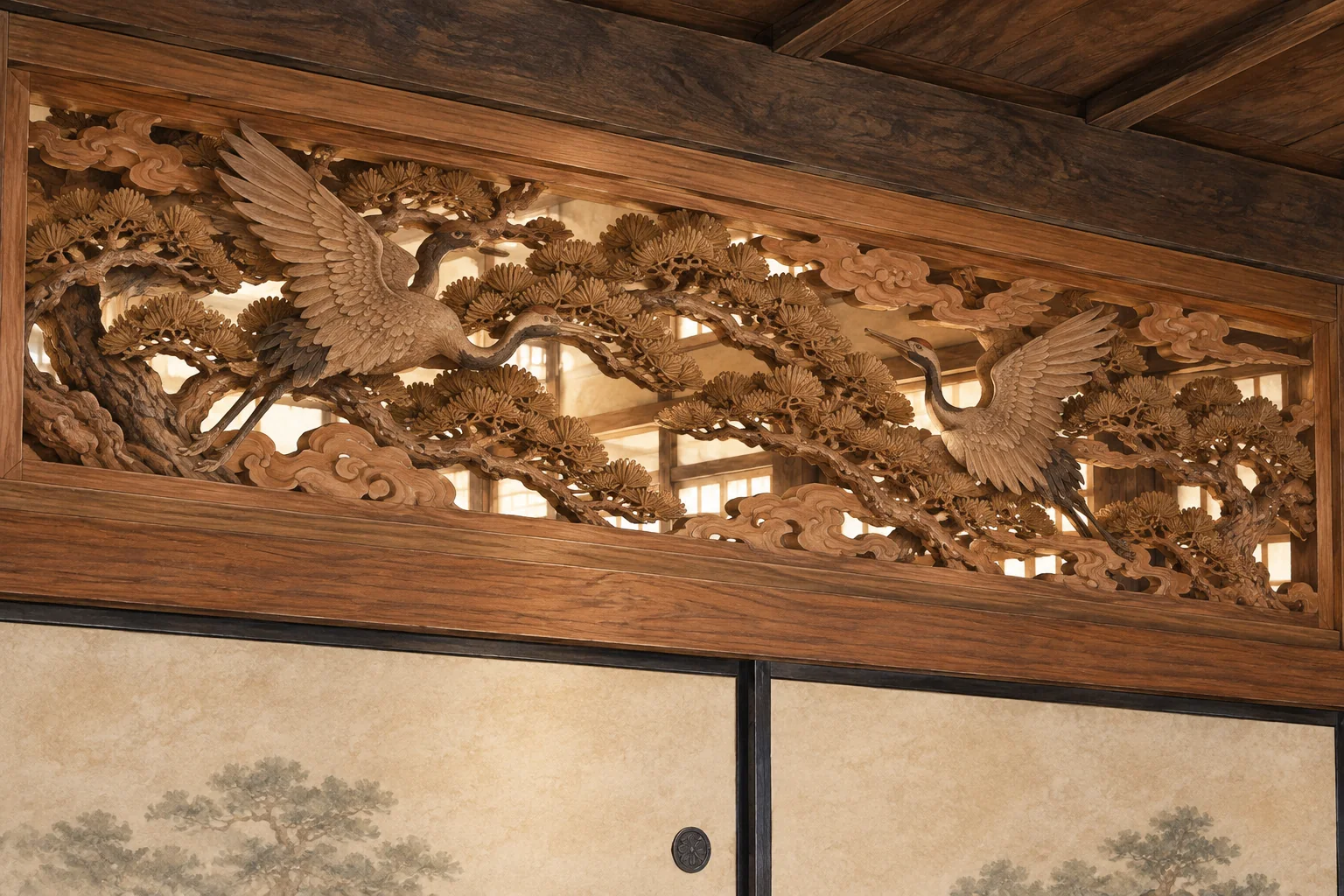
In a traditional Japanese house the sliding doors stop below the ceiling, and the gap above them is filled with a ranma — an openwork panel, carved with a landscape or birds, or made as a lattice. It is decorative, but its job is practical: in many traditional houses the rooms open straight into one another, and the inner rooms have no windows, so the ranma is how light and air get through.
参As a short speechスピーチ・英作文
Ranma is one of those details in a Japanese house that looks purely decorative and turns out to be practical design. In a traditional room the sliding doors run in grooves and stop well below the ceiling, leaving a band of open space between the lintel above the doors and the ceiling.
That band is filled with a ranma: a panel of wood carved right through with a landscape, pine branches, cranes or a wave pattern, or a simple lattice, or occasionally a piece of frosted glass. The reason it is open rather than solid is airflow. A traditional house is a series of rooms opening into each other without corridors, and the inner rooms have no exterior wall, so without the ranma they would have neither light nor ventilation.
In a hot, humid summer that matters more than it sounds. The carving is a serious craft, and in some designs the same panel shows a different picture from each side. Modern houses rarely have them, which is why an old inn or temple building surprises people.
欄間らんまranmathe carved panel above the sliding doors
襖の上の透かし彫り。飾りに見えて、光と風を隣の部屋へ通すための仕掛け。
壱一言で言うとIn one line
欄間とは、襖や障子の上に入れる彫りや格子の板で、光と風を通すものです。
弐30秒で説明するIn 30 seconds
日本の伝統的な家では、襖や障子は天井まで届きません。その上の隙間に入れるのが欄間です。山水や鳥を彫り抜いた板や、格子を組んだもの。飾りではありますが、役目は実際的です。伝統的な家の多くは部屋どうしがじかに続き、内側の部屋には窓がありません。光と風が通る道が、この欄間なのです。
参スピーチ・英作文As a short speech
欄間は、日本の家にある細部のうち、ただの飾りに見えて、実は暮らしの工夫だったというものの一つです。伝統的な部屋では、襖や障子は溝を走り、天井のずっと手前で止まります。戸の上の鴨居と天井のあいだに、帯のような隙間が空く。そこに入るのが欄間です。
山水、松、鶴、波の文様を彫り抜いた板、あるいは格子を組んだもの、ときには磨りガラス。ふさがずに透かしてあるのは、風のためです。伝統的な家は、廊下を持たずに部屋どうしが続いていく造りで、内側の部屋には外に面した壁がありません。
欄間がなければ、光も風も入らないのです。蒸し暑い夏には、これが聞こえる以上に効いてきます。彫りは本格的な工芸で、図柄によっては、どちら側から見るかで別の絵になるものもあります。いまの住宅にはほとんどありません。だから古い旅館や寺の建物に入ると、人は驚くのです。
こう聞かれたらQuestions people actually ask
QIs it just decoration?
ANo. It carries light and air between rooms that have no windows or corridor of their own. The carving is the decoration; the opening is the function.
飾りなのですか。違います。窓も廊下もない部屋どうしのあいだで、光と風を通しています。彫りが飾りで、空いていることが役目です。
QWhere can I see a good one?
ATemples, old inns, samurai residences and preserved townhouses. Inami in Toyama is the best-known production area and has workshops open to visitors.
良いものはどこで見られますか。寺、古い旅館、武家屋敷、保存された町家などです。富山の井波が最もよく知られた産地で、工房を見学できます。
QDo new houses have them?
ARarely. Modern homes often have doors that run right up to the ceiling, and air conditioning does the work of ventilation, so the gap and its panel have mostly disappeared.
いまの家にもありますか。ほとんどありません。いまの家は戸が天井まで届く造りが多く、風通しは冷暖房が担います。あの隙間も、そこに入る板も、ほぼ姿を消しました。
誤解されやすいA common misunderstanding
MYTHThe ranma is a purely ornamental carving.欄間は装飾のための彫り物だ、と思われがちです。
FACTIts openwork exists to move light and air between rooms that have no exterior wall, in a house built without corridors.透かしてあるのは、外に面した壁を持たない部屋のあいだで光と風を動かすためです。廊下のない造りだからこそ要るものです。
そのまま使えるフレーズPhrases you can use
- It's the carved panel above the sliding doors.襖の上にある彫りの板です。
- The openings let light and air through.透かしから光と風が通ります。
- Inner rooms here have no windows of their own.内側の部屋には自分の窓がありません。
- Some designs show a different picture from each side.表と裏で別の絵に見えるものもあります。
- New houses don't usually have them.いまの家には、ふつうありません。
豆知識Background
欄間は、鴨居と天井のあいだに設ける開口部の建具で、彫刻欄間、組子欄間、筬(おさ)欄間、書院欄間などの種類がある。富山県南砺市の井波は井波彫刻の産地として知られ、寺院の欄間彫刻から発展して1975年に国の伝統的工芸品に指定された。両面から彫り、表と裏で異なる絵柄に仕上げたものもある。現代の住宅では天井高と空調の変化により設けられることが少なくなっている。
出典日本文化ナビ(原田英語.com)「欄間を英語で説明する(ranma)」https://www.haradaeigo.com/japanese-culture/w/ranma
- 文
- 日本文化ナビ編集部(原田英語.com)— 英文・和訳・解説はすべて独自に作成
- イラスト
- 日本文化ナビ オリジナル
- 発行
- 原田英語.com https://www.haradaeigo.com/
- 印刷日
- 2026.10.17
© 2026 Harada Eigo (原田英語.com). Text and illustration: Japan Culture Navi.
ページはこちら