音ゲー
壱In one line一言で言うと
Rhythm games, called otoge in Japan, are arcade machines where you hit buttons or panels in time with music.
弐In 30 seconds30秒で説明する
Rhythm games ask you to press, tap, slide or step in time with a song while notes scroll toward a line. Japan's arcades are full of them, each with its own controller: a dance platform, a set of turntables and keys, a drum, a row of touch panels. The genre began in the late 1990s, spread worldwide, and in Japan it has stayed strong in arcades. Top players are extraordinary to watch and often have their own audiences.
参As a short speechスピーチ・英作文
Walk into a big Japanese arcade and there is often one floor louder than the rest. That is the rhythm game section, called otoge for short. The principle is simple: notes scroll down or in toward a judgment line, and you have to act exactly when they arrive, with the machine rating each hit from perfect down to miss. What makes the genre Japanese is the hardware.
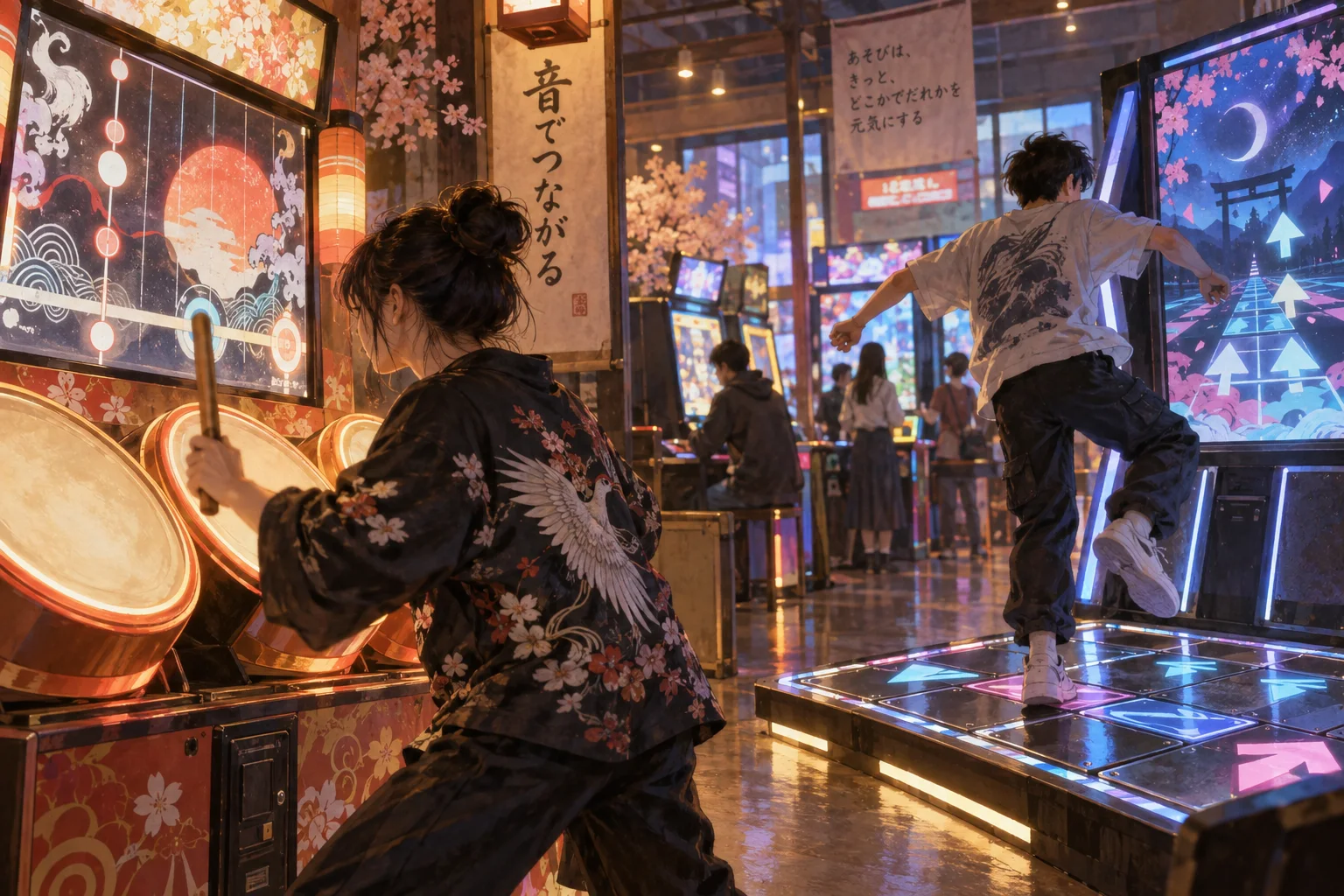
Instead of a controller, each title has its own physical interface: a metal platform with arrows you step on, a pair of turntables with keyboard-like buttons, a drum you hit with sticks, a wide curve of touch-sensitive panels, a screen you slide your palms across. Players bring their own gloves, wrist supports and sometimes their own keycaps.
The genre began in the late 1990s and spread worldwide, but elsewhere it mostly moved to home consoles and phones, while in Japan the arcade version stayed alive, updated with new songs online. Standing behind a good player is genuinely worth doing: the hands move faster than you can follow, and a small crowd usually gathers.
音ゲーおとげーotogerhythm games
ゲームセンターの音と光の一角。足で踏む台から、指が追いつかない画面まで。
壱一言で言うとIn one line
音ゲーとは、音楽に合わせてボタンや床のパネルを叩く、ゲームセンターの音楽ゲームのことです。
弐30秒で説明するIn 30 seconds
音ゲーは、音符が線に向かって流れてくるあいだに、曲に合わせて押す、叩く、滑らせる、踏む、といった操作を求めます。日本のゲームセンターはこれで一杯で、それぞれ専用の操作部があります。踊る床、ターンテーブルと鍵盤、太鼓、並んだタッチ画面。この分野は1990年代の終わりに始まり世界に広まりましたが、日本ではゲームセンターで根強く残っています。上級者の腕前は見ていて驚くほどで、それぞれに観客がついています。
参スピーチ・英作文As a short speech
日本の大きなゲームセンターに入ると、一つのフロアだけがほかより騒がしいことがよくあります。そこが音楽ゲームの一角で、略して音ゲーと呼ばれます。仕組みは単純です。音符が判定の線に向かって流れてきて、届いた瞬間ちょうどに操作しなければならず、機械が一打ごとに完璧から失敗までを判定します。
この分野を日本的にしているのは筐体です。コントローラーの代わりに、作品ごとに専用の操作部があります。矢印を踏む金属の台、鍵盤のようなボタンのついた二つのターンテーブル、ばちで叩く太鼓、大きく弧を描いたタッチの板、手のひらを滑らせる画面。遊ぶ人は自分の手袋やリストバンド、ときには自前のキーの部品まで持ってきます。
この分野は1990年代の終わりに始まって世界に広まりましたが、よその国では主に家庭用機や携帯に移り、日本ではゲームセンターの筐体が生き続け、新しい曲がネット越しに追加されています。うまい人の後ろに立って見る価値は本当にあります。手は目で追えないほど速く動き、たいてい小さな人だかりができます。
こう聞かれたらQuestions people actually ask
QCan a complete beginner play?
AYes. Almost every machine has an easy difficulty and songs you will recognize, and the drum-based one is the friendliest starting point because hitting a drum is obvious. Play on the easiest setting first; the difficulty curve in these games is steep and unforgiving.
まったくの初心者でも遊べますか。遊べます。ほとんどの筐体に簡単な難易度と、聞き覚えのある曲があります。太鼓の機種は、叩けばよいと分かるので入り口としていちばん親切です。まずは最も易しい設定で遊んでください。この分野の難易度は急で容赦がありません。
QWhy do players bring their own equipment?
ABecause at high levels small differences matter. Gloves reduce friction on sliding panels, wrist supports prevent injury from repetitive motion, and some games allow players to swap in their own buttons or keycaps. It is closer to a musician bringing their own sticks than to showing off.
どうして自分の道具を持ち込むのですか。上の水準では小さな差が効いてくるからです。手袋は滑らせる板の摩擦を減らし、リストバンドは繰り返しの動きによる故障を防ぎ、自分のボタンやキーの部品を持ち込める機種もあります。見せびらかしというより、演奏家が自分のばちを持ってくるのに近いことです。
QIs there an etiquette in the arcade?
AYes. Do not stand right behind someone in a way that blocks the screen, do not photograph a player without asking, and if a line forms, people usually place a coin or a card on the panel to mark their place. One play then step aside is the norm when it is busy.
ゲームセンターに作法はありますか。あります。画面をふさぐほど真後ろに立たないこと、断りなく撮影しないこと。順番待ちができたら、台に硬貨やカードを置いて場所を示すのがふつうです。混んでいるときは一回遊んだら交代するのが決まりです。
そのまま使えるフレーズPhrases you can use
- That whole floor is rhythm games.あのフロアは全部音ゲーです。
- You hit the notes in time with the music.音楽に合わせて音符を叩きます。
- Start on the easiest difficulty.いちばん易しい難易度から始めてください。
- Put a coin down to hold your place in line.硬貨を置いて順番を取ってください。
- Don't photograph players without asking.断りなく撮影しないでください。
豆知識Background
音楽ゲームは1990年代後半に相次いで登場し、足で矢印を踏む機種や、ターンテーブルと鍵盤を使う機種、太鼓を叩く機種などが、それぞれ専用の筐体とともに定着しました。海外では家庭用機やスマートフォンへ移行した一方、日本ではゲームセンターの筐体が更新を続け、ネットワークを通じて楽曲が追加され、全国の成績が集計される仕組みが整いました。上級者向けの譜面は打鍵数が非常に多く、手袋やリストバンドを持参する人もいます。ゲームセンター自体は施設数が長期的に減少していますが、音楽ゲームはクレーンゲームと並んで集客の柱とされます。ボーカロイドの楽曲や、アニメ・ゲームの曲が多く収録されており、他のポップカルチャーとのつながりが強い分野でもあります。
出典日本文化ナビ(原田英語.com)「音ゲーを英語で説明する(otoge)」https://www.haradaeigo.com/japanese-culture/w/onge
- 文
- 日本文化ナビ編集部(原田英語.com)— 英文・和訳・解説はすべて独自に作成
- イラスト
- 日本文化ナビ オリジナル
- 発行
- 原田英語.com https://www.haradaeigo.com/
- 印刷日
- 2026.10.17
© 2026 Harada Eigo (原田英語.com). Text and illustration: Japan Culture Navi.
ページはこちら