夏越の祓
壱In one line一言で言うと
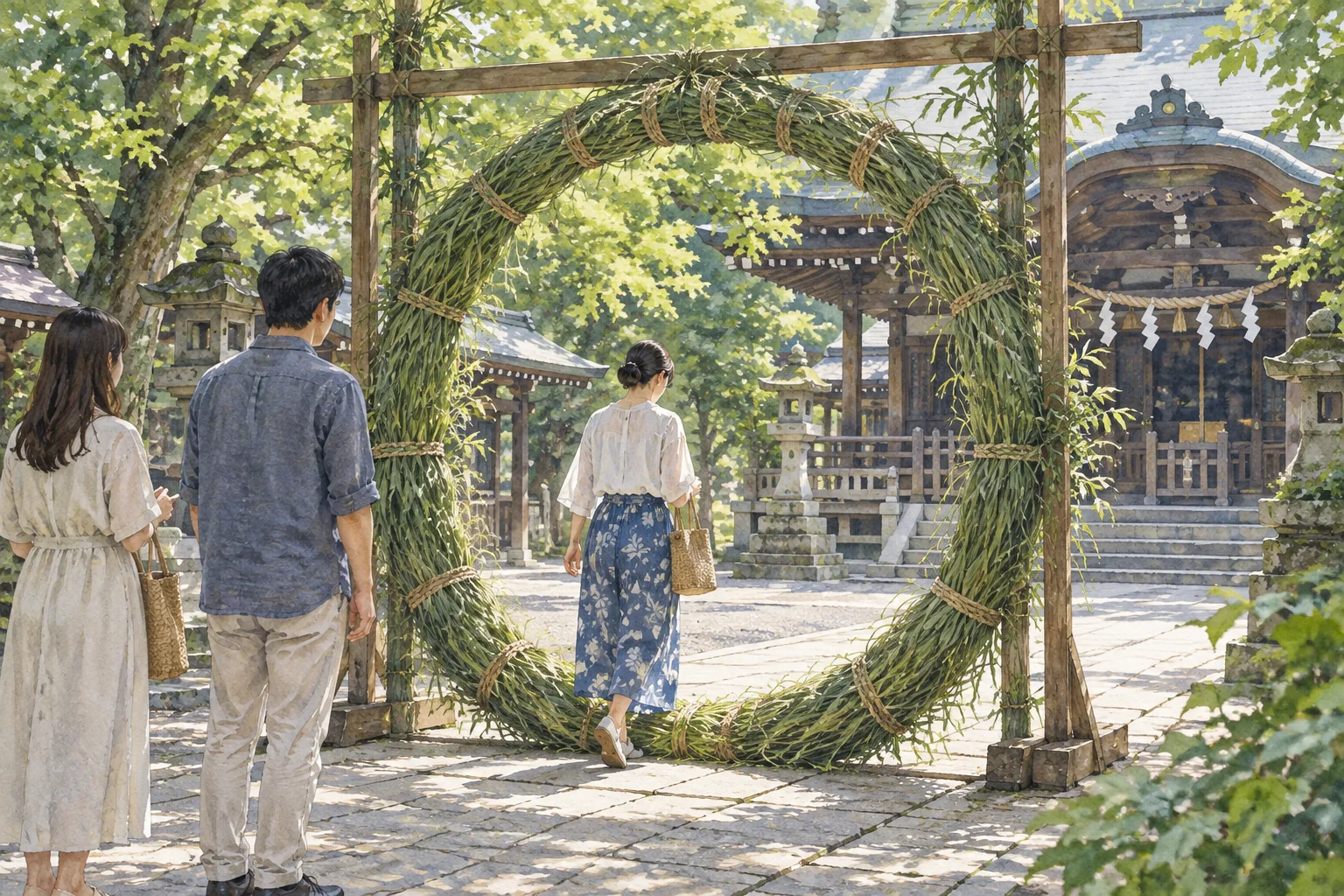
Nagoshi no harae, the midsummer purification, is a June 30th shrine rite of walking through a large grass ring.
弐In 30 seconds30秒で説明する
Nagoshi no harae is a purification rite held at shrines on June 30th, halfway through the year. A large ring woven from cogon grass is set up at the entrance, and worshippers walk through it in a figure-eight pattern. Paper human figures are also used to carry away misfortune.
参As a short speechスピーチ・英作文
Nagoshi no harae is a purification held at shrines on the last day of June, at the midpoint of the year. The visible part is the chinowa, a ring often about two meters across woven from cogon grass and set up at the approach to the shrine. Worshippers walk through it three times, tracing a figure eight, with a short verse recited at each pass.
The idea is that impurity accumulated over six months is left behind, and the same shrines hold a matching rite on the last day of December. A second element is the paper figure: you write your name on a small human-shaped cutout, breathe on it or rub it against yourself, and hand it in so that it can be disposed of ritually, taking misfortune with it.
In Kyoto there is a sweet eaten on this day, a triangle of chewy rice-flour cake called uiro, topped with red beans. Visitors are welcome to walk the ring; the shrine will usually have a sign showing the route.
夏越の祓なごしのはらえnagoshi no haraethe midsummer purification
六月三十日、茅の輪をくぐって半年分の汚れを落とす。
壱一言で言うとIn one line
夏越の祓とは、六月三十日に神社で大きな茅の輪をくぐるお祓いの行事です。
弐30秒で説明するIn 30 seconds
夏越の祓は、年の半ばにあたる六月三十日に神社で行われる祓えの行事です。茅で編んだ大きな輪が入口に立てられ、参拝者はそれを八の字を描くようにくぐります。人の形に切った紙に穢れを移して流す形もあります。
参スピーチ・英作文As a short speech
夏越の祓は、年の折り返しにあたる六月の末日に神社で行われる祓えです。目に見える中心は茅の輪で、直径二メートルほどのことが多い輪を茅で編み、参道に立てます。参拝者はそれを八の字を描くように三度くぐり、そのたびに短い歌を唱えます。
半年のあいだにたまった穢れをそこに置いていくという考えで、同じ神社が十二月の末日にも対になる神事を行います。もう一つの要素が人形です。人の形に切った紙に名を書き、息を吹きかけたり体をなでたりして、神社に納めます。
穢れを移して祓ってもらうためです。京都には、この日に食べる菓子があり、三角の外郎の上に小豆をのせたものです。茅の輪は訪れた人もくぐってかまいません。たいてい順路を示す掲示が出ています。
こう聞かれたらQuestions people actually ask
QHow do I walk through the ring?
ABow, step through with the left foot, circle left back to the front, step through again circling right, then a third time circling left, and finally walk through to the shrine. A sign usually shows the pattern.
輪はどうくぐればよいのですか。一礼して左足から入り、左回りで正面に戻り、もう一度くぐって右回り、三度目は左回り、最後にそのまま拝殿へ進みます。たいてい順路の図が掲示されています。
QWhat is the paper figure for?
AYou transfer your impurity to it by writing your name and breathing on it. The shrine collects them and disposes of them ritually, sometimes by floating them on water or burning them.
人の形をした紙は何に使うのですか。名前を書き、息を吹きかけて自分の穢れを移すためのものです。神社がそれを集め、水に流したり焚き上げたりして祓います。
QIs there an equivalent at the end of the year?
AYes, on December 31st, called toshikoshi no harae. Together the two divide the year in half, which is the same logic as a mid-year and year-end accounting.
年末にも同じような行事がありますか。あります。十二月三十一日の年越の祓です。二つで一年を半分に分けており、中間決算と年度末の決算と同じ考え方です。
そのまま使えるフレーズPhrases you can use
- Walk through the grass ring.茅の輪をくぐってください。
- Three times, in a figure eight.八の字に三度くぐります。
- Write your name on the paper figure.人形に名前を書いてください。
- It clears the first half of the year.半年分の穢れを祓います。
- There's one again at New Year's Eve.大晦日にも同じ神事があります。
豆知識Background
夏越の祓は、六月の末日に行われる大祓の一つです。十二月の末日の年越の祓と対をなし、半年ごとに穢れを祓うという考えにもとづきます。茅の輪の由来には、旅の神を宿した家が茅の輪によって疫病を免れたという伝承が語られます。くぐるときに唱える歌は神社によって掲示されています。京都では六月三十日に水無月という菓子を食べる習わしがあり、三角の形は氷を、小豆は魔除けを表すと言われます。
出典日本文化ナビ(原田英語.com)「夏越の祓を英語で説明する(nagoshi no harae)」https://www.haradaeigo.com/japanese-culture/en/nagoshi-no-harae
- 文
- 日本文化ナビ編集部(原田英語.com)— 英文・和訳・解説はすべて独自に作成
- イラスト
- 日本文化ナビ オリジナル
- 発行
- 原田英語.com https://www.haradaeigo.com/
- 印刷日
- 2026.10.17
© 2026 Harada Eigo (原田英語.com). Text and illustration: Japan Culture Navi.
ページはこちら