木組み
壱In one line一言で言うと
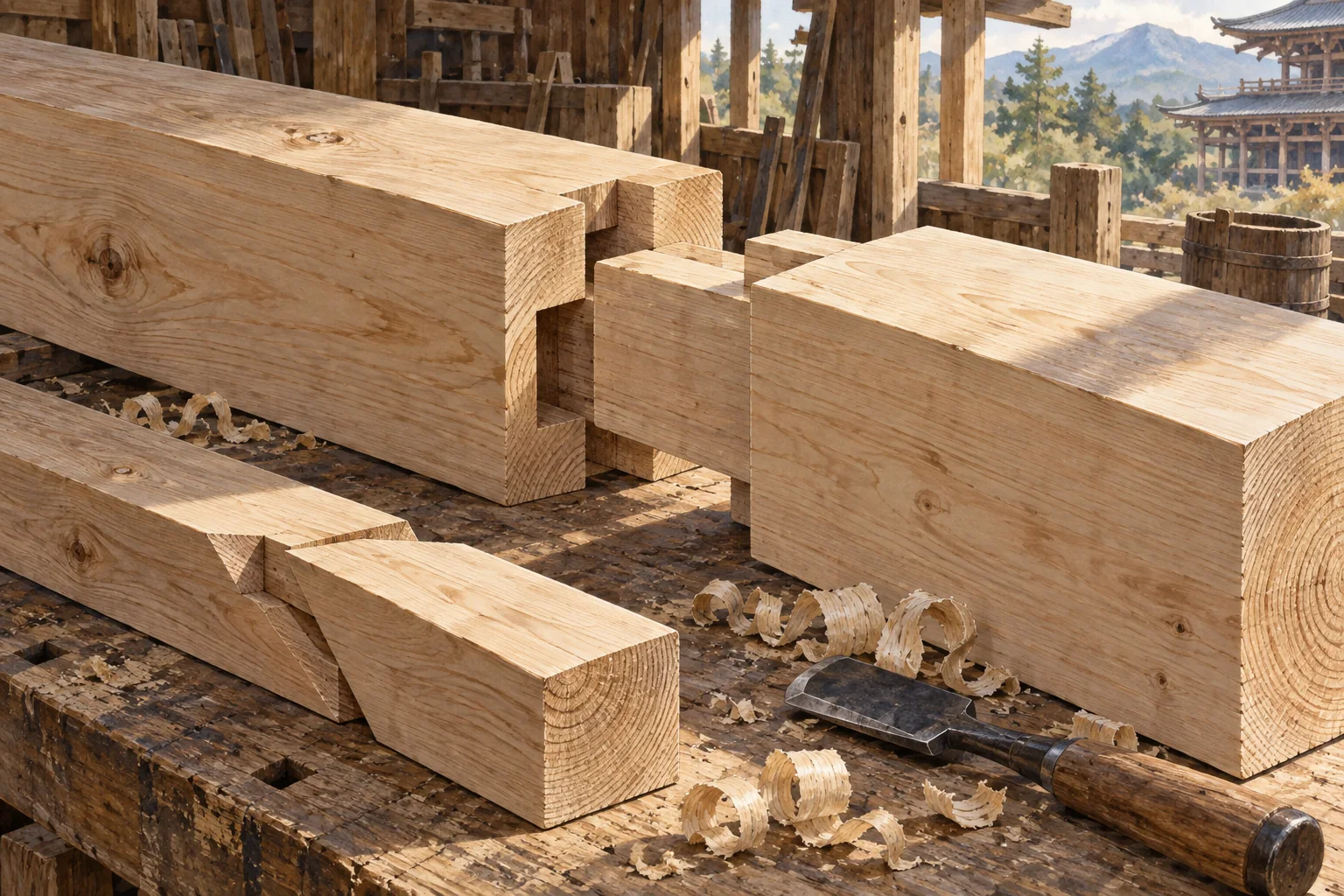
Kigumi is the Japanese technique of joining timber by cutting the pieces to lock together without nails.
弐In 30 seconds30秒で説明する
Kigumi is timber joinery in which pieces of wood are cut so that they interlock, held by their shape rather than by nails or glue. Japanese carpentry developed a large vocabulary of such joints, which allows a building to flex in an earthquake and to be taken apart, repaired and reassembled.
参As a short speechスピーチ・英作文
Kigumi is Japanese timber joinery, and the famous claim that traditional buildings use no nails is an exaggeration, but it points at something real. Pieces of wood are cut so that they lock into each other, and the joint is held by its own geometry.
Japanese carpentry developed an enormous vocabulary of these, with names, for joining beams end to end, for meeting at right angles, for taking loads in different directions. There are two real advantages. A jointed frame has some give in it, so a building can move in an earthquake and settle back rather than snapping.
And because nothing is glued, a structure can be dismantled, individual rotten members replaced, and the whole thing reassembled, which is how temple buildings have been maintained across many centuries. The precision required is considerable: the cut has to be tight enough that the joint holds, and the tools, particularly the pull saw and the plane, are designed for exactly this kind of work.
木組みきぐみkigumijoining timber without nails
釘を使わずに木を組む。だから解体して建て直せる。
壱一言で言うとIn one line
木組みとは、釘を使わず、木材を削り合わせて噛み合わせる日本の接合の技術です。
弐30秒で説明するIn 30 seconds
木組みとは、木材を互いに噛み合うように削り、釘や接着剤ではなく形そのもので固定する接合の技術です。日本の大工はこうした継手と仕口の型を数多く育て、それによって建物は地震のときにしなり、また解体して修理し、組み直すことができます。
参スピーチ・英作文As a short speech
木組みは日本の木材の接合で、伝統的な建物は釘を使わないという有名な話は言い過ぎですが、本当のことを指してもいます。木材は互いに噛み合うように削られ、継ぎ目はそれ自体の形によって保たれます。日本の大工はこうした形を膨大に育て、それぞれに名前がつきました。
梁を端で継ぐもの、直角に交わるもの、違う向きの力を受けるもの。実際の利点が二つあります。組んだ骨組みには少しの遊びがあるので、地震のとき建物は動いて元に戻り、折れずにすみます。そして何も接着していないので、構造を解体し、腐った部材だけを取り替え、また組み直すことができます。
寺社の建物が何世紀にもわたって維持されてきたのは、この方法によります。求められる精度はかなりのもので、継ぎ目が保てるほど密に削らなければなりません。道具、とりわけ引いて使う鋸と鉋は、まさにこの仕事のために作られています。
こう聞かれたらQuestions people actually ask
QReally no nails at all?
ANails and metal fittings were used in places, so the strict claim is an overstatement. What is true is that the structural frame is held by the joints themselves, and modern restoration work still follows that principle.
本当に釘を一本も使わないのですか。釘や金物が使われた箇所はあるので、まったく使わないという言い切りは言い過ぎです。確かなのは、構造の骨組みが継ぎ目そのものによって保たれていることで、今日の修理の仕事もその原則に従っています。
QWhy does this help in an earthquake?
ABecause the joints allow small movements and absorb energy instead of transmitting it rigidly. A frame that can deform slightly and return is less likely to fail than one held rigid, which is one reason old wooden buildings have survived.
どうしてそれが地震に強いのですか。継ぎ目がわずかな動きを許し、力を硬く伝える代わりに吸収するからです。少し変形して戻れる骨組みは、固く留められたものより壊れにくくなります。古い木造建築が生き延びてきた理由のひとつです。
誤解されやすいA common misunderstanding
MYTHJapanese traditional buildings contain no metal at all.日本の伝統建築には金属がまったく使われていないと思われがちです。
FACTMetal fittings and nails were used at specific points. The structural principle is that the frame is held by the cut joints, not that metal was forbidden.金物や釘は要所で使われました。原則は、骨組みが削り合わせた継ぎ目で保たれていることであって、金属が禁じられていたわけではありません。
そのまま使えるフレーズPhrases you can use
- The pieces lock into each other.木材どうしが噛み合います。
- It can be taken apart and rebuilt.解体して組み直せます。
- The frame can flex in an earthquake.地震のとき骨組みがしなります。
- Japanese saws cut on the pull stroke.日本の鋸は引いて切ります。
豆知識Background
木材を長さ方向につなぐものを継手、直角などに組み合わせるものを仕口と呼び、それぞれ数十の型に名前がついています。日本の鋸は引くときに切れるよう歯がついており、押して切る西洋の鋸より薄い刃で正確な切断ができます。法隆寺をはじめとする古い寺院は、部材を取り替えながら維持されてきました。2020年には「伝統建築工匠の技」がユネスコの無形文化遺産に登録され、木組みを含む修理の技術が対象になっています。
出典日本文化ナビ(原田英語.com)「木組みを英語で説明する(kigumi)」https://www.haradaeigo.com/japanese-culture/en/kigumi
- 文
- 日本文化ナビ編集部(原田英語.com)— 英文・和訳・解説はすべて独自に作成
- イラスト
- 日本文化ナビ オリジナル
- 発行
- 原田英語.com https://www.haradaeigo.com/
- 印刷日
- 2026.10.17
© 2026 Harada Eigo (原田英語.com). Text and illustration: Japan Culture Navi.
ページはこちら