竿燈まつり
壱In one line一言で言うと
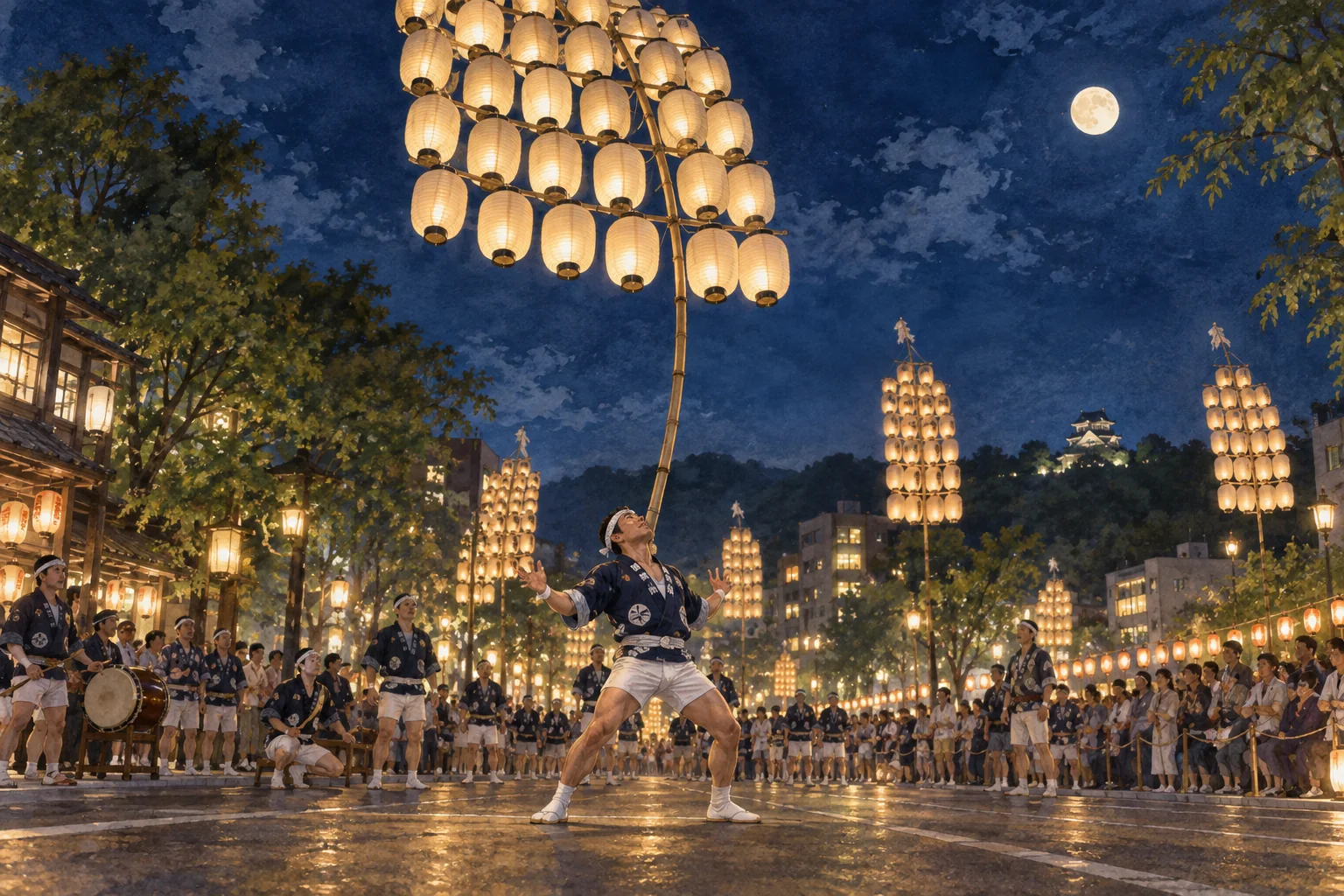
Kanto matsuri is Akita's August festival of bamboo poles hung with lanterns, balanced on the palm, forehead, shoulder or hip.
弐In 30 seconds30秒で説明する
Held in Akita city from August 3 to 6. A full-size pole carries 46 lanterns, stands about 12 meters and weighs around 50 kilograms, and the bearer balances it on one palm, then moves it to the forehead, shoulder or hip while the crowd watches for the wobble. It began as a summer rite for driving off sickness and sleepiness, and is a designated important intangible folk cultural property.
参As a short speechスピーチ・英作文
The Kanto festival in Akita, in early August, is the one where people balance lanterns on their foreheads, and the numbers explain why it is impressive. A full-size pole is about twelve meters tall, carries forty-six paper lanterns lit from inside, and weighs around fifty kilograms.
A bearer lifts it upright, settles the base in the palm of one hand, and then transfers it to the forehead, the shoulder or the hip, holding it there while the pole bends in the wind. Extensions are added at the bottom to make it taller, which makes it harder. When a pole starts to go, the bearer runs under it to get back beneath the center, and when one does fall, it can come down toward the crowd, so the street has people whose job is to watch for it.
The origin is a midsummer rite for sweeping away illness and the sleepiness that comes with the heat, which is a widespread idea in northern Japan, and the lanterns are also read as heads of rice, a prayer for the harvest. Teams come from neighborhoods and companies, and children carry smaller poles.
竿燈まつりかんとうまつりkanto matsurithe Akita festival of lantern poles balanced on one hand
提灯四十六個を吊るした十二メートルの竿を、手のひらや額に乗せる。
壱一言で言うとIn one line
竿燈まつりとは、提灯を吊るした竹竿を、手のひらや額、肩、腰で支える、秋田の八月の祭りです。
弐30秒で説明するIn 30 seconds
秋田市で八月三日から六日にかけて行われます。大きな竿燈は提灯四十六個を吊るし、高さおよそ十二メートル、重さは五十キロほど。差し手はこれを片方の手のひらに立て、額、肩、腰へと移します。見物人は揺れを見守ります。夏の病と眠気を払う行事として始まり、重要無形民俗文化財に指定されています。
参スピーチ・英作文As a short speech
八月初めの秋田の竿燈まつりは、提灯を額に乗せるあの祭りです。数字を知ると、なぜすごいのかが分かります。大きな竿燈は高さおよそ十二メートル、内側から灯りのともる提灯を四十六個吊るし、重さは五十キロほど。
差し手はこれを立て、竿の根元を片手の手のひらに据え、そこから額へ、肩へ、腰へと移して支えます。そのあいだ竿は風にしなります。根元には継ぎ竹を足して高くしますが、高くするほど難しくなります。倒れかけると、差し手は竿の下へ走り込んで重心の下に戻ります。
それでも倒れるときは見物人の側へ倒れることもあるので、通りにはそれを見張る役の人がいます。起こりは、病と暑さから来る眠気を流す真夏の行事で、東北に広く見られる考え方です。提灯を稲穂に見立て、実りを願うものとも言われます。町内や会社ごとに組を作り、子どもは小さな竿燈を持ちます。
こう聞かれたらQuestions people actually ask
QHow heavy is it really?
AThe largest size is around 50 kilograms with 46 lanterns. There are four sizes, and children start with the smallest, which is a fraction of that.
本当はどれくらいの重さですか。いちばん大きいもので提灯四十六個、五十キロほどです。大きさは四種類あり、子どもはそのごく軽いものから始めます。
QWhen and where is it?
AAkita city, August 3 to 6 each year, on a main street in the evening. There are paid seats, and visitors can sometimes try holding a pole, for example right after the evening performance.
いつどこで行われますか。毎年八月三日から六日、秋田市の大通りで夕方から行われます。有料の観覧席があり、夜の演技のあとなどに、竿燈を持たせてもらえる機会もあります。
QDo the lanterns catch fire?
AThey are lit with real candles, so yes, occasionally, when a pole comes down. Crews are on hand for it and it is treated as part of the evening.
提灯が燃えることはありますか。本物の蝋燭を使うので、竿が倒れたときに燃えることはあります。備える人手が配置されており、祭りの一部として扱われています。
誤解されやすいA common misunderstanding
MYTHThe poles are held up with a harness or a support.竿は道具で支えている、と思われがちです。
FACTNothing supports them. The base rests on the palm, forehead, shoulder or hip, and the bearer moves under the pole to keep it balanced.支えるものはありません。根元を手のひら、額、肩、腰に据え、差し手が竿の下を動いて釣り合いを取ります。
そのまま使えるフレーズPhrases you can use
- That's 46 lanterns on a twelve-meter pole.十二メートルの竿に提灯が四十六個です。
- It weighs about fifty kilograms.重さは五十キロほどです。
- They balance it on the forehead and the hip.額や腰で支えます。
- Nothing is holding it — no harness.支える道具はありません。
- It's held in Akita, August 3rd to 6th.秋田で八月三日から六日に行われます。
豆知識Background
竿燈は大若・中若・小若・幼若の四種類があり、最も大きい大若は提灯46個、高さ約12メートル、重さ約50キログラムとされる。1980年(昭和55年)に国の重要無形民俗文化財に指定された。起源は、夏の眠気や病を払う「ねぶり流し」の行事にあるとされ、東北各地に似た行事がある。青森のねぶた祭、仙台の七夕まつりとあわせて東北三大祭りと呼ばれることが多い。
出典日本文化ナビ(原田英語.com)「竿燈まつりを英語で説明する(kanto matsuri)」https://www.haradaeigo.com/japanese-culture/en/kanto-matsuri
- 文
- 日本文化ナビ編集部(原田英語.com)— 英文・和訳・解説はすべて独自に作成
- イラスト
- 日本文化ナビ オリジナル
- 発行
- 原田英語.com https://www.haradaeigo.com/
- 印刷日
- 2026.10.17
© 2026 Harada Eigo (原田英語.com). Text and illustration: Japan Culture Navi.
ページはこちら