バリアフリー
壱In one line一言で言うと
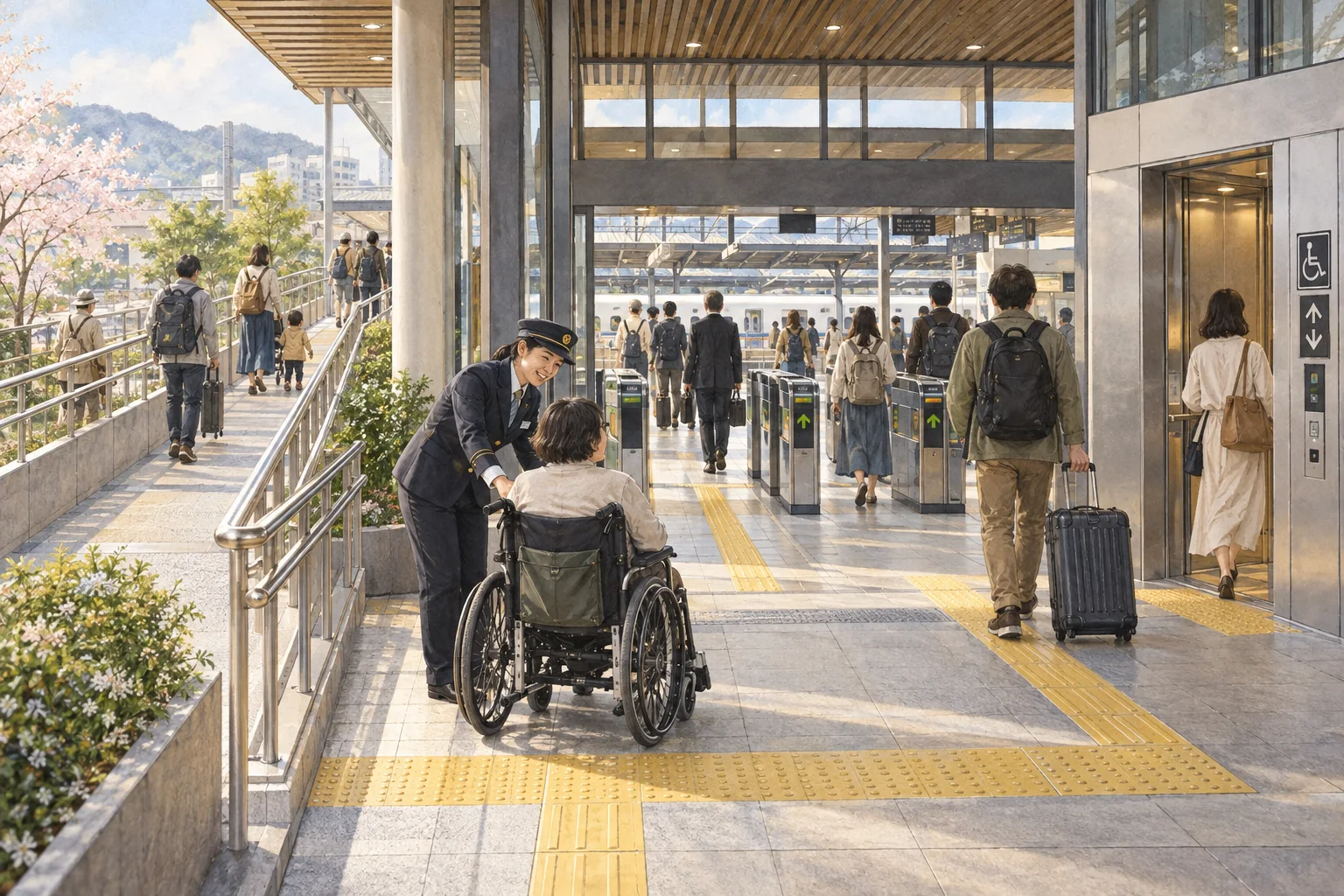
Baria furi, or barrier-free design, is Japan's accessibility effort, including the yellow tactile paving invented in Japan, now used worldwide.
弐In 30 seconds30秒で説明する
Japanese stations, public buildings and new construction are covered by accessibility law, and the visible results are elevators, tactile paving, audio signals at crossings and staff who will accompany a wheelchair user between trains. The gaps are real too: old buildings, narrow streets without sidewalks, and small restaurants up stairs. Tactile paving was first laid in Okayama in 1967 and spread from Japan.
参As a short speechスピーチ・英作文
Accessibility in Japan is uneven in a way that is worth describing honestly, because visitors notice both halves of it. The strong half is the public transport system. Major stations have elevators and tactile guidance, station staff will meet a wheelchair user, put out a ramp, and radio ahead so someone is waiting at the transfer and at the destination, and it is a free service you arrange at the gate.
Crossings have audio signals, buses kneel, and new public buildings must meet standards set by law. The Tokyo Paralympics in 2021 pushed a further round of station work. The weak half is everything old and small.
Streets in residential areas often have no sidewalk at all, older buildings have steps at the entrance, many restaurants are on an upper floor reached by a narrow staircase, and toilets in small premises are small. One thing worth telling anyone interested: the bumpy tactile paving now used in stations from London to Sydney was invented in Japan, by Seiichi Miyake, and first laid in Okayama in 1967.
バリアフリーばりあふりーbaria furiaccessibility in Japan, and the yellow tactile paving it invented
足元の黄色い点字ブロックは、1967年に岡山で初めて敷かれた日本の発明。
壱一言で言うとIn one line
バリアフリーとは、段差解消などの日本の取り組みで、日本で生まれ世界に広がった黄色い点字ブロックもその一つです。
弐30秒で説明するIn 30 seconds
日本の駅や公共の建物、新しい建築には、移動や利用のしやすさを定める法律がかかっています。目に見える形では、エレベーター、点字ブロック、交差点の音響信号、そして車椅子の乗り換えに付き添う駅員です。足りないところもはっきりあります。古い建物、歩道のない細い道、階段の上にある小さな店。点字ブロックは1967年に岡山で初めて敷かれ、日本から世界へ広がりました。
参スピーチ・英作文As a short speech
日本の使いやすさには濃淡があり、正直に説明する値打ちがあります。訪れた人は、その両方に気づくからです。強いのは公共交通です。主要な駅にはエレベーターと点字ブロックがあり、駅員は車椅子の利用者を出迎え、渡し板を出し、乗り換え先と目的地に連絡して人を待たせます。
改札で頼めばよく、料金はかかりません。交差点には音響信号があり、バスは車体を傾け、新しい公共の建物は法の基準を満たす必要があります。2021年の東京パラリンピックは、駅の工事をさらに一段進めました。弱いのは、古いものと小さいものです。
住宅地の道には歩道がまったくないことが多く、古い建物は入口に段があり、多くの飲食店は細い階段を上がった上の階にあり、小さな店の手洗いは狭い。関心のある人に伝える値打ちのあることが一つあります。ロンドンからシドニーまでの駅で使われている凹凸のある点字ブロックは日本で生まれました。三宅精一という人が考案し、1967年に岡山で最初に敷かれたものです。
こう聞かれたらQuestions people actually ask
QCan a wheelchair user travel by train alone?
AYes, and it is common. Tell the staff at the gate where you are going; they will bring a ramp and arrange for someone to meet you at each change and at the end.
車椅子で一人で電車に乗れますか。乗れますし、よくあることです。改札で行き先を伝えれば、渡し板を用意し、乗り換えと到着の駅に人を手配してくれます。
QWhat is the yellow paving for?
AGuidance for blind and partially sighted people: long bars mean go this way, round dots mean stop or a decision point. Standing on it or putting luggage on it blocks the path.
黄色いブロックは何のためですか。目の不自由な人のための案内です。棒状の線は進む方向、丸い点は止まる場所や分かれ目を示します。上に立ったり荷物を置いたりすると、通り道をふさぎます。
QIs the countryside accessible?
ALess so. Small stations may be unstaffed with steps only, temple grounds have gravel and stairs, and inns vary. Ask before booking rather than assuming.
地方は回れますか。都市部ほどではありません。小さな駅は無人で階段だけのことがあり、寺の境内は砂利と石段です。宿によって差があるので、予約の前に尋ねてください。
誤解されやすいA common misunderstanding
MYTHJapan is uniformly accessible because it is a developed country.先進国だから日本はどこでも使いやすい、と思われがちです。
FACTTransport and new buildings are strong; old streets, upper-floor restaurants and small premises often are not.交通と新しい建物は進んでいますが、古い道、上階の飲食店、小さな店はそうではないことが多いです。
そのまま使えるフレーズPhrases you can use
- Ask the staff at the gate for a ramp.改札で渡し板を頼んでください。
- They'll radio ahead to the next station.次の駅に連絡してくれます。
- Don't stand on the yellow tactile paving.黄色い点字ブロックの上に立たないでください。
- The tactile paving was invented in Japan in 1967.点字ブロックは1967年に日本で生まれました。
- Small restaurants are often up narrow stairs.小さな店は細い階段の上にあることが多いです。
豆知識Background
点字ブロックは三宅精一が考案し、1967年(昭和42年)に岡山県の交差点付近に世界で初めて敷設されたとされる。のちに日本工業規格で形状が定められ、国際規格にも採用された。現在の法律は2006年に施行されたバリアフリー新法(高齢者、障害者等の移動等の円滑化の促進に関する法律)で、一定規模以上の建築物や旅客施設に基準を課している。2021年の東京パラリンピックに向けて、駅の段差解消やホームドアの整備が進められた。
出典日本文化ナビ(原田英語.com)「バリアフリーを英語で説明する(baria furi)」https://www.haradaeigo.com/japanese-culture/en/barrier-free
- 文
- 日本文化ナビ編集部(原田英語.com)— 英文・和訳・解説はすべて独自に作成
- イラスト
- 日本文化ナビ オリジナル
- 発行
- 原田英語.com https://www.haradaeigo.com/
- 印刷日
- 2026.10.17
© 2026 Harada Eigo (原田英語.com). Text and illustration: Japan Culture Navi.
ページはこちら